Tech Service repairs Zanussi refrigerators in Astana both on-site and at the service center: a technician arrives within 60 minutes anywhere in the city, diagnostics are free, and there is a 1-year warranty on labor and parts. We work with No Frost, drip, inverter, and electronically controlled models, including appliances older than 10 years.
Why a Zanussi Refrigerator Stops Cooling and How to Recognize It by Symptoms
With Zanussi, as with any brand, a symptom points to a specific component. Let's break down what each sign means and why "not cooling but the light is on" is more often the cooling circuit than the electronics.
Zanussi Refrigerator Not Cooling but the Light Is On
If the light is on but there's no cold, the unit is receiving power, and the cause is almost always in the cooling circuit — refrigerant leak, clogged capillary tube, or loss of compressor performance. The motor-compressor may hum and even shut off due to overheating, but no cold is generated: in single-circuit Zanussi models, refrigerant R600a or R134a flows from the compressor through the condenser on the rear grille to the evaporator, and a breach anywhere in the circuit breaks the entire cycle. A clogged capillary tube gives a similar picture — the motor runs, the condenser is partially warm, but the evaporator stays dry. You can check this by the rear grille: if it remains cold while the motor is running, the refrigerant has most likely leaked out, and a simple "reboot" won't help here. If you notice such signs, it's best to entrust Zanussi refrigerator repair in Astana to a technician with experience specifically with this brand.
Zanussi Refrigerator Hums or Clicks and Won't Start
A click followed by shutdown is the start-protection relay tripping, which prevents the compressor from starting, and most often the relay itself or a seized motor is to blame. In Zanussi models, the start relay sits on the compressor and sends a pulse to the winding; when the contacts burn or the coil loses its parameters, a click is heard, the motor jerks and stalls. The second scenario is an interturn short or mechanical seizure: then the compressor itself hums, and the current rises above nominal. The third, rarer one is a control board failure that doesn't send a start signal. If after a click the motor hums for a few seconds and stalls, don't turn the refrigerator on again and again — this overheats the compressor winding, and instead of the relay you'll have to replace the whole assembly.
Ice and Frost Build Up, Water Pools at the Bottom
Frost and water at the bottom are two different scenarios: frost on the rear wall of a drip-type refrigerator indicates a faulty temperature sensor or defrost failure, while ice in a No Frost unit points to a failed heating element, timer, or clogged drain. In drip-type Zanussi models, moisture should flow down the groove into the tray above the compressor; if the temperature sensor misreads and doesn't trigger defrost, the wall gets covered with frost, and water overflows and ends up at the bottom of the compartment. In No Frost, the defrost heater–timer–defrost sensor chain is responsible for evaporator icing: if any element fails, frost doesn't melt, the fan stops circulating cold air, and food in the upper section starts to spoil. A clogged drain causes a puddle under the vegetable drawers. In No Frost models, evaporator icing is often masked as "normal" operation until the fan stops circulating cold air, so it's not worth delaying diagnostics.
Zanussi Display Error Codes and How a Technician Reads Diagnostics
Zanussi electronics display a code when a sensor detects a deviation in a component's operation. The code narrows the search, but the final conclusion is made only after checking specific parts.
What a Zanussi Display Error Code Means
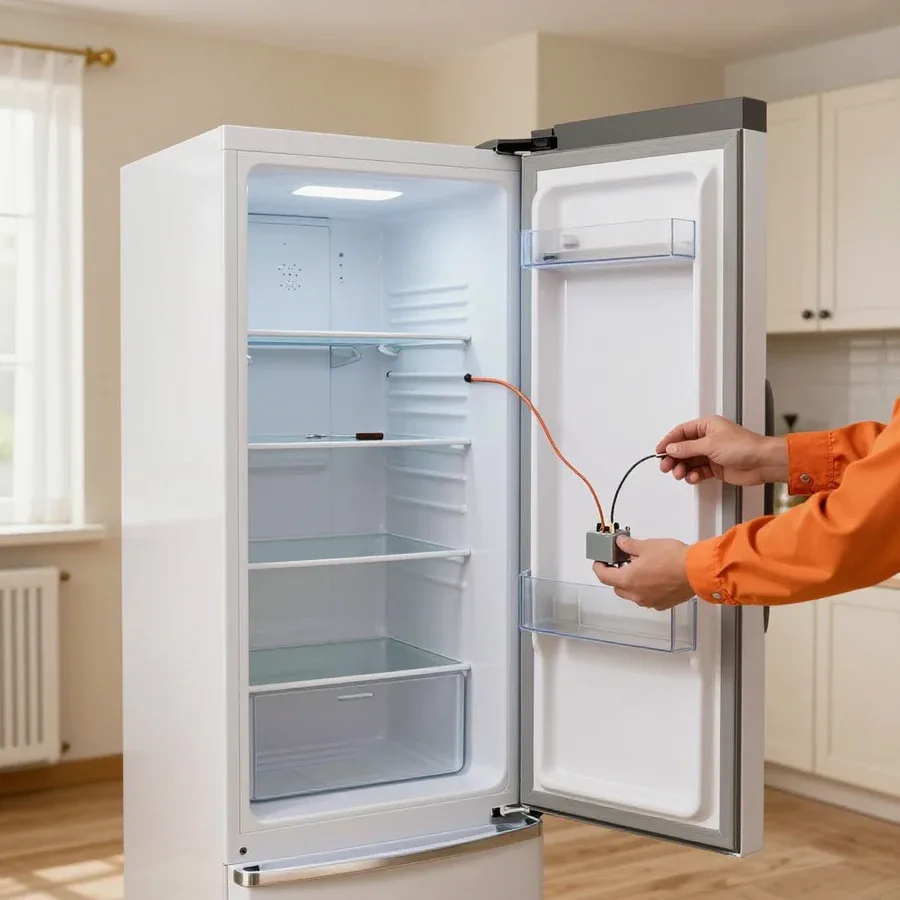
We decode the Zanussi error code using the manufacturer's table and immediately check the component it points to — most often it's a temperature sensor, control board, or defrost circuit. The electronic module polls the sensors every few seconds and records resistance going beyond acceptable limits, an open circuit, or a short circuit. The code number tells you which circuit to look in: refrigerator compartment, freezer, No Frost system, or defrost heater. Then the specialist opens the relevant compartment and tests the part with a multimeter to confirm the suspicion. The same code on different Zanussi series can mean different things, so we verify the model and series rather than relying only on the digits on the display.
How to Tell a Faulty Temperature Sensor from a Control Board
A temperature sensor more often causes inconsistent cooling and incorrect temperature readings, while the control board produces chaotic error codes, fan failure, or a complete lack of response to buttons. The sensor is a thermistor whose resistance changes with temperature: if it breaks or shorts, the module loses feedback and goes into emergency mode, running the compressor nonstop. The board behaves differently: various codes flash on the display in succession, the backlight flickers, and buttons don't respond to presses. There can also be a mixed picture—a burnt-out sensor takes the module's switch with it—so components must be checked in sequence. Testing starts with checking the sensor's resistance: if it's fine but the fridge behaves illogically, we look for the cause in the module rather than replacing parts at random.
How a technician finds a refrigerant leak on site
We trace leaks on site along the circuit: our specialist inspects solder joints and connections, checks pressure, and uses a leak detector if needed to pinpoint the spot rather than blindly recharging refrigerant. Refrigerant R600a or R134a more often escapes through microcracks in the foamed section, at pipe solder joints, or through seals. The specialist looks for oil traces at joints, listens for hissing, checks the circuit with a leak detector, and pressure gauges show whether the system holds vacuum. Finding the leak is more important than topping up gas: without fixing the cause, cooling will return only briefly. Recharging without fixing the leak gives temporary cooling for a couple of weeks, so we first solder the circuit, replace the filter-drier, and then recharge the system with refrigerant.
What we do on site and what requires in-shop repair
Most Zanussi refrigerator breakdowns are fixed on site, but some jobs require taking the unit in. Below is what can realistically be done at your home and when the appliance is taken to the shop.
What work we perform on site
- Start relay: we replace it on site when there are clicks and the motor won't start, and immediately check compressor startup.
- Temperature sensor: we install a new one when compartment temperatures are wrong and monitor the cooling cycle after installation.
- Defrost heater and timer: we restore the No Frost system, inspecting the sensor and drain right at your place.
- Fan: we eliminate icing and abnormal noise, and check evaporator airflow.
- Door seal and hinges: we replace them when the door doesn't fit tightly and ice forms around the perimeter.
- Refrigerant leak: we find it, solder the circuit, and recharge on site, measuring pressure and tightness.
What we do on site and what in the shop
| Work | Where we perform it | What we check |
|---|
| Start relay replacement | On site | Motor startup after installation |
| Temperature sensor replacement | On site | Cooling cycle and temperature |
| No Frost defrost system repair | On site | Heater, timer, sensor, drain |
| Leak repair with circuit soldering | On site | Circuit pressure and tightness |
| Compressor replacement with re-soldering | In the shop | Winding, start group, circuit |
| Major control board repair | In the shop | Module and electronic circuit |
| Built-in model repair | In the shop | Access to components without disassembling the cabinet |
Do we take Zanussi models older than 10 years
Yes, we do take on older Zanussi models: our technicians have 4 to 20 years of experience, and we decide what to do with such a fridge after a free diagnostics visit — sometimes a repair makes sense, sometimes it's easier to replace the whole unit. We start by checking the motor-compressor, the condition of the circuit and the seals: a worn seal causes ice buildup, and a tired compressor can't hold the temperature. If the body and circuit are intact, installing a new compressor or relay gets the appliance running again for years, and there's no need to haul it to a service center. In my view, you shouldn't write off an appliance just because of its age — assess the condition of its components first. Around the city, a technician arrives within 60 minutes.
How Zanussi fridge repair works and what to do before the technician arrives
Zanussi fridge repair follows a clear sequence — from your request and free diagnostics to checking the finished appliance. And before the technician arrives, there are a few steps you can take to protect your food and the unit itself.
The process from request to final check
- Request: you describe the symptoms, the technician clarifies the details and heads out — the drive to your door takes up to 60 minutes anywhere in the city.
- On-site diagnostics: the specialist inspects the appliance, checks the components and finds the cause — the inspection is free.
- Approval: you hear what work is needed and what the cost consists of, and you decide whether to go ahead.
- Repair: the mobile technician replaces faulty parts and adjusts the system right on the spot.
- Check: when the work is done, the appliance is tested — the technician makes sure it cools down and the cycle runs normally.
- Warranty: we provide a 1-year warranty on labor and parts, and we accept Kaspi QR, Kaspi Red, bank card, cash or bank transfer.
What to do with your food and the fridge before the technician arrives
- Move perishables: put meat, fish and dairy in a cooler bag, at a neighbor's, or in another working appliance.
- Don't take the appliance apart: don't remove the back panel or touch the components — it interferes with diagnostics and isn't safe.
- Don't restart it: if the appliance clicks and won't start, don't turn it on again — that's how you protect the compressor.
- Defrost if needed: if ice has built up, let the compartment thaw naturally, without a knife or a hairdryer.
- Leave access: clear the space around the unit so the technician can easily reach the components.
What to do if your Zanussi won't turn on after defrosting
If your Zanussi won't turn on after defrosting, let it sit switched off for a few hours, check the outlet, and only then try starting it — often the cause is a tripped protection or moisture on the contacts. After defrosting, moisture gets on the start-protection relay and terminals, and the automation won't let the compressor start until the contacts dry out. Also check that the plug is firmly in a working outlet, not in an overloaded extension cord. The thermostat can stay in the middle position — you don't need to touch it. If the appliance stays silent or clicks after the pause, that's a reason for diagnostics, not for repeated attempts: this way you won't burn the compressor winding or make the breakdown worse. In our experience, such cases usually end with replacing the start relay — the part is inexpensive, and the technician brings it along.
Warranty, diagnostics and Tech Service terms
Before contacting a service center, it's important to understand what you're getting: who will come to your appliance, what the quote is based on, and what warranty applies after the Zanussi fridge repair is complete.
1-year warranty on labor and parts
We provide a 1-year warranty on labor and parts — it covers the replaced motor-compressor as well as relays, sensors, control module, and door seal. The warranty period starts from the moment the repaired refrigerator is handed over and covers both the repair procedure and the installed parts. For the compressor — the most expensive component in the circuit — the warranty applies under the same conditions as for small elements: if the unit fails again due to our fault, we fix it at no extra cost to you. Our experience with refrigeration equipment ranges from 4 to 20 years among our technicians, and over this time we have seen that an honest warranty relies on accurate diagnostics, not promises. The commitment is tied to the specific job and installed part, so within a year, if the same issue recurs for the same reason, you come back to us without new labor costs.
Free diagnostics and on-site visit within 60 minutes
Diagnostics are free, and a technician arrives within 60 minutes anywhere in the city — you pay only for the agreed work and parts after the inspection. This approach removes the main concern for owners: first find out the cause and scope of work, then make a decision. The technician inspects the unit on site, checks the circuit, electrics, and sensors, and explains which component has failed. The visit also works as a standalone service: if you urgently need help with Zanussi refrigerators in Astana, a technician will come to your apartment or office and determine which work can be done on site and which requires a workshop. A quick arrival is especially important when a Zanussi refrigerator is not cooling: the sooner the unit is inspected, the lower the risk of food spoiling and the problem growing. In our practice, an early inspection often turns a complex case into a simple sensor replacement.
Cost, payment, and direct contractor
The technician quotes the cost after free diagnostics, you can pay via Kaspi QR, Kaspi Red, bank card, cash, or bank transfer for companies, and we work as a direct contractor — our own employee comes to your home or performs work in the service center, without intermediaries. You hear upfront what the sum consists of: labor, part, scope of disassembly — and you approve it before any work begins. You can pay in a convenient way, including by bank transfer. Direct contractor means the same organization that sent the technician is responsible for the work and warranty — no need to look for someone to blame between a aggregator and a subcontractor. In our practice, this significantly simplifies resolving any disputes: you contact one place instead of being passed along a chain. You get Zanussi refrigerator service with a one-year warranty from a team that is itself responsible for the result.
What to remember about Zanussi refrigerator repair
Symptoms, error codes, and the sequence of work all add up to one picture: accurate diagnostics saves time and money instead of triggering a chain of random replacements.
- Start with the symptom: "not cooling but the light is on" points to the cooling circuit, not the electronics, and narrows down the fault.
- An error code is a hint, not a verdict: the display names the unit, but the technician checks the sensor, board, and wiring separately.
- Home or service center: most breakdowns can be fixed on-site, while the compressor and control board require a workbench.
- Before the technician arrives: save your food and do not plug the refrigerator back in — this reduces the risk of losing supplies and making the breakdown worse.
- Warranty as a guide: a year on labor and parts shows the contractor's confidence in the result.