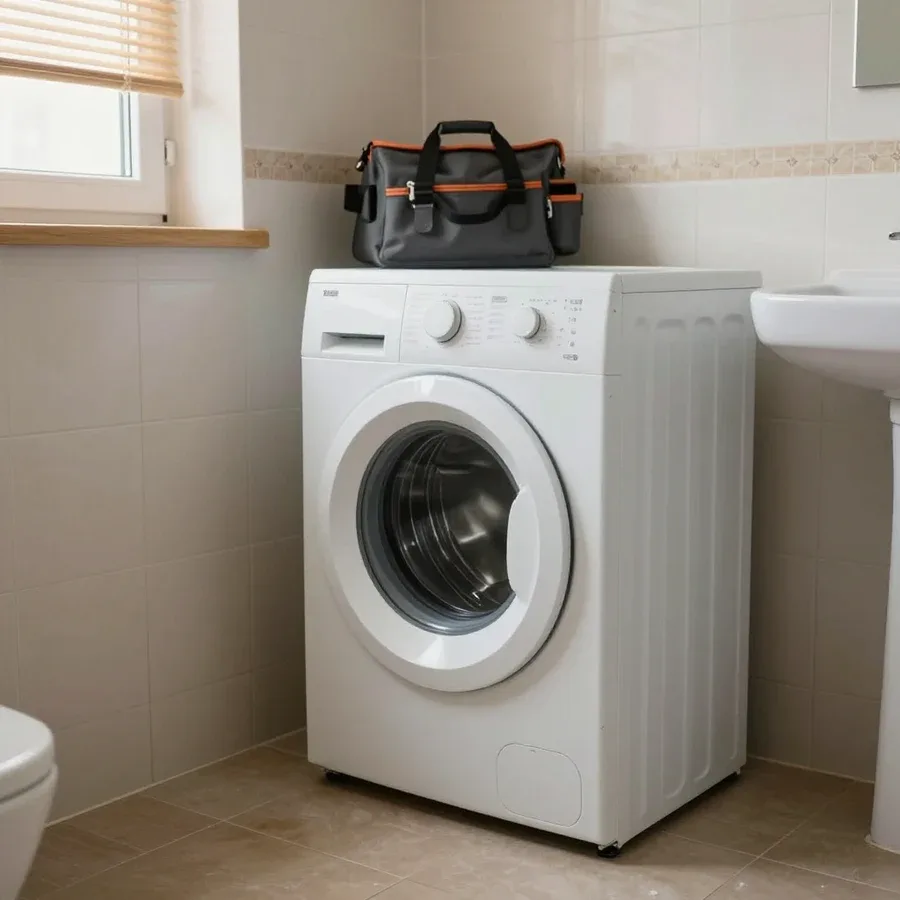
Tech Service repairs washing machine motors in Astana with a technician visiting your home within 60 minutes anywhere in the city. Diagnostics are free, the technician gives you the price after diagnostics, and we provide a 1-year warranty on labor and parts. We fix brushed, inverter, and asynchronous motors, working as a direct contractor with our own technicians.
Why the machine hums but the drum won't spin, and how to tell a motor failure apart during washing machine motor repair
"It won't spin" and "it hums but won't turn" are the most common reasons to call a technician, and the motor is far from always to blame. Let's look at how to distinguish a motor failure from related issues.
It hums but the drum doesn't rotate — where to look for the cause
If the machine hums but the drum stays still, the cause is more often the drive belt, drainage, or an unbalanced load, and only after checking those — the motor. The drive belt stretches or slips off the pulley over time, and the unit hums idle without transferring rotation to the drum. A drain pump clogged with debris or lint prevents the machine from reaching the spin cycle: the cycle stops but the humming continues. An unbalanced load — a clump of sheets or a single heavy item — makes the electronics reduce speed even though the power unit is fine. Speeds on different models are usually 800–1600 rpm, and imbalance shows up more sharply at higher stages. The check order saves time: first see if the drum turns freely by hand and whether water drains, and only then test the motor.
How a technician determines that the motor itself has burned out
We check the windings with a multimeter, the tachogenerator, and the Hall sensor, while the smell of burning and sparks in brushed motors indicate worn brushes and commutator bars. Windings are tested for open circuits and inter-turn shorts, the tachogenerator provides speed feedback, and when it fails the machine treats it as a stopped power unit. Sparks and carbon deposits on the commutator bars are visible when disassembling the brushed unit — inverter motors have no brushes, so this symptom doesn't apply to them. The control board is one possible cause of stopping mid-cycle, but not the main one: first rule out drainage, imbalance, and the motor, otherwise replacing the electronics won't fix the problem. In our practice diagnostics are free, and the technician compares readings with the table for the specific model before naming the cause.
Brushed or inverter motor and what it means for washing machine motor repair
The motor type determines what exactly breaks and how it's repaired. Let's look at three motor designs and the scope of work you should know about in advance.
How brushed, inverter, and asynchronous motors differ
| Motor design | What wears out | What we check first |
|---|
| Brushed | Brushes, commutator, bars | Graphite wear, bar condition, winding |
| Inverter | Hall sensor, magnets, board | Sensors, winding, connection to module |
| Asynchronous | Winding, bearings | Winding with multimeter, support assembly |
Can brushes and bearings be replaced separately
For brushed motors we replace brushes separately, but the motor bearing is only replaced if the tank is disassemblable — on a sealed tank it isn't replaced separately. Graphite insert wear affects brushed designs specifically: inverter Bosch EcoSilence Drive and LG Direct Drive motors don't have such parts, so diagnostics start with Hall sensors and the control board. The shaft support assembly is replaced together with the seal, otherwise the leak returns through the seal. This is the longest job in servicing because it requires removing the tank and drum, so it's scheduled separately from a simple graphite replacement. In our practice consumables are replaced faster and more often, while the support assembly is ordered in advance for the specific model. The technician verifies the motor design and part number against the machine's rating plate before quoting the scope of work. Speeds on most models are usually 800–1600 rpm, but this doesn't affect the choice of components. Diagnostics are free with us, and the warranty is 1 year on labor and parts.
Which error codes point to the motor
A code on the display narrows down the search, but it doesn't make a diagnosis on its own. Here's which signals are more often linked to the motor and which point to a spin problem.
Code F21 on Bosch and Siemens and other motor signals
On older Bosch and Siemens series (Maxx, Classixx, Logixx, Avantixx), code F21 points to the motor, and on models without a display it's shown by indicator lights. This signal appears when the control board detects a mismatch between the set speed and the actual speed: the drum doesn't spin up, rotation is jerky, or the motor doesn't start after filling with water. Household machines typically run at 800–1600 rpm depending on the model, and during the spin cycle the electronics pick up deviations from the norm fastest. Bosch EcoSilence Drive inverter motors have no brushes, so we don't consider brush wear as a cause of F21 — instead we check the winding, the tachometer sensor, and the connector contacts. Our technician arrives within 60 minutes in the city and cross-checks the readings against the spec sheet for the specific series. The meaning of F21 depends on the model, so we check it against the table for your machine rather than relying on a generic online explanation.
Drain codes that are mistaken for a motor failure
| Brand / series | Code | What it indicates |
|---|
| Bosch and Siemens, some d02 models | F18 or E18 | Drain problem |
| Samsung | 5E (SE, E2) | Drain problem |
| Electrolux | E20 | Drain problem |
| Indesit and Hotpoint | F05 | Drain problem |
Motor repair or replacement, and when it's more cost-effective than a new machine
After diagnostics, the technician offers two options: restore the motor or install a new one. Let's look at what the choice depends on and when restoration no longer makes sense.
When the motor is repaired and when it's replaced
We start by restoring the motor — replacing brushes, commutator bars, bearings — and only suggest a motor replacement if the windings or commutator are irreversibly worn. On brushed models, the brushes wear evenly, and by how much is left you can tell whether it's worth replacing the consumable or whether the commutator bars are already the issue. Inverter versions have no brushes at all, so there we check the windings and the bearing, and if the bearing is worn, we decide whether the tub can be disassembled. We follow the same logic for washing machine motor repair in Astana: restoration first, replacement as a last resort. The control board and the motor are different parts: repairing the board won't fix motor wear, and installing a new motor won't solve an electronics problem, so both are diagnosed. In practice, most units can be brought back to life by replacing the brushes and bearing — we end up buying a new motor less often.
When restoring the motor no longer makes sense
Restoration stops making sense when the wear affects a sealed tub with a bearing or several parts at once, and the work becomes comparable to the lifespan of a new machine. On a sealed tub, the bearing isn't replaced separately — the whole tub assembly has to be installed, and that's a major component, not a consumable. The second case is when the heating element, pump, and electronics are worn along with the motor: fixing everything one by one costs more than replacing the appliance. The third is when the windings or commutator are irreversibly damaged and the unit simply can't be restored. The decision is made after free diagnostics: the technician gives you the cost and honestly says when replacement isn't justified — that's part of the job, not a reason to push a service. In my view, it's better to hear that conclusion before work starts than to find out after the fact.
How motor repair works with a technician visit
Motor repair takes several steps — from the request to the post-assembly check. Here's how the process works and what the owner should do before the specialist arrives.
From request to warranty — how we work
- Request: you describe the symptom, we confirm the model and agree on a visit time.
- Visit: we arrive within 60 minutes anywhere in the city, or you can bring the appliance to our service center.
- Diagnostics: free of charge. We check the windings, tachometer sensor, other sensors, and related components.
- Approval: we quote the price after the inspection, and you decide whether to go ahead with the work.
- Repair and check: reassembly, leak test, and drum balance check. 1-year warranty on labor and parts.
- Part selection: we source the part by part number or model code — for Bosch, the E-Nr is on the sticker inside the door, so the part matches your appliance without guesswork.
What to do before the technician arrives
Unplug the machine and drain the water through the emergency drain hose behind the service flap at the bottom front, placing a towel underneath — the water may be hot. Pull the hose out of its holder and point it into a basin; the flap can be removed by hand, no tools needed. If the water won't drain, leave it as is and wait for the technician — they'll deal with the clog on site. A burning smell from the wiring means you shouldn't touch the appliance at all: unplug it and don't start it again until the motor, control board, and wiring have been checked. Don't unscrew the filter while the machine is running and don't take the pump apart: pressurized water will flood the floor, and without experience it's easy to damage the impeller. Before the visit, just unplug the machine and clear access to it.
Getting your washer motor running again
A quick summary of what determines the outcome of washing machine motor repair: where to look for the cause, how the motor type changes the work, and why diagnostics matter more than the symptom.
- Diagnostics before the verdict: if the drum hums but won't spin, first rule out drainage, imbalance, and the belt, and only then check the motor.
- Motor type decides the outcome: brushes are replaced only on brushed motors; inverter motors don't have them, and the bearing is replaced separately only if the tub is serviceable.
- Error code narrows the search: the meaning of the signal depends on the model, so it's checked against the table for that specific machine, not guessed.
- Repair or replace: the choice between restoring the unit and installing a new one is made after opening it up and testing, not based on an internet description of the symptom.
- Before the technician arrives: unplug the machine and drain the water through the emergency hose behind the service flap without unscrewing the filter.