Валентина Р.Order No. ZK-2026-446 · 18 October 2026
oursПриехал по записи, всё было готово к моему приходу. Выбрал techservice, потому что близко к работе

A technician arrives within 60 minutes anywhere in the city. Free diagnostics, 1-year warranty on labor and parts.
Our own technicians4 to 20 years of experience




Repair prices
The symptoms people most often call a technician for: from no heating to cracks in the glass.
power surge or blown fuse
from3 500 ₸
faulty coil or inverter
from11 500 ₸
board or temperature sensor failure
from5 000 ₸
overheating or faulty fan
from6 500 ₸
the code points to a specific component
from7 500 ₸
impact or sudden temperature change
from5 000 ₸
clogged fan or worn thermal paste
from3 500 ₸
worn bearing or dust
from6 500 ₸
1 visittime
from 10 000 ₸cost
 BeforeAfter

From request to final check — five steps, including free diagnostics.
You submit a request, and the technician clarifies the symptoms and cooktop model.
The technician comes anywhere in the city to inspect the cooktop on site.
The technician agrees with you on the list of work and parts needed for the repair.
The technician confirms the cooktop model and serial number to bring the right tools.
The technician demonstrates the cooktop working in your presence and answers any questions about using it.
We reply during working hours
A technician arrives within 60 minutes anywhere in the city. Ask the technician about a convenient visit time and payment method.

Warranty question? Call us
+7 (778) 046 88 53 experience11 years
Dishwasher repair technician
 experience10 years
Senior washing machine technician
 experience11 years
Stove and oven repair technician
 experience11 years
Freezer repair technician
 experience16 years
Washing machine installation technician
 experience8 years
Dishwasher technician
 experience12 years
Washing machine repair technician
 experience10 years
Washing machine board repair technician
Tech Service repairs induction cooktops and built-in hobs in Astana: our technician arrives at your home within 60 minutes or takes the appliance to our service center. Diagnostics are free, we provide a 1-year warranty on labor and parts, and our technicians have 4 to 20 years of experience. We quote the price after diagnostics.
Induction cooktops break differently from gas or conventional electric stoves: here it's the electronics that do the work — the coil, power module, and sensors. Let's break down what's behind each symptom and when to call a technician.
Most often, induction doesn't heat because the cookware lacks a ferromagnetic bottom, and if the pot is suitable, the culprit is the IGBT transistor or the induction coil. The power transistor controls the current through the winding, and if it fails, it simply doesn't deliver power to the burner. The coil itself loses solder contact over time or overheats, and heating stops on one zone while the others work normally. There's a third scenario: the pot detection sensor doesn't read the bottom diameter, and the electronics block activation even though the burner is fine. Before calling a technician, check your cookware with a magnet: if the magnet doesn't stick to the bottom, the cooktop physically can't heat it — that's not a malfunction. If the magnet sticks but the burner still stays silent, the cause is in the electronics: a technician will test the coil and power transistor and determine which component has failed.
In our experience, spontaneous shutdown is most often caused by a temperature sensor detecting overheating or by a clogged cooling fan on the power board. The temperature sensor sits under the glass-ceramic surface, and when it fails, it sends a shutdown signal even at normal burner temperature. The fan gets clogged with dust and grease, airflow drops, and the power board goes into protection after a few minutes of heating. The cooktop works intermittently when the input power sags or the filter capacitor has lost capacitance — power fluctuates, and the electronics either turn heating on or reset it. If the cooktop turns off after a few minutes of operation, don't keep restarting it — overheating the power module without cooling accelerates IGBT failure.
Sparking and a burning smell indicate a problem in the power section or wiring, and it's best to unplug such a cooktop immediately and not turn it on until diagnostics. A blown interference filter capacitor causes crackling and a distinct burnt varnish smell, while a loose ribbon connector between the control board and power module sparks every time you turn it on. Ribbons and connectors oxidize over time from moisture and temperature changes, contact becomes unstable, and arcing occurs at the connection point. A slight hum and clicks during operation are normal for induction, but crackling with a burnt smell means a capacitor or connector is breaking down somewhere, and that's dangerous. With this symptom, don't wait for the safety system to trip: disconnect power to the cooktop and call a technician to check the power section.
The combination on the screen is a hint from the cooktop itself about which component to check. Let's break down what typical groups of codes mean and why the same combination can point to different things across brands.
The combination on the display points to a specific component — a temperature sensor, the power board, or the sensor connection — and narrows down the search during diagnostics. The cooktop tests its circuits at startup and during heating: if the thermistor's resistance goes beyond acceptable limits or the control board doesn't get a response from the power section, the controller blocks heating and shows a combination of letters and numbers on the screen. The decoding depends on the firmware: on one model E3 means the burner is overheating, on another it means an open sensor. That's why the technician checks the code on the screen against the service table for that specific model rather than reading it from memory. Write down the code and when it appears (at startup, during heating, a couple of seconds later) — this detail saves the technician time and helps pinpoint the cause more accurately.
| Code group | What it indicates | What we check |
|---|---|---|
| Power and power section | voltage failure, module breakdown | power board, IGBT, capacitor |
| Temperature and overheating | thermistor tripped | thermistor, cooling fan |
| Sensor connection | no signal from the panel | touch panel, ribbon cables and connectors |
| Cookware and burner | no load on the coil | induction coil, cookware base |
If after our service the cooktop shows the same combination again, that's a reason for a repeat diagnostic under warranty — we check whether the cause was left in an unexamined component. The 1-year warranty covers both labor and the parts installed, so a repeat inspection doesn't turn into a new charge. A recurring code often means that the first time we replaced the effect rather than the cause: we changed the sensor but didn't fix the overheating that was killing it, or didn't check the cooling fan that was causing the power section to go into protection. During the repeat diagnostic, the technician runs the cooktop under load on different burners, checks the thermistor readings, and inspects the connectors for oxidation. Bring the code you wrote down and a description of exactly when it appeared.
Induction cooktops are more complex than regular electric stoves, and the symptom "not responding" or "not heating" can point to different parts. Here's how to tell a sensor failure from a board or coil problem.
In our experience, no response to touch is most often a problem with the touch panel or ribbon cable, and the control board is less often to blame — we check it after the sensor. The touch panel sends commands to the control board through the touch controller, and the weak point along this path is the ribbon cables and connectors: constant heating oxidizes the contacts, the signal drops, and the cooktop stops responding to touches. We take on the control board when the panel is intact but commands don't reach it or get lost along the way. If only certain zones don't work while neighboring ones respond, the issue is almost always in the panel itself, not the board — this narrows diagnostics down to a single component. In my opinion, this is the first sign to check: it immediately rules out half the possibilities and saves time during disassembly.
Induction doesn't heat with a coil but with the magnetic field of a coil, so the work involves electronics — the power module and the board — not the heating element. The induction coil creates a magnetic field that heats the bottom of the cookware, and power is controlled by an IGBT transistor on the power board. In a regular electric stove, heat comes from a spiral, and its failure is visible as a break or burnt nichrome, while a thermostat controls the temperature. Here, the fault hides in the electronics: a blown IGBT, a dried-out capacitor, or a broken coil all produce the same external symptom — the burner doesn't heat up. That's why "not heating" on an induction and on a regular electric stove means different breakdowns: there you check the spiral and thermostat, here — the coil and IGBT. In practice, this means the technician needs a different set of checks, not the usual continuity test of the heater.
| Component | Symptom | What we check |
|---|---|---|
| Induction coil | one zone doesn't work | coil and contact integrity |
| IGBT and power board | heating doesn't work, trips breaker | module breakdown, capacitor |
| Touch panel | doesn't respond to touch | panel, ribbons, and connectors |
| Temperature sensor | turns off by itself | sensor readings, overheating |
| Cooling fan | shuts off when heated | rotation, clogging |
Induction repair can be done at home or in the service center — it depends on the breakdown. Here's how our process works from request to post-repair check.
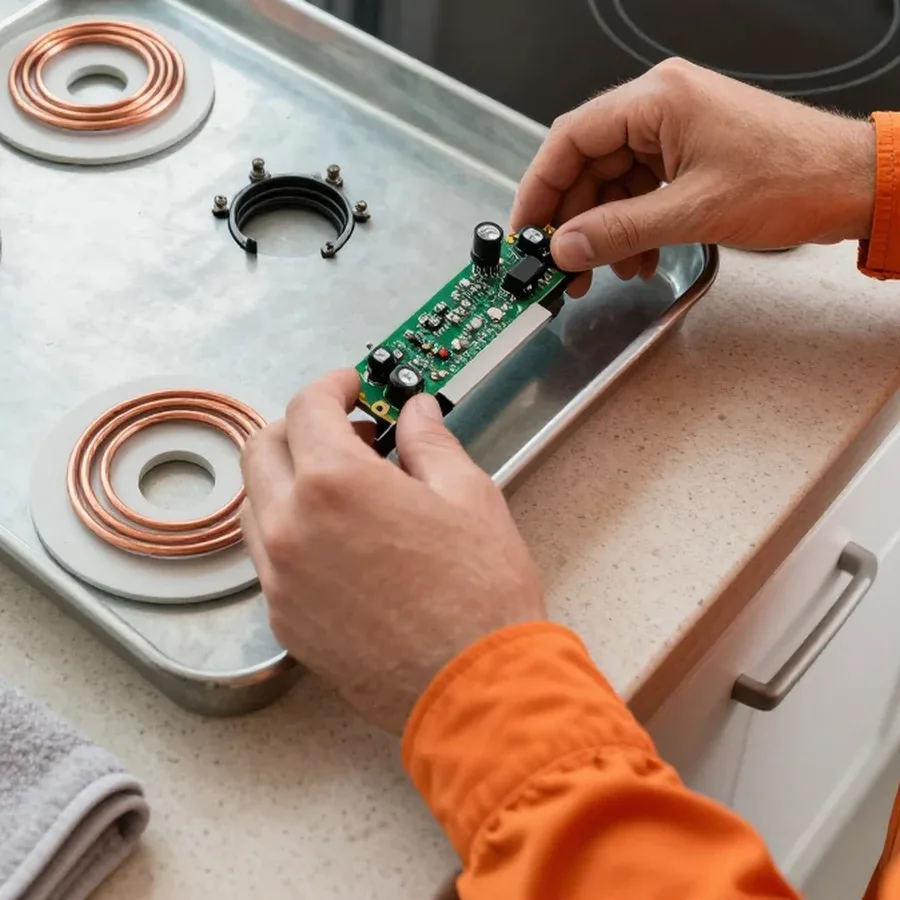
We arrive within 60 minutes anywhere in the city and perform free diagnostics, after which we tell you the cause and the cost of work. The specialist clarifies the panel model in advance to bring the right tools and common parts for induction cooktops. On site, they check the power supply, touch board, induction coils, and ribbons, test the power circuits, and compare readings with error codes on the display. This is how induction stove repair in Astana goes — from the first inspection to agreeing on the work. Based on the inspection, you get a clear explanation of which component failed and what work is needed. Diagnostics at home isn't always possible without removing the panel from the countertop — if access to the power board is needed, the technician will agree on the next steps with you.
We fix some breakdowns on site, but for replacing the power board or glass-ceramic, it's more convenient to take the panel to the service center — the technician suggests the format after diagnostics. At home, we usually replace the touch sensor, ribbons, coil burner, power button, and seals: these components are accessible without removing the entire panel. If the inverter or IGBT module is faulty, or when replacing the glass-ceramic surface, the appliance is transported to the workshop, where there are conditions for precise disassembly and reassembly of the housing. A built-in panel doesn't always need to be removed from the countertop: the sensor and ribbons are often accessible from above, while the power section is reached at the service center. Before taking it away, we explain why the work can't be done on site and agree on the next steps with you.
A crack in the glass-ceramic surface is a special case: it determines whether the panel can still be used and how it should be serviced. We explain when the top needs to be replaced and why a patch won't work here.
A cracked glass-ceramic surface can't be restored with a patch — the entire surface must be replaced, because moisture gets inside through the crack and damages the coil and the board. The glass-ceramic surface maintains not only heat but also the sealed housing: it protects the induction coil and electronics from liquids and crumbs. Any attempt to fill a chip or cover it with sealant gives only a temporary effect — when heated, the compound peels off and the crack keeps spreading. Replacing the glass restores the panel's original protection and appearance, and the defective part is not used further: it has already lost its strength and won't survive repeated heating. Even a small crack eventually spreads from heating and cooling, so it's best not to delay replacing the top — this protects the electronics from more expensive board repairs.
Using a panel with a crack is unsafe: moisture and crumbs get inside, and shards can cause injury, so it's better not to turn the stove on until the top is replaced. The glass-ceramic surface protects the coil and internal components from spilled liquids — through the damaged area, water reaches the control board and causes a short circuit. The sharp edges of the crack can easily cut fingers when washing or moving dishes, and small shards remain on the cooking zone and get onto the bottom of pots. If the crack runs through a cooking zone, the glass may crack further when heated — the risk is especially high when heavy cookware with a thick base is placed on the surface. In our practice, a panel with damage over a cooking zone has often been completely shattered by a heavy pot.
We handle glass-ceramic replacement through our service: the panel is removed, a surface is selected for the model, and after installation all zones are tested for heating. A technician comes to your home in the city, performs free diagnostics, and determines whether the entire top needs replacing or a local repair is sufficient. The glass-ceramic is matched to the specific model, the touch panel and ribbons are carefully disconnected, and after reassembly each burner is tested under load — with real cookware, not just switched on empty. We provide a 1-year warranty on the replacement and labor. After replacement, it's important to check not only heating but also the touch controls — ribbons and connectors can easily be damaged when removing the panel if not checked immediately.
A warranty on induction repair is just as important as the work itself: power electronics are sensitive to part quality. We explain what our warranty covers and what we do if the problem comes back.
We provide a 1-year warranty on both labor and installed parts — if a part fails or the same issue recurs within this period, we resolve it under warranty. Inside an induction stove, an IGBT transistor, induction coil, power board, and capacitors operate: each component experiences thermal and current load every time it's turned on. The warranty covers both the soldering and the replaced component — the technician is responsible for both. In my opinion, a one-year term honestly reflects the service life: if a part is defective, it shows up in the first months of operation under load. A warranty on parts separate from labor is important because the power module or coil can fail on its own — then it's the part's fault, not the technician's work.
When we service a hob, we fit parts matched to the specific model, because the power module and coil differ in specs from one hob to another. The IGBT transistor is rated for a certain current and voltage, the induction coil for its own inductance, the capacitor for its working capacitance; the power board is built around this combination. A universal part that "fits the size" may drop into the slot but run in a different mode. We check the component's marking against the specific model's specs before fitting a replacement. A module with the wrong characteristics runs at its limit and heats up more — the hob may seem to work, but the part's lifespan drops sharply. That's why matching electrical specs matters more than a similar-looking housing.
If the fault returns during the warranty period, we run diagnostics again and fix the cause — that's a warranty case, not a new job at your expense. Our diagnostics are free, so a second look at the hob adds no cost. The technician checks the temperature sensor, power board and power circuits: a repeat of the same fault often means the root cause wasn't found the first time — for example, overheating that knocked out the sensor or module again. Around the city, a visit takes up to 60 minutes, so the inspection doesn't drag on for days. We pin down the cause before replacing parts, not after. If the hob stops heating again or shows the same code, don't wait for the warranty to end — getting in touch early makes the source easier to find.
Here's the key things an induction hob owner should keep in mind: what makes it fail, how to quickly check simple causes, and why the repair conditions matter.
Tech Service technicians repair other appliances too — with the same 1-year warranty on labour and parts.
 Refrigerator Repair in Almatyfrom 3 000 ₸
 Washing Machine Repair in Almatyfrom 3 000 ₸
 Dishwasher Repair in Almatyfrom 3 500 ₸
 Oven Repair in Almatyfrom 3 000 ₸
 Cooktop Repair in Almatyfrom 3 500 ₸
 Air Conditioner Repair in Almatyfrom 3 500 ₸
 Boiler and Water Heater Repair in Almatyfrom 2 500 ₸
 Freezer Repair in Almatyfrom 6 000 ₸
 Tumble Dryer Repair in Almatyfrom 5 000 ₸
 Coffee Machine Repair in Almatyfrom 2 500 ₸
 Robot Vacuum Cleaner Repair in Almatyfrom 3 500 ₸
 Vacuum Cleaner Repair in Almatyfrom 1 500 ₸
 Microwave Oven Repair in Almatyfrom 2 000 ₸
 Hair Dryer Repair in Almatyfrom 1 500 ₸
 Iron Repair in Almatyfrom 3 000 ₸
 Electric Kettle Repair in Almatyfrom 2 500 ₸
 Mixer Repair in Almatyfrom 2 500 ₸
 Multicooker Repair in Almatyfrom 500 ₸

If your dishwasher won't drain, the most common culprits are a clogged filter or drain hose; less often, it's the pump, impeller…
24 March 2026 · 12 minutes read
A washing machine can hum for many reasons, and the first thing to figure out is when the sound appears.
20 March 2026 · 12 minutes read
If your washing machine isn't filling with water, the most common culprits are a closed valve, a clogged inlet filter screen on the hose…
20 February 2026 · 13 minutes read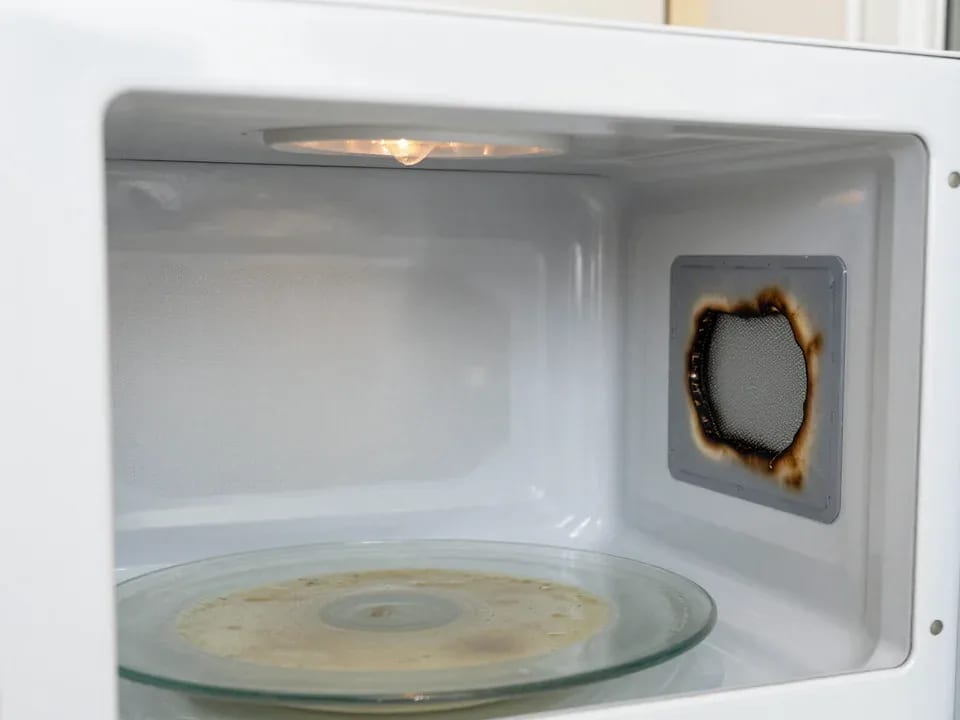
If your microwave isn't heating but the light and turntable still work, the problem is usually one of the high-voltage components — the magnetron, diode…
15 February 2026 · 12 minutes read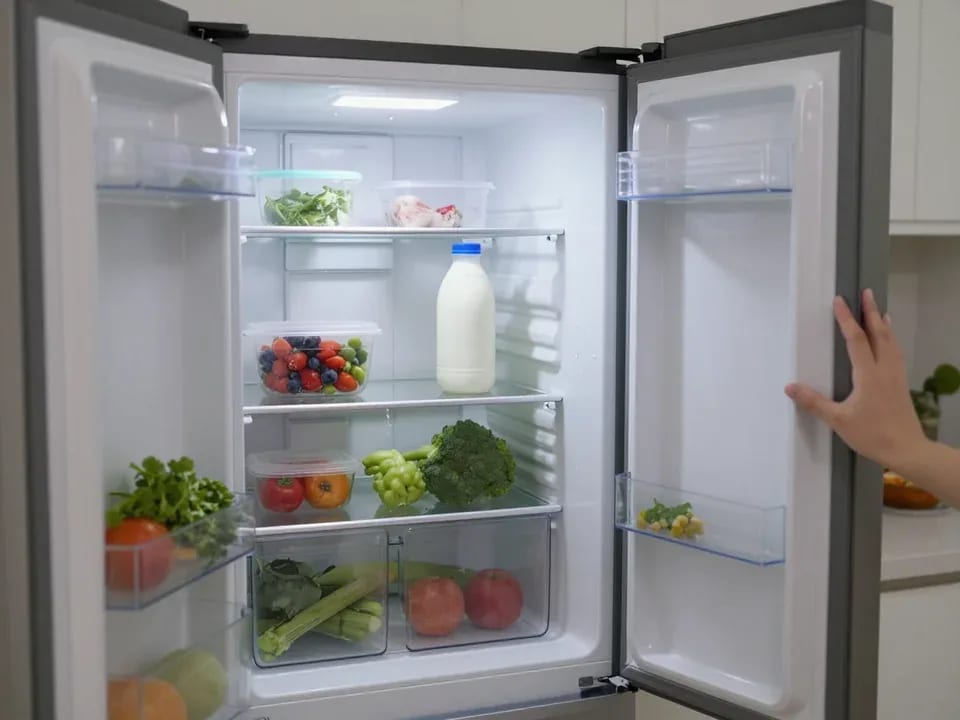
If your refrigerator stops working, first check the outlet, the power cord, and the thermostat setting, and after defrosting let it stand for a while.
4 February 2026 · 12 minutes read
Washing machine error codes are self-diagnostic codes that point to a specific component: drain, water fill, heating, motor, or door lock.
29 January 2026 · 13 minutes read