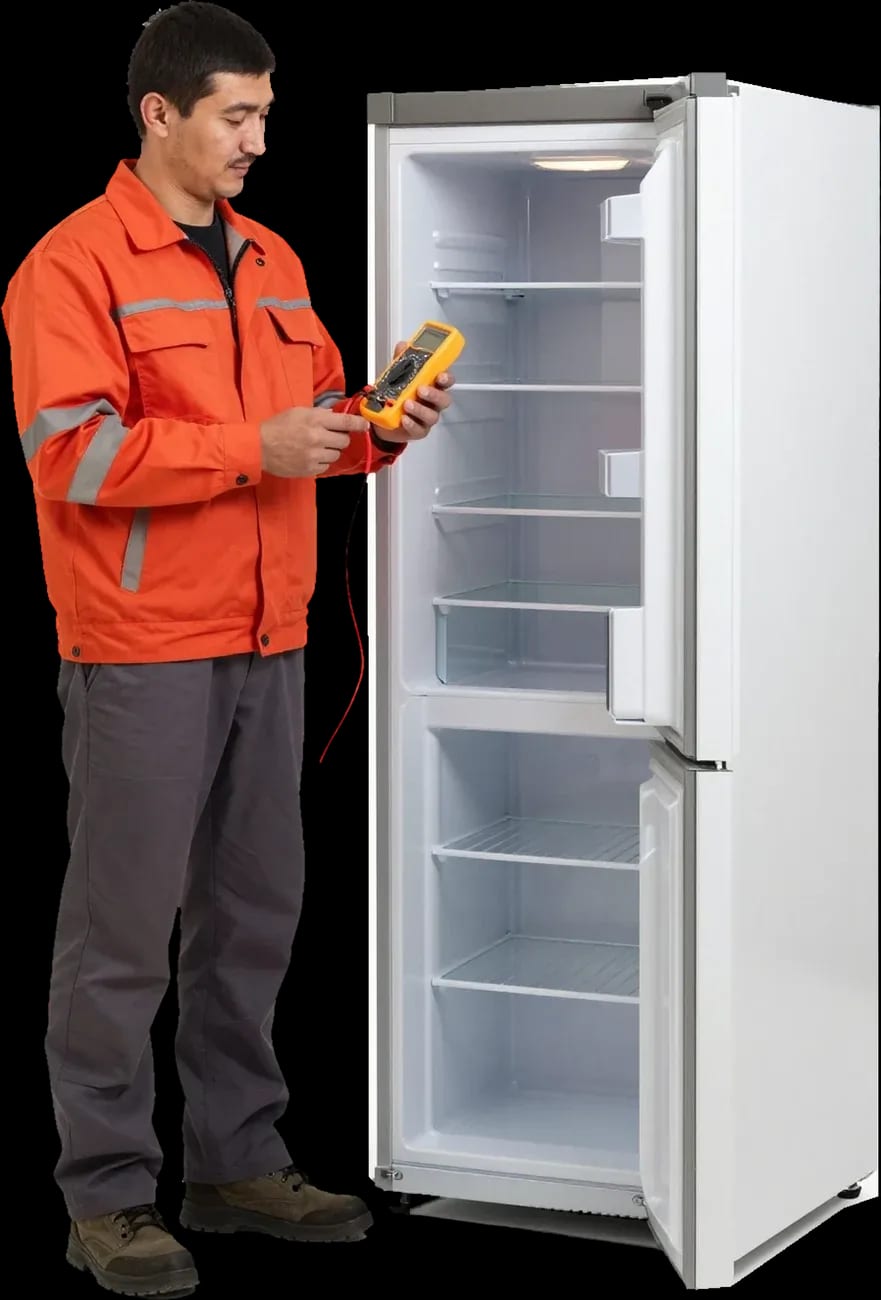

How to Figure Out Why the Refrigerator Won't Turn On
If your refrigerator stops working, first check the outlet, the power cord, and the thermostat setting, and after defrosting let it stand for a while. Tech Service sends a technician to your home within 60 minutes anywhere in the city, diagnostics are free, and there's a 1-year warranty on labor and parts. The technician gives you the price after diagnostics.
The most common scenario: the appliance is silent but the light inside is on. Let's go through what to check step by step and what causes a complete shutdown.
Why It's Not Working but the Light Is On
If the light inside is on but the compressor is silent, power is reaching the unit, and the cause is almost always in the start relay or the control board, not the outlet. The start relay sits on the motor housing and sends it a pulse; if the winding is broken or the contacts stick, the compressor hums for a second and clicks but doesn't start. The control board distributes commands between the compartment, defrost, and motor, and if it fails, you get complete silence while the light stays on. The thermostat opens the circuit when the temperature is reached—a stuck contact leaves the appliance off permanently. The lamp and compressor are on different circuits, so a burning light tells you nothing about the motor's condition, and you need to check the start circuit specifically.
How Long to Wait After Defrosting and Moving
- After defrosting: let the unit stand turned off for 2–4 hours so moisture from the internal cavities and control board can evaporate.
- After moving it lying down: wait at least 8 hours—if it was tilted heavily, the oil travels farthest.
- After moving it upright: 3–4 hours is enough if the body wasn't tilted more than 40 degrees.
- After a short move within the apartment: 1–2 hours will do, but turn it on without load and listen to the first start.
- Oil in the circuit: when tilted, oil leaves the compressor and goes into the tubes, and the pause lets it drain back; rushing the start costs more than waiting.
What Could Burn Out After a Power Surge
After a power surge, the control board most often fails, less often the start relay, and diagnostics show which circuit was affected. The board's electronics take the hit: traces, the varistor, and the compressor triac burn out, and externally the appliance just shows no signs of life. The relay suffers from the current spike when the voltage returns—contacts burn and stop closing the start circuit. The temperature sensor gives false readings, and the board blocks the start, thinking the temperature is unreachable. Our technicians check the compressor, relay, thermostat, and control board one by one so they don't replace parts at random. Electronics suffer even from a short pulse, so after a power outage it's worth checking the appliance before loading it with food.
Refrigerator Hums but Doesn't Cool: Where to Look
The motor runs, there's sound, but there's no cold in the compartments. Let's break down how a refrigerant leak, a faulty relay, and a thermostat failure differ by the appliance's behavior, so you can describe the symptom to the technician before they arrive.
Refrigerant Leak or Thermostat
If refrigerant is leaking, the compressor hums continuously and doesn't shut off, while a thermostat failure gives the opposite picture: the motor may not start at all. In the first case, pressure in the circuit drops, the capillary tube stops passing the needed volume of gas, and cold gradually leaves both compartments—first the freezer weakens, then the refrigerator section, and uneven frost appears on the evaporator. In the second case, the sensor contacts don't open the circuit, so the appliance either stays silent or runs nonstop: it all depends on which position the contacts stuck in. Checking the thermostat is easy—turning the knob to maximum should be accompanied by a click, and its absence is already a warning sign. A leak can't be detected by sound; only checking the circuit with a manifold and pressure testing shows it, so attempts to top up by eye only delay the repair and add work to find where the gas is escaping.
Compressor or Start Relay by Sound
When an appliance clicks, tries to start, and immediately goes silent, the culprit is usually the start relay, not the compressor itself. This component sends a pulse to the windings and cuts them off after a couple of seconds in case of overload—hence the characteristic click, followed by silence and another attempt a few minutes later. The compressor itself may be fully functional: the windings are intact, the mechanics are not jammed, and the piston group is not worn. You cannot tell one from the other by ear because both scenarios produce the same rhythm of clicks and pauses. An indirect sign is the motor housing temperature: if it stays cold during start attempts, the windings are likely not receiving power. The start relay is quick to replace and is an inexpensive part, so don't write off the unit until the start circuit has been checked—diagnostics begin there.
Table of symptoms and likely causes
| Symptom | Likely cause | What we check |
|---|---|---|
| Hums continuously, no cooling | refrigerant leak | circuit and pressure |
| Clicks and shuts off | start relay | start circuit |
| Silent, light is on | thermostat or module | control |
| Hums, weak cooling | No Frost fan | air circulation in compartments |
| Hums but doesn't shut off | thermostat or sensor | settings and contacts |
When the refrigerator doesn't shut off: normal or a fault
Continuous operation doesn't always mean a breakdown. We explain when the appliance is simply going through its working cycle and when prolonged humming points to a refrigerant leak or a worn seal.
When continuous operation is normal
- After loading warm food: the compartment receives extra heat, and the compressor runs without pauses until it returns the temperature to the set level.
- With super freeze turned on: accelerated cooling disables automatic pauses for several hours until the food is fully frozen.
- In a hot room: if there's a stove or radiator nearby, or the unit stands by a sunny window, the cycle lengthens.
- After defrosting or moving: the appliance needs time to stabilize pressure in the circuit and settle into its working rhythm.
- In a No Frost system: the fan and defrost timer remove moisture, and the interval between stops seems longer than usual.
- Give the appliance a few hours to reach operating mode before looking for a fault—otherwise it's easy to mistake normal operation for a malfunction.
Why running without stopping is risky
Constant operation wears out the compressor and dries out food, and if the cause is a leak, the motor heats up for nothing and may fail. The door seal keeps cold air inside the compartment: when the rubber hardens or pulls away, outside air is constantly drawn in, and the appliance can't reach the set temperature. A refrigerant leak produces a similar picture—there's little refrigerant in the circuit, the compressor circulates it without pauses, the motor housing overheats, and the oil loses its properties. Meanwhile, food dries out and thaws near the back wall, even though the appliance seems to be working from the outside. An experienced technician finds such a cause faster than you would on your own: they check the circuit and the seal, not just the temperature inside. The sooner the cause is found, the cheaper the repair, because a worn motor is replaced entirely.
What to check yourself during continuous operation
- Door seal: inspect the rubber around the perimeter — cracks, creases, and hardened areas let warm air inside.
- Super freeze: check whether the fast freeze mode is still on after loading a large amount of food.
- Heat sources nearby: move the unit away from the stove and radiators, and leave a gap for ventilation at the back grille.
- Door position: a misaligned or loosely fitting door prevents the compartment from sealing tightly.
- Loading the compartments: a tightly packed appliance blocks airflow, and the sensors keep the compressor running longer.
- Paper test: clamp a sheet of paper around the door perimeter — if it pulls out without resistance, the seal is broken.
Why one compartment isn't freezing
When frost disappears only in the freezer or only in the fridge compartment, the cause depends on the defrost system type. Let's look at both scenarios and the differences in design.
How No Frost and drip systems differ
In No Frost, a fan and defrost timer handle cooling, while in a drip system frost comes directly from the evaporator, and something else breaks there. In forced-air units, the fan pushes air through an evaporator hidden behind a panel, and the electronic board periodically turns on a heater to remove ice from the fins. In drip models, the evaporator is exposed on the back wall: moisture settles on it as frost, the compressor stops, the ice melts and drains into a tray. That's why the symptoms differ — in No Frost, a fan failure immediately cuts off airflow to the compartment, while in a drip model a clogged drain leaves a puddle under the vegetable drawers. Another difference: if the control relay fails in the first scheme, ice builds up on the hidden evaporator and gradually blocks airflow. Knowing your system helps you describe the symptom more accurately to the technician and avoid looking for a fan that doesn't exist in a drip model.
Freezer isn't freezing, but the fridge compartment works
If only the freezer is warm, the culprit is often the circulation fan, defrost timer, or a clogged capillary tube. The fan stops pushing cold air through the evaporator — and the lower section still holds temperature due to residual cold, while the upper section is already thawing. A defrost mechanism stuck in the heating cycle prevents cooling from resuming, and a blocked capillary tube restricts refrigerant flow specifically to the freezer circuit. Check whether the door is frozen shut and whether the seal fits tightly: a loose gasket lets warm air in, and ice builds up faster. Frost on the back wall of the freezer suggests the defrost system isn't coping, which narrows down the search. Another sign is humming without the usual clicks: that's how a jammed fan behaves, not spinning and not moving air.
Fridge compartment isn't freezing, but the freezer works
When the fridge compartment loses frost while the freezer holds temperature, the cause is usually a clogged duct, a leak, or a faulty temperature sensor. The air duct connects the evaporator to the upper section, and it gets blocked by an ice plug or a foreign object shifted during loading. A refrigerant leak lowers pressure in the circuit, and the needed cold simply doesn't reach the far compartment. A sensor with incorrect readings makes the control module "think" the compartment is already cool enough, and the compressor doesn't start. Check whether you've blocked the duct with food near the back wall and what setting the temperature control is on. Don't move all your food to the freezer permanently: with this fault, the duct freezes over, and the upper section stops cooling.
What you can check yourself and when you need a technician
The line between "I can handle it myself" and "I need a technician" depends on whether the repair requires opening the circuit and special tools. Below is what's safe to check yourself and where it's time to stop.
What you can actually check yourself
- Outlet and power cord: plug another appliance into the outlet or test it with a voltage tester — this rules out a power supply issue.
- Plug and cable: inspect the cord along its entire length for kinks, dark spots, and melted areas near the plug.
- Door seal: close a sheet of paper between the door and the body — if it pulls out without resistance, the seal isn't tight.
- Thermostat setting: make sure the dial isn't set to "off" and hasn't been accidentally moved during cleaning.
- Time after defrosting: let the appliance sit unplugged for a while, then plug it back in — sometimes it restarts on its own.
- Thermostat with a multimeter: test only with the plug pulled out of the outlet, otherwise you can easily damage the contacts and add a new fault.
When you definitely need a technician
- Opening the circuit: as soon as the repair requires cutting pipes and releasing refrigerant, the job needs a technician with equipment.
- Compressor and start relay: replacing the motor and relay requires tools and testing the electrical part under load.
- Control module: the electronic board is diagnosed using a wiring diagram, not by eye — you need a meter here.
- Smell of gas or oil: a sharp technical smell near the rear grille means a leak, and you shouldn't turn the unit on until it's inspected.
- Opening the circuit without equipment and experience almost always ends in a leak, so it's better to stop before this step and not touch the pipes.
Technician at home or bring it to the service center
We can send a technician to your home or accept the unit at our service center, and the format depends on what the free diagnostics show. A technician visit takes 60 minutes within the city, so most breakdowns are fixed on the spot without transporting the appliance. If the fault requires a test bench or disassembling a component, the unit is taken to the service center — it's easier to check the compressor and electronics in calm conditions. We provide a 1-year warranty on labor and parts, you can pay via Kaspi QR, Kaspi Red (instalments), bank card, cash, or bank transfer for companies, and the technician gives you the price after the free diagnostics. It's rarely worth transporting large appliances yourself, because it's easy to tilt them and damage the circuit during moving — let those who do it regularly handle the loading.
How a technician visit works in Almaty
Requesting a direct contractor is simple: from the request to the repair, there's a clear chain of steps, and the terms for diagnostics, warranty, and payment are known in advance. Below is the procedure and what to consider when choosing.
Who comes and how soon
Tech Service sends its own technician to your home within 60 minutes anywhere in the city, and this is a direct contractor, not an aggregator or intermediary. Our service takes the request and our staff specialist fulfills it — it isn't passed to a third party or resold to a subcontractor. Our technicians have 4 to 20 years of experience and work with appliances of various systems, including No Frost and drip models, so they handle both electronics and mechanics on site without redirecting you to another service. The on-site format covers apartments in high-rises and private houses where it's inconvenient to transport the unit. In my opinion, the direct scheme saves time: you know right away who will open the door and who is responsible for the result.
Free diagnostics and cost
Diagnostics are free, and the technician gives you the price after them, once the cause is clear. First, the specialist checks the compressor, thermostat, start relay, and circuit pressure, then explains which component failed and what work is needed. So you pay for a specific job, not for a guess over the phone, and you can decide whether to repair the appliance or not. Refrigerator repair at home in Almaty with a visit starts with this check — without it, any quoted sum would be a guess. In our practice, a common reason for a call is not a compressor failure but a small component that diagnostics identify in a few minutes. The decision is always yours: after the check, you see the scope of work and can calmly weigh whether to proceed with the repair.
Warranty and payment
- 1-year warranty: covers both the technician's work and the parts installed — if a part fails, it's replaced under warranty.
- Payment methods: we accept cash, cards, and bank transfers, so you can choose what works for you.
- Repair of popular brands: we work with Atlant, Beko, LG, Samsung, Bosch, Haier, and other models found in homes across the city.
- Separate warranty on parts: a new part can fail too, and then it's replaced under warranty, not at your expense again.
Reviving a refrigerator that stopped
Here are the key takeaways: what to check before the specialist arrives, which signs point to a serious breakdown, and when to stop troubleshooting on your own.
- Basic checks: start with the outlet, power cord, door seal, and thermostat setting, and after defrosting let the appliance sit unplugged for a while.
- Clicking and attempts to start: such sounds often point to the start relay, while a steady hum without cooling suggests a refrigerant leak.
- One compartment not cooling: the cause depends on the system type, No Frost or drip, so check your model before drawing conclusions.
- Limits of DIY repair: stop before opening the refrigerant circuit or doing any work on the compressor — beyond that, you need a specialist with equipment.
- Before the technician arrives: keep the door closed and don't load warm food, or the compressor will get extra load.