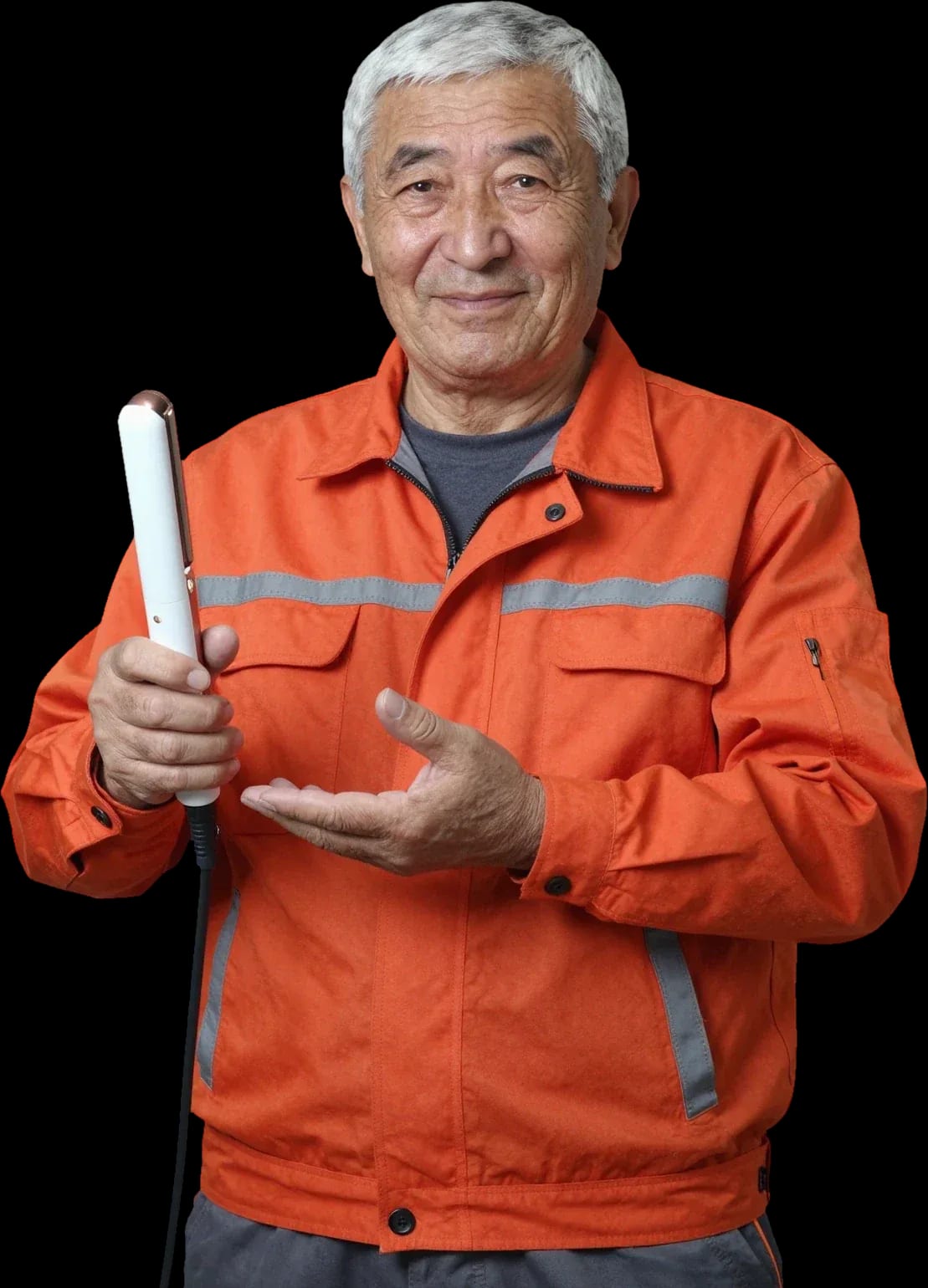
Tech Service repairs hair straighteners in Astana: our technician comes to your home or you can drop the device off at our service center. Diagnostics are free, we arrive within 60 minutes anywhere in the city, and you get a 1-year warranty on labor and parts. The technician gives you the price after diagnostics, and you can pay via Kaspi QR, Kaspi Red, bank card, cash, or bank transfer for companies.
Why your straightener stopped working and what exactly broke
A device doesn't break "in general" — it breaks in a specific part, from the power cord to the control board. We go through the symptoms to show which component fails most often.
The straightener won't turn on at all
Most often the device won't turn on because of a break in the power cord or where it enters the housing, and less often because of the control board. The cable at the base of the handle bends every time you turn the styler, and the copper wire inside the insulation breaks — the cord looks fine from the outside, but current doesn't pass through. The second most common culprit is the power button: dust and styling product residue build up under it, the contact oxidizes and stops closing the circuit. The control board fails less often, usually after a voltage surge or moisture getting on the contacts. Before taking the device to a service center, check that the outlet works and the cord isn't twisted at the base — these are the most common everyday reasons for a "dead" device.
It heats up but won't turn off, or turns off by itself
Spontaneous shutdowns and "stuck" heating are usually caused by the thermostat and temperature sensor, which stop sending accurate temperature data to the board. The sensor is mounted near the heating plates and signals the actual heat level; when it shifts or its contact oxidizes, the board gets distorted data and either cuts power too early or keeps heating the plates without limit. The thermostat is responsible for maintaining the selected setting — if it fails, the device may not respond to the power button. Plate wear and housing overheating speed up if the problem is left unattended. If the device won't turn off with the button, don't leave it plugged in — when the thermostat fails, the plates keep heating above the operating temperature and the housing near them melts.
The light blinks and the heat fluctuates
A blinking indicator and temperature swings mean the control board is getting conflicting data from the sensor or the heating element is working unstably. The board regulates heating and the temperature buttons: it reads the sensor and supplies voltage to the heating element, and when the data doesn't match, it triggers protection — hence the blinking and drops in heat. The second scenario is a partial break inside the heating element: the plates heat unevenly, one side gets hotter than the other, and the device can't hold the set mode. Oxidized contacts on the ribbon cable between the board and the plates cause the same symptoms. Don't try to "warm up" the device at maximum temperature to get it working — with a faulty sensor, this speeds up wear on the plates and housing.
Dangerous symptoms: when not to plug in the device
Some faults don't just get in the way of styling — they make the device unsafe. Here are the symptoms when it's best to turn the straightener off and leave it alone until diagnostics.
It sparks, smells burnt, or gives electric shocks
Sparks, a burnt smell, and noticeable electric shocks almost always point to damaged cord insulation or a problem where the cable enters the housing. Most often the insulation wears through at the base of the cord — where the cable constantly bends during styling — and the exposed wire starts touching the housing. The second typical spot is where the cable enters the housing: from frequent turning, the plastic cracks, moisture and dust get inside, and the contact starts to spark. You hear crackling when the contacts inside the connector burn. Don't test such a device on yourself by plugging it in again — damaged insulation can give you a shock the moment you touch the working surfaces with your hand. Both faults are in the power cord area, and both are fixed after disassembling the housing.
The housing near the plates has melted
Melted casing near the working surfaces points to local overheating — caused by a faulty temperature sensor, heating elements that don't fit tightly, or using the device with damaged coating. The temperature sensor reads the surface temperature and sends a signal to shut off; when it fails, the heating elements keep heating above the set level. The second scenario is loose elements: a gap remains between them and the casing, so heat goes into the plastic instead of the hair. The third is chips and scratches on the coating: at the damaged spot heating is uneven, and that's where deformation appears. Even if the device still heats, a melted casing is a reason to stop using it: the next cycle will repeat the overheating in that spot and the defect will grow. Replacing the temperature sensor or realigning the plates solves the problem before the plastic is damaged further.
When you should definitely not turn it on
- Sparks or crackling: heard when turning on or during use, especially near the base of the cord.
- Smell of burnt plastic: appears for no apparent reason and doesn't go away after unplugging.
- Electric shocks: felt when touching the casing or working surfaces even with dry hands.
- Melted casing: signs of deformation near the heating elements or control buttons.
- Smoke or darkening: appears on the casing or power cord after plugging in.
- Exposed wire: insulation is swollen, cracked, or the core is exposed right at the base of the cable.
- Turning it on again: doesn't help and only increases heating in the damaged area of the casing.
What we repair in straighteners and stylers
Straightener repair means fixing a specific component, not replacing the whole device. Here's what we fix and how it relates to the type of working surface.
Heating elements and plates
We install a new heating element and working panels, including ceramic and tourmaline coated ones, when the coating is damaged or heating becomes uneven. The cause is usually the same: the nichrome coil inside the element eventually burns out at the edge or loses contact, and one side heats less than the other. On ceramic and tourmaline, chips and scratches appear from contact with hairspray, styling products, and sudden temperature changes when turning on. We also check how tightly the panels fit to the casing: a loose screw causes play, and the coating chips faster. We select the part for the specific model's power, not a universal one. A surface with a damaged layer is not only bad for styling — it snags hair and overheats certain areas, so during service it is replaced, not sanded down.
Electronics, buttons, and thermostat
We restore the thermostat and temperature sensor, fix the control board and temperature adjustment buttons if the device doesn't hold heat or doesn't respond to controls. The temperature sensor reads the temperature from the working panel and sends a signal to the board, which turns heating on and off; when the sensor is off, styling goes either too hot or barely warm. On the board, the tracks near the power connector and the contacts under the buttons are most often damaged — they oxidize from moisture, hairspray, and dust. Membrane buttons wear out over time, become stiff, and the device stops switching modes. We also take in the cord at the entry to the casing if the insulation is worn at the base. If the buttons stick after moisture or hair product gets in, cleaning without disassembly often brings the problem back — the board and contacts need to be inspected from the inside.
What we replace and restore by component
| Component | What we check | What we do |
|---|
| Power cord | insulation, entry point into the housing | replace the cord, restore the entry point |
| Heating panels | coating, even heating | replace the panels |
| Heating element | heating, open circuit | replace the element |
| Thermostat and sensor | temperature stability | repair or replace |
| Control board | response to buttons, indicators | repair the board |
| Hinge | fixation, play | restore the mechanism |
| Housing | melting, cracks | fix the housing defect |
How the repair goes from request to pickup
Our rectifier repair process is simple: request, technician visit, acceptance of the device at the service center, free diagnostics, approval, and the work itself. This order helps you understand the scope of the issue in advance and avoid unexpected costs, so we recommend keeping all acceptance documents.
Technician arrives at your home within 60 minutes
We send our own technician to your home anywhere in the city, arrival within 60 minutes after your request, and this is not a middleman but an employee of our service. We take requests by phone, clarify the rectifier model and what exactly is wrong: won't turn on, not heating, indicator blinking. Then the technician comes to you with a set of tools for typical jobs — checking the cord, connector, buttons, and heating element. Residents of Astana can call a specialist to their home — the visit service works throughout the city. Rectifier repair in Astana is available both at home and at the workshop — you choose the convenient format when requesting. Acceptance at the service center is also still available: if it's easier to bring the rectifier yourself, the workshop will accept it for diagnostics. If the device sparks or won't turn on, mention this during the request — the employee will bring the necessary parts and check safety on the first visit.
Free diagnostics and work approval
Diagnostics are free: the technician finds the cause, explains what needs to be replaced and what can be repaired, and only then quotes the price. The check takes time but not money — you pay only for the work itself once you agree to it. The specialist opens the housing, tests the heating element, checks the thermal fuse, control board, and button contacts. For each component, they tell you directly: what can be restored and what needs full replacement. After the inspection, you get a clear picture of the breakdown and solution options — no pushy upsells. Approval before starting is important not as a formality — it lets you decline if the breakdown turns out to be minor or the work isn't worth it. The price is quoted after free diagnostics, and it doesn't change during the process unless a hidden defect is found.
Repair at home or at the service center
Some operations the technician performs right at your home, and if a component needs replacement or board soldering, the device can be left at the service center. On-site, we typically replace the power cord, connector, buttons, thermal fuse, and clean and align the plates. Soldering the control board, replacing the heating element and housing parts require stationary conditions — such operations are done at the workshop, where our employee delivers the device. We don't hand the rectifier over to third parties: both at home and at the service center, the same specialist who did the diagnostics works on the device. After the work, the device is tested in operating modes — heating, temperature switching, auto shut-off. If you're not ready to part with the device for long, ask during the request which operations are done on-site — this will save you a second trip.
Warranty, timelines, and repair cost
Clients care not only about whether the device will be fixed but also about what happens if the breakdown returns. We explain the warranty, payment procedure, and what affects the final cost of rectifier repair.
1-year warranty on labor and parts
We provide a 1-year warranty on labor and parts that we install when servicing a straightener. This period is the same for both at-home visits and in-shop work—it doesn't depend on where the technician fixed the device. The warranty covers the specific unit we replaced or restored: the heating element, plates, thermostat, buttons, or control board. Our technicians have been working with straighteners and stylers for 4 to 20 years, so they can usually tell right away from the nature of the breakdown which part has failed and what parts will be needed. The warranty applies specifically to the work performed and the parts installed, so when you contact us again, it's important for the technician to know which unit was replaced last time—keep this information and mention it when you call.
What affects the cost
The cost depends on which unit has failed and what work is needed—the technician gives you the price after free diagnostics, before starting work. Diagnostics are free for the customer: the specialist opens the case, checks the heating element, thermostat, board, and contacts, finds the cause, and only then quotes the price for replacing the specific part and for labor. Replacing plates, restoring electronics, and fixing buttons are operations of different complexity, so the final price varies. In our experience, restoring the control board and replacing heating elements are the most expensive, while contacts and buttons are cheaper. If you already know what's not working (not heating, not turning on, sparking), mention it when you call—the technician will bring the necessary parts and you won't need a second visit.
Payment and device drop-off
You can pay via Kaspi QR, Kaspi Red, card, cash or bank transfer, and you can hand the device to the technician at your home or leave it at the service center—whichever is more convenient. For at-home visits, the specialist either takes the device with them or fixes it on the spot if the work allows; at the service center, the device is accepted for the duration of the work and returned after inspection. The customer chooses the payment method—cash, card, or transfer—there are no restrictions on this. Before starting work, the technician once again confirms the agreed scope so the customer understands what they're paying for. The price quoted after free diagnostics is fixed before work begins, so there are no surprises at checkout. If the service is done at the service center, clarify at drop-off what work has been agreed—this helps avoid discrepancies when you pick up the device.
Repair or buy new, and how to extend the life of your device
Sometimes restoring a straightener is worth it, sometimes it's easier to buy a new model. Here's how to decide and what affects the longevity of the device in Astana.
When restoration is worth it and when it's not
Restoration makes sense when the breakdown involves a single unit—the cord, plates, thermal sensor, or hinge—and the body and electronics are otherwise intact. Replacing the power cable, restoring the coating on the working surfaces, soldering a button contact, or installing a new sensor gets the straightener back in working order without buying a whole new device. It's more complicated when the control board has failed or the heating element has burned out along with the thermostat: then a set of units is replaced, and the decision depends on the class of the device. Models with ceramic and tourmaline coating are serviced more often—their base and body are designed for long-term use. If the device is expensive and has high-quality working surfaces, replacing one unit usually extends its life for years, whereas an equivalent of the same class would have to be bought entirely.
Local factors of the capital
In the capital, straighteners more often suffer from power surges and from the dry, static-heavy climate, while hard water during cleaning speeds up wear on the plate coating. Voltage spikes hit the control board and thermostat — electronics are the first to fail when the power supply is unstable. Dry air and static add stress to the hinge and working surfaces: the coating cracks faster than in a mild climate. Hard water leaves residue on ceramic and tourmaline if the plates are wiped with a damp cloth without drying. Models with ceramic and tourmaline coating handle this better than metal ones. If your home has voltage spikes, it's best not to leave the device plugged in when not needed — this reduces the risk to the control board.
How to care for the device between services
- Clean the plates after they cool down: warm surfaces with product residue damage the coating and leave streaks.
- Don't wet the entire body: moisture around the buttons and opening hinge is a common cause of electronics failure.
- Store it closed: this reduces wear on the power cord and opening hinge during transport.
- Don't pull the cord to unplug: hold the plug, not the cable — this prevents the wires from fraying at the base.
- Don't leave it on unattended: if the thermostat fails, it's dangerous for the body and heating elements.
- Wipe dry after wet cleaning: hard water residue crystallizes on ceramic and speeds up wear.
Hair straightener repair and what to expect
Diagnosing a breakdown comes down to simple logic: first identify the faulty component, then decide whether it's worth replacing. Below is a short summary to help you decide without unnecessary doubt.
- The symptom points to the component: if the device won't turn on, check the cord and board; if it doesn't heat, check the heating element and temperature sensor.
- Dangerous signs are a stop signal: sparks, a burning smell, or electric shocks when touching the body require immediate unplugging.
- Repair is justified for a localized fault: replacing one component gets the device working again and extends its overall lifespan.
- Diagnostics before work: the technician discusses the scope of work and final cost before starting, not after.
- Prevention reduces risks: cleaning the plates and handling the cord carefully lower the chance of repeat breakdowns.