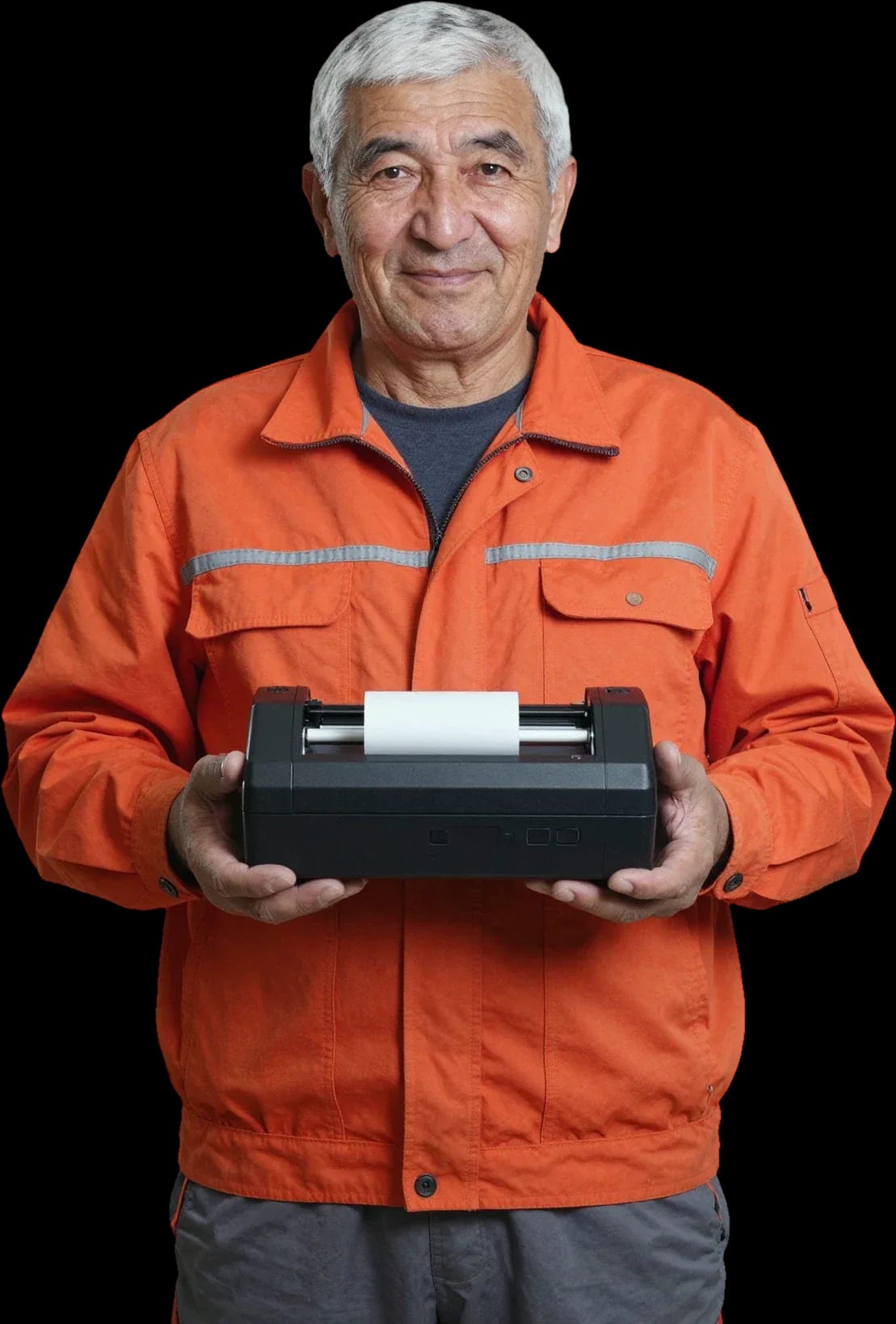
Tech Service repairs label printers in Astana: a technician arrives at your location within 60 minutes or takes the equipment to the service center. Diagnostics are free, the technician provides the cost after diagnostics, and there is a 1-year warranty on labor and parts. We repair thermal and thermal transfer models from Zebra, TSC, Godex, and Argox.
Why Your Label Printer Stopped Printing and What to Check Before Calling a Technician
Your label printer is down—and it's not always a component failure. Some symptoms can be resolved with settings and consumables, while others require a technician visit. Here's where to start troubleshooting.
Blank Labels When Printing
Blank labels usually mean that a thermal transfer printer isn't feeding the ribbon or the ribbon is installed with the wrong side facing the label, or in a direct thermal printer, the printhead isn't pressing against the paper. Check the ribbon supply mechanism: the spool should rotate, and the ink side should face the label. In a direct thermal printer, the printhead presses against the thermal paper via the pressure mechanism, and a loose clamp produces a clean blank stripe instead of text. The print type is set in the driver: thermal transfer and direct thermal are different modes of the same device, and a mixed-up mode is more common than an actual printhead failure. Before calling a technician, verify that the correct print type is selected in the driver: thermal transfer mode without a ribbon produces a blank label even when the printer is fully functional.
Printer Jams or Tears Labels
Jamming and tearing are usually related to the label path: dirty feed rollers, a misaligned pressure roller, or incorrectly loaded labels cause creasing at the output. Inspect the feed rollers—adhesive dust from the liner accumulates on them, and the roller starts slipping, pulling the label at an angle. The pressure roller should be parallel to the printhead shaft: even a couple of millimeters of misalignment causes the label to shift sideways and catch on the guide. Check the loading according to the diagram on the inner cover—each model has its own label path, and loading "by eye" is often the cause of jams. If the label tears at the same spot, mark that spot—it helps the technician immediately identify whether it's the roller, guide, or tension, and bring the right part.
Faint Printing, Stripes, and Gaps
Faintness and stripes are caused by contamination or wear of the printhead, low print density and speed settings; a test print helps distinguish mechanical issues from settings. Run the built-in test—it prints a reference image without the driver, and if stripes remain on the test, the cause is the printhead or ribbon, not the software settings. Wipe the printhead with a lint-free cloth and alcohol: burnt residue and adhesive from the ribbon cause random light streaks. Increase print density gradually—a sharp jump accelerates printhead wear and leads to ribbon sticking. Uniform vertical gaps across the entire width usually indicate printhead wear, while random stripes indicate contamination or poor-quality ribbon; these are different repair jobs.
Print Shift, Calibration, and Label Sensor
Label shift is the most common reason for service calls, and it's not always a breakdown. Here's when calibration helps and when the problem is in the sensor or feed path.
Printer Doesn't Detect Label Edge
If the printer doesn't detect the label edge, first calibrate the sensor; if the shift persists after calibration, check the sensor for contamination and proper operation. This unit determines the media boundary and the gap between adjacent labels, and its readings determine where the device places the starting point. During calibration, the device feeds several labels in a row and remembers the step length, liner transparency level, and gap position. Incorrect parameters cause a characteristic image shift—text moves to the edge or onto the adjacent label. Calibration should be repeated after changing to a roll with a different width or gap: the device remembers the media parameters, and with new media it "drifts" without recalibration. Before repeating the procedure, wipe the sensor with a dry lint-free cloth—dust and adhesive from the liner distort readings.
When Calibration Doesn't Help
We calibrate the label printer when print shifts, and if the sensor still loses the edge after the procedure, we check its condition and replace it if necessary. Our technicians have 4 to 20 years of experience, and calibration is included in the free diagnostics. Persistent misalignment after several attempts is a signal not to keep tweaking settings but to inspect the unit and the media path: accumulated dust, adhesive from the liner, or a misaligned roller produce the same picture as a settings failure. At Tech Service, we first determine exactly where the border is lost, and only then suggest replacing the unit. That way you don't waste rolls on repeated runs and don't pay for a part that's still good.
Table of symptoms and likely causes
| Symptom | Likely cause | What the technician checks |
|---|
| Blank labels | ribbon or print mode | ribbon feed unit, settings |
| Print shift | label sensor, calibration | sensor, calibration |
| Stripes and gaps | printhead, ribbon | printhead, ribbon quality |
| Media jams | feed rollers, pressure roller | media path, tension |
| Won't turn on | control board, power supply | power, controller |
Label printer repair at home or in the service center
A label printer usually sits at a checkout or in a warehouse, and taking it away is inconvenient. Here's when a specialist fixes it on site and when the equipment is taken to the service center.
Technician comes to you
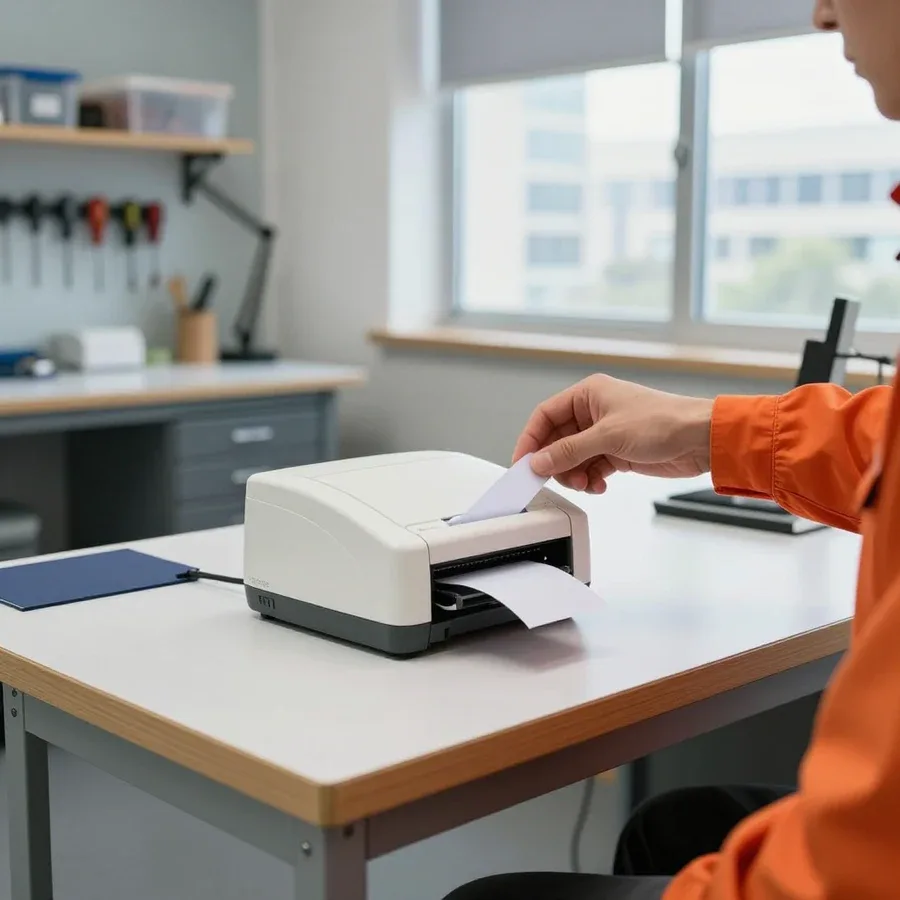
We travel to clients' homes or offices across the city, and a specialist arrives within 60 minutes of your request. The on-site format covers most breakdowns that don't require disassembling the case down to the electronics: lost calibration, clogged feed path, worn rollers, label sensor, printhead overheating from long operation. Our technicians bring tools and cleaning supplies, check the mechanics and settings on site, and show you exactly what went wrong. Label printer repair at home in Astana is convenient because the printer doesn't sit idle away from its workplace: the checkout, warehouse, or pickup point keeps running while the specialist is there. In my view, on-site service wins for routine and minor issues—no need to pack up the equipment, haul it in, and wait to get it back. Diagnostics are free, and we quote the price after them.
When the equipment is taken to the service center
If the problem involves the control board or power supply, it's better to repair it at the service center, where we take the equipment. The control board is responsible for turning the printer on and its operation, and the power supply for stable voltage to the printhead and motors; accessing them requires disassembling the case and testing under load, which can't be done carefully on site. Symptoms of this type: the device won't turn on, shuts down by itself during printing, or shows a power error code. A printer that won't turn on shouldn't be disassembled on your own—it makes it harder to determine the cause later, and our diagnostics are free. At the service center, a specialist checks the power circuit and board, and after the work provides a 1-year warranty on labor and parts. In our practice, such cases are less common than on-site ones, but they're the ones that require a full disassembly.
Urgent case when you need to print right away
When label printing stops and you need it urgently, we arrive within 60 minutes to get it working on site. Urgency usually comes from shipping, receiving goods, or a flow of customers at the checkout: every minute of downtime means a queue and manual labeling. In such cases, the on-site technician brings typical consumables and quickly checks what most often stops printing: calibration, sensor, printhead cleanliness, ribbon tension. If you need the printer right now, describe the symptom over the phone — the technician will bring likely parts and won't waste the visit on clarification. We work throughout the city and you can pay via Kaspi QR, Kaspi Red, bank card, cash, or bank transfer for companies. Also, for an urgent call, it's worth telling us in advance which model you have and what error code is on the display — this speeds up preparation.
Diagnostics, warranty, and transparent repair
The main fear of a label printer owner is that after service the equipment will break again, and the price will be pulled out of thin air. Below we explain how our diagnostics, work approval, and warranty are set up.
Free diagnostics and when the price is quoted
Diagnostics are free, and the technician quotes the price after them, once the cause is established. First, the engineer checks the feed mechanism, printhead condition, label sensor, and driver settings — for the symptom 'not printing' there can be three or four causes, and each entails its own scope of work. The technician arrives within 60 minutes anywhere in the city, inspects the device on site, and records what exactly has failed. Only after that does he list the work and the amount, and you decide whether to proceed. Ask for prices before starting — that way you understand what you're paying for and can compare with the cost of a new printer if the work turns out to be impractical.
Warranty on labor and parts
We provide a 1-year warranty on labor and parts, so a repeat breakdown doesn't become your problem. For a label printer this is essential: the printhead and label sensor are consumable components, they wear out from thermal paper, adhesive, and dust, and their replacement should be protected just like the work itself. At Tech Service, the warranty covers both the installed part and the quality of its installation — if the component fails prematurely, we deal with it, not you searching for a new printhead. Our experience ranges from 4 to 20 years on various thermal printer models, and over this time we've seen how a cheap compatible printhead degrades in a couple of months. That's why we install parts with a margin for real printing load, not for the minimum price of the component.
How service proceeds step by step
- Contact: you describe the symptom — stripes, blank labels, ribbon jams — and the technician clarifies details over the phone.
- Visit or drop-off: the technician arrives within 60 minutes anywhere in the city, or the equipment is taken to the service center if disassembly is needed.
- Diagnostics: we determine the cause of the breakdown for free and show which component has failed.
- Approval: we state the scope of work and the amount before starting, and you confirm or decline.
- Repair and check: we fix it, test printing on a sample label, and provide a 1-year warranty on labor and parts.
Which label printers we repair and how models differ
Label printers of different brands break in similar ways, but their components and spare parts differ. Here's what an owner should know before contacting a service center.
Zebra, TSC, Godex, Argox
We service Zebra, TSC, Godex, and Argox label printers—both thermal transfer and direct thermal models. These four brands are the ones we see most often, and each has its own feed path design: on Zebra the printhead is secured with two screws and a retaining plate, TSC and Godex sometimes use quick-release carriages, and on Argox the label edge sensor sits closer to the guide and gets knocked out of alignment more often when you change a roll. A technician with 4 to 20 years of experience can identify the series from the symptom description and a photo of the nameplate, and from the series determine which part you'll need. Different brands have different designs for the label edge sensor and printhead mounting, so the technician confirms the model before the visit to bring the right parts. Be sure to specify the series if the unit was bought for warehouse use and handles large rolls—industrial models wear out the printhead and rollers at a different rate than desktop ones.
Thermal transfer vs. direct thermal
A thermal transfer printer uses a ribbon, while a direct thermal printer works with thermal labels and no consumable, so their typical failure sets differ. In thermal transfer models the ribbon winds onto a take-up shaft, and uneven tension makes it wrinkle, causing white gaps along the edges of the label. Direct thermal printers have no ribbon, but the printhead stays in contact with the thermal layer, and with cheap labels the abrasive coating wears down the heating elements faster. The ribbon remaining sensor is a separate story: it tracks the ribbon, and if it gets dirty, the unit throws an error even with a full roll. Thermal transfer models more often suffer from the ribbon feed mechanism and its optics, while direct thermal printers suffer from the printhead and the quality of the thermal label itself. Store thermal labels away from heat sources: a warmed-up roll darkens and loses contrast before you even print.
Repair options table
| What happened | Where we fix it | What we check |
|---|
| Shift, calibration | on-site | edge sensor, settings |
| Stripes, faint print | on-site | printhead, ribbon |
| Label jams | on-site | rollers, feed path |
| Won't turn on | at the service center | control board, power supply |
| Printhead replacement | on-site or at the service center | printhead wear |
When a label printer can't be repaired
Not every breakdown is worth fixing. Here are three scenarios: when restoration makes sense and when the cost is already comparable to replacing the device.
Printhead or replace the unit
Printheads are usually replaced rather than restored, and the decision is based on wear level and the condition of the printer's other components. The printhead is a consumable part of a thermal printer: heating elements wear down from constant contact with the ribbon, and they can't be brought back. The technician assesses the depth of wear, the condition of the feed rollers, the thermal bar, and the control board. If the printhead is worn but the mechanics and electronics work properly, replacing the unit restores normal label printing. It's a different matter when wear affects several components at once—printhead, rollers, and board: then the total repair cost should be compared with buying a new printer. Before deciding on replacement, ask the technician to list all worn components—it's easier to see the full picture than to fix things one by one. On models with metal mechanics, printhead replacement usually makes sense for longer than on budget plastic housings.
The printer won't turn on at all
If a label printer won't turn on, the cause is usually the power supply or the control board, and diagnostics will show whether the unit can be repaired. The control board handles powering on and operating the printer, while the power supply converts mains voltage into the levels needed by the components. The symptom of no response to the button is often linked to failed capacitors or a blown fuse in the power circuit. A device that won't turn on isn't always dead: sometimes it's just the power supply, and once that's fixed, the printer keeps working. So don't write off the device too soon. In practice, the first step is to check the cable, outlet, and external adapter if there is one—these small things can create a false impression of a breakdown. Once external causes are ruled out, diagnostics will show whether the board can be repaired or is easier to replace.
Error code on the display
An error code on the display points to a specific component, but the interpretation depends on the model, so you can't draw conclusions from the code alone. The same number can mean different things across manufacturers: on some models it's the ribbon sensor, on others it's a problem with the printhead or feed. The ribbon sensor often causes ribbon-related errors: it doesn't detect the ink ribbon and stops printing. Write down the code and printer model before calling a technician—with that pair, it's easier to guess the cause right away and prepare the needed parts. In our experience, this saves time: the technician arrives with a likely inspection plan instead of starting from scratch. Don't reset the error ten times in a row—a repeating code on a specific operation narrows down the fault.
Keeping label printers running on schedule
We've gathered what most often explains printing failures and helps you choose the right path to getting your device back up and running—from a DIY check to handing it over to a technician.
- Consumables come first: blank prints, streaks, and misalignment are more often caused by the ribbon, printhead, or sensor rather than a fatal breakdown of the device.
- Calibration isn't a cure-all: adjustment only removes misalignment if the sensor is working; a persistent defect is a direct reason to check the sensor itself.
- Home or service center: some tasks can be done on-site, but board and power supply issues are better handled in the workshop.
- Check first: diagnostics are done before any work is approved, so you understand the cause and scope of the fix rather than replacing parts at random.
- Warranty as protection: a 1-year warranty on labor and parts covers you if consumable components like the printhead and sensors fail again.