Tech Service is a direct AC repair provider in Astana: our technician arrives at your home within 60 minutes anywhere in the city or repairs the unit at our service center. Diagnostics are free, we give a 1-year warranty on labor and parts, and our technicians have 4 to 20 years of experience. We quote the price after diagnostics.
Why ACs in Astana break down more often and what to check before the technician arrives
Sharp temperature swings and long heating operation in winter speed up wear on AC components. Let's look at the typical breakdowns here, why they happen, and what checks you can do yourself before calling a technician.
How the climate affects AC components
Sharp temperature swings and long operation in heating mode in winter put extra load on the compressor and heat exchanger, so components wear out faster than in a mild climate. During the cold season, a split system goes through dozens of defrost cycles of the outdoor unit: the controls pause heating for a while, melt the ice on the radiator, and restart the compressor under load. Each cycle means a pressure drop in the circuit and thermal deformation of the brazing. Air filters clog with dust several times faster during the heating season than in summer, and a clogged mesh reduces airflow through the heat exchanger. When running in heating mode in winter, the outdoor unit periodically freezes up and goes into defrost—this is a normal cycle, but dirty filters and a dirty radiator make it longer and speed up wear. That's why AC repair in Astana is in demand all year round, not just in the heat.
Typical AC breakdowns
- Outdoor unit icing: ice buildup during heating operation and defrost cycle failures.
- Indoor unit leaking: clogged drain or a shifted condensate drain slope.
- Not cooling: refrigerant leak, clogged filters, or a dirty heat exchanger.
- Noise and rattling: worn fan, loose fasteners, a foreign object in the unit.
- Won't turn on: faulty board, remote, or inter-unit wiring.
- Random shutdowns: compressor protection tripping due to overheating or pressure drop.
What to check yourself before the technician arrives
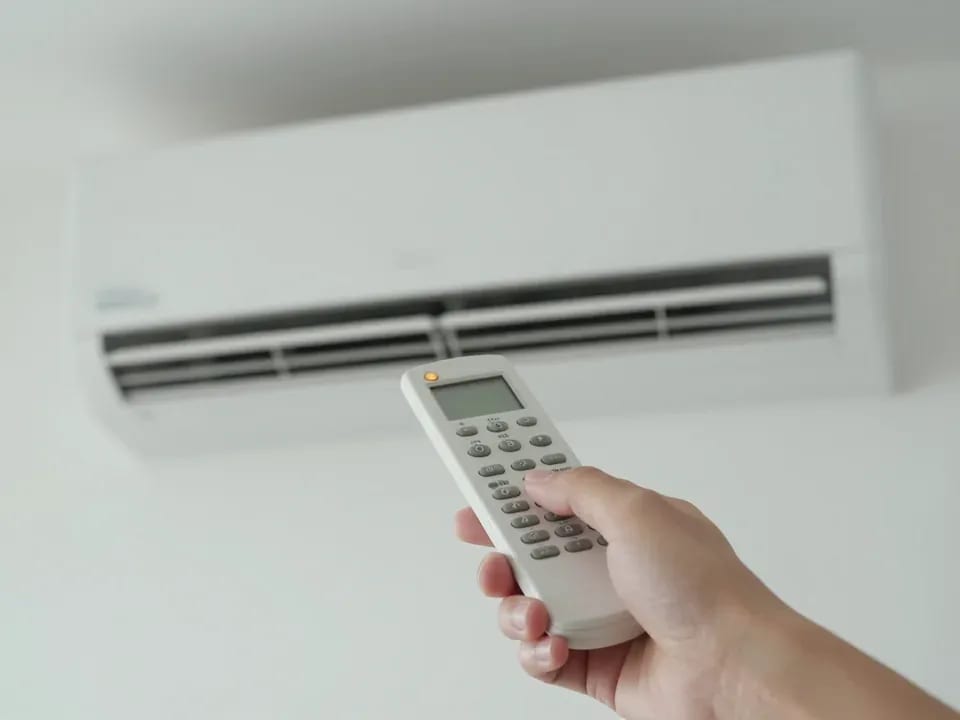
Before the technician arrives, check the remote and batteries, the indoor unit filters, the breaker in the panel, and make sure there's no ice on the outdoor unit—this rules out some simple causes. Remove the front panel and rinse the mesh filters with warm water: a clogged mesh gives the same "not cooling" symptom as a refrigerant leak, and it's easier for the technician to rule this out right away. Check the panel—if the AC breaker is tripped, switch it on once and see if it trips again. Don't chip ice off the outdoor unit with a knife or pour hot water on it: that damages the radiator tubes. Don't remove the outdoor unit or try to top up the refrigerant yourself: without gauges and a leak detector, it's not diagnostics but a risk of damaging the wiring and making subsequent service more difficult. A Tech Service technician arrives at your home within 60 minutes anywhere in the city and starts with free diagnostics.
What your breakdown means and what to do before the technician arrives
Customers come with a specific symptom, so let's go through the most common scenarios: why it's not cooling, where the water is coming from, how to read an error code, and when noise is already a reason to call a specialist.
The AC runs but doesn't cool
If the AC blows but not cold air, it's most often a refrigerant leak, clogged filters, or a dirty heat exchanger, not a broken compressor. Air filters clog with dust in 2-4 weeks of active use—airflow drops through them, and the heat exchanger stops delivering cold. When refrigerant leaks, pressure in the circuit drops, the compressor runs idle and heats up. The compressor itself fails less often: usually it suffers as a consequence of long operation without refrigerant. It's easy to check: remove the filters and hold them up to the light—if the mesh doesn't let light through, start by washing it. A refrigerant leak can't just be "topped up": first find the leak, otherwise the refrigerant will escape again in a few weeks and the work will have to be repeated.
Water is leaking from the indoor unit
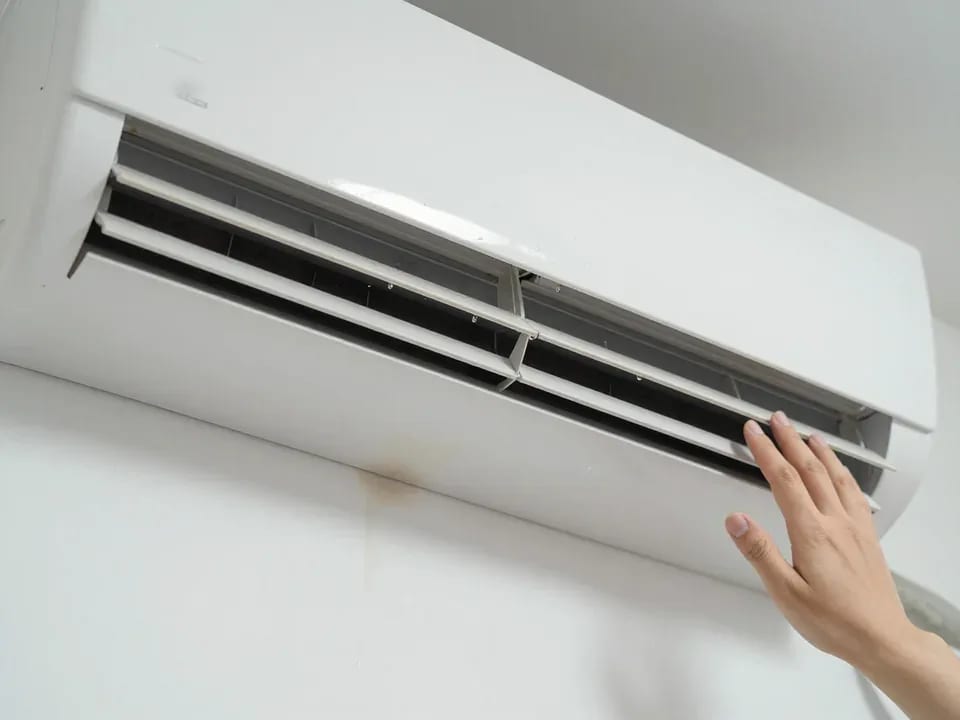
An indoor unit leak is almost always related to the drainage system: a clogged condensate drain, a shifted slope, or freezing that prevents meltwater from draining. Condensate collects in the pan and flows outside through a tube; when dust and slime build up in the drain, water overflows the pan and drips onto the wall. A condensate drain pump only helps if it's working—if it fails, water also goes inside. Ice on the heat exchanger is a second source: ice builds up, and during defrost, meltwater doesn't drain fast enough. While the technician is on the way, unplug the air conditioner and place a container under the drip so water doesn't get into the wall and ruin the finish—that's cheaper than restoring the facade later.
Error code on the display and noise during operation
- Error code: a signal about a specific component, decoded using the service documentation for your model, not generic tables.
- Fan noise: worn bearing or dirty impeller causing the blades to hit the housing.
- Rattling and vibration: loose unit mounting or a foreign object inside the housing.
- Clicking at startup: the starter or magnetic contactor engaging when the compressor turns on.
- Compressor hum: increased load on the component or wear, often due to low refrigerant.
- Control board squeal: an electronics fault signal that should be checked along with the inter-unit wiring.
How free diagnostics works and what determines the cost
To help you make an informed repair decision, we'll show you exactly what checks are included in free diagnostics and why the price is only quoted after them.
What the technician checks during free diagnostics
During free diagnostics, we check system pressure, the condition of filters and the heat exchanger, drainage, electrics, and inter-unit wiring to find the cause, not the symptom. The specialist inspects the indoor and outdoor units, listens to the fan and compressor, and checks whether condensate drains through the drain tube. Then they connect gauges to the service ports, assess refrigerant pressure, and test the control board and contacts between units. The cause of a leak is often a clogged drain rather than a refrigerant leak, and vice versa—good pressure doesn't mean the heat exchanger is clean. Diagnostics go from simple to complex: first ruling out clogs and power issues, then checking the circuit and electrics—so the cause is found faster and without unnecessary disassembly. Make sure the specialist explains each step out loud: that way you see the logic and don't pay for work that wasn't done.
What determines the cost of work
The cost depends on which component failed, whether a part is needed, and whether the problem can be fixed without removing the unit—the specialist quotes it after free diagnostics, once the cause is known. Replacing a control board, working on the compressor, and fixing a refrigerant leak are tasks of different complexity, and lumping them into one average figure makes no sense. On-site work usually doesn't require disassembly: drain cleaning, filter replacement, tightening contacts. If the compressor or board is faulty, the part is selected for the specific model, which affects the final amount. Agree on the scope of work before starting: if another fault is discovered along the way, the specialist should come back to you for new approval, not silently expand the work. Ask in advance whether the visit is included in the price—with us, it's already covered in diagnostics.
Which work is done where and what determines the duration
| What we check | Where it's done | What affects the timing |
|---|
| Drainage and leaks | At your home | Access to the indoor unit |
| Filters and heat exchanger | At your home | How dirty they are |
| Circuit and refrigerant | At your home | Whether there's a leak |
| Control board | Usually at the service center | Model and component |
| Compressor | Usually at the service center | Type of compressor |
Repair at home or at the service center, and how to tell a direct contractor from a middleman
The format of the work depends on the nature of the breakdown, not on the client's preference. Let's look at when a technician fixes the issue on site, when the unit is removed, and how to tell a direct contractor from a middleman.
When the work is done at your home
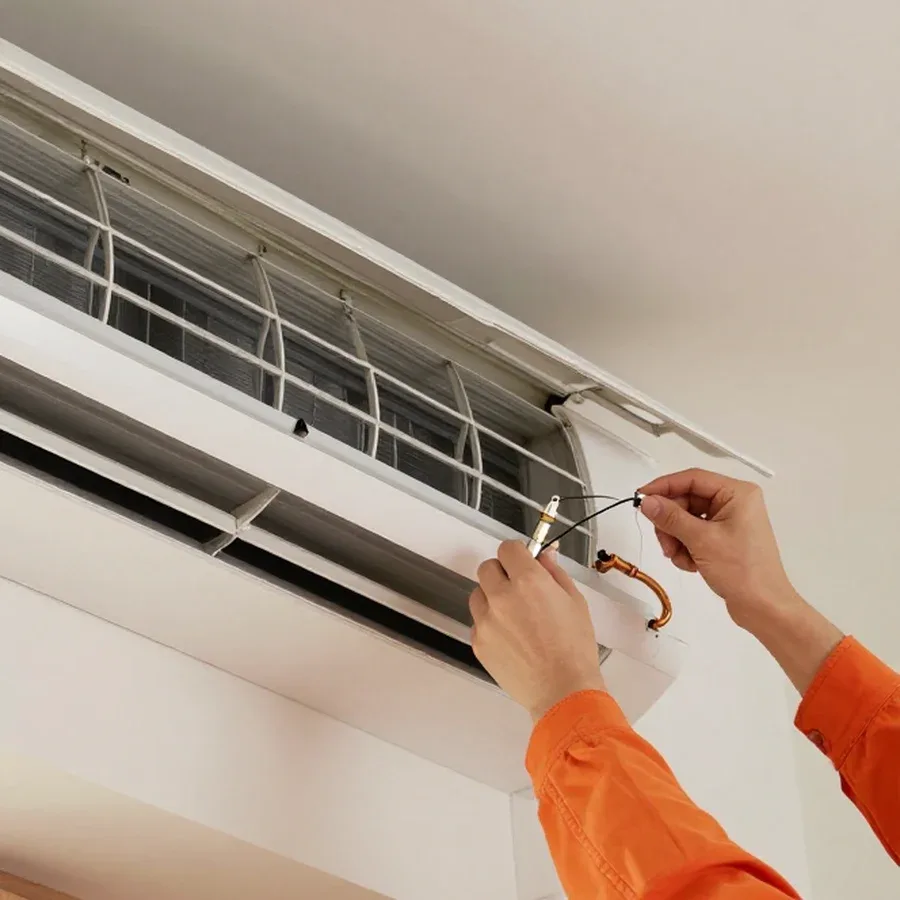
At your home we fix drainage leaks, clogs, power and inter-unit communication problems, and we clean and recharge refrigerant — anything that doesn't require removing the unit and testing it on a bench. A leak is most often caused by a clogged drain or a displaced condensate drain tube, and the technician removes the pan, flushes the channel, and sets the slope right at your place. Power and communication problems between units are checked with a multimeter on site: testing the circuit takes minutes, and replacing a terminal or a section of cable doesn't require removing the casing. Refrigerant charging and heat exchanger cleaning are also part of the on-site service — you just need access to the outdoor unit. If the technician suggests removing the unit for a breakdown that can be fixed on site, ask why: removal is justified when the component is inaccessible or the casing needs to be disassembled.
When the unit is removed and taken to the service center
The unit is sent to the service center when the breakdown is inside the compressor, the control board, or requires disassembly and testing on equipment that isn't available on site. The compressor is a sealed component: to assess the winding and mechanics, it's connected to a bench and the current draw, inlet and outlet pressure are measured — you can't do that while it's hanging on the wall. The control board is checked for blown traces and failed relays — diagnostics require a soldering station and an oscilloscope. The heat exchanger with clogs or microcracks is also easier to test with pressure testing in the workshop. Before removing the unit, ask what exactly will be checked at the service center and how the unit will be reinstalled: removal and installation are separate work that should be discussed in advance.
How to tell a direct contractor from a middleman
- Their own technician: a service employee arrives, not a subcontractor from a marketplace.
- Warranty from the contractor: it's provided by the one who does the work.
- Clear scope of work: agreed before starting, not after the fact.
- One responsible party: the service center is responsible for the work and parts.
- Diagnostics before work starts: the cause is identified before the scope is agreed.
- 1-year warranty on labor and parts: it's backed by the same contractor who came.
1-year warranty and what to do if it breaks again after repair
The warranty is the main factor a city resident uses to choose a technician. Let's look at what exactly it covers and what to do if the air conditioner breaks again after service.
What the 1-year warranty covers
We provide a 1-year warranty on the technician's work and on the parts installed, so both the labor and the part are covered for a year. If during this period the compressor or control board that we replaced fails again, the case is handled under warranty, not as a new order. The warranty covers exactly the unit the technician worked on: the replaced compressor, the installed control board, the soldering performed, or the leak fixed. It does not apply to work unrelated to the repair — for example, if six months later a drain clogs elsewhere in the line. Air conditioner repair technicians record which unit was touched and which part was installed. Keep the information about which unit was repaired and which part was installed: when you contact us again, this speeds up the check and helps determine accurately whether the case is covered by the warranty.
What to do if something breaks again after repair
If the air conditioner breaks down again after service, contact the service center and describe the symptom: we will check whether the breakdown is related to the work performed or the part installed. Then the technician runs diagnostics on the air conditioner and compares the picture with the previous visit: the same unit, the same error on the display, the same type of noise — grounds to treat the case as a warranty one. If the breakdown occurs elsewhere in the line or in another unit, that is a separate fault and is handled as a new request. When you contact us, state the date and nature of the previous repair — this makes the check faster. On a repeat visit, air conditioner repair technicians look specifically at the area that was worked on. Do not disassemble the unit yourself before the check: interfering with the unit that was repaired makes it harder to determine the cause and may complicate the warranty check.
How to choose a service so the warranty works
- Warranty period known in advance: ask about it before the repair starts, not after.
- Warranty from the provider: it is given by the one who performs the work, not by an intermediary.
- Agreed scope of work: the list of operations is fixed before the repair begins.
- Clear terms: what is covered and what is not is discussed in advance.
- Diagnostics before repair: the cause is identified before the work is agreed.
- Direct provider: the technician comes to your home personally and is responsible for the result.
- Ask before work: if a service names the warranty period only after the repair, you will no longer be able to compare terms with other providers.
Refrigerant charging and maintenance to avoid repairs in spring
Some breakdowns are easier to prevent than to fix. Let's look at how often refrigerant charging is needed, what maintenance gives you, and when it makes more sense to replace an old air conditioner.
How often refrigerant charging is needed
Refrigerant in a properly working system is not consumed, so charging is needed not on a schedule but when there is a leak — first we find the leak, then we charge. The refrigerant circulates in a closed loop, and a drop in its amount means a leak: a flare connection, a copper tube, a valve, or the heat exchanger itself. During free diagnostics, the technician checks the system pressure, inspects the line and soldering points, and uses a leak detector if necessary. Due to a lack of refrigerant, the air conditioner does not cool, and the compressor runs non-stop and overheats. Only after the cause is fixed is the loop evacuated and charged with refrigerant — topping up without fixing the cause gives only a temporary effect. If the refrigerant leaks again a few weeks after charging, the leak was simply not fixed: look for a service that first finds the cause instead of just topping up the gas.
What maintenance and winter preparation give you
Preventive maintenance includes cleaning filters and the heat exchanger, checking drainage and pressure, and winter preparation involves checking heating mode operation and the condition of the outdoor unit. Over a season, air filters accumulate dust and lint, which weakens airflow and causes condensation on the indoor unit. Clogged filters lead to heat exchanger freezing and compressor overheating in heating mode. The drain pipe freezes in cold weather when water remains inside, so it is blown out and the slope is checked. The outdoor unit is inspected for icing and secure bracket mounting. Seasonal maintenance takes little time but reduces the number of spring service calls. Cleaning filters and the heat exchanger before the season reduces compressor load: a clogged heat exchanger makes the system run longer and wears out the unit faster.
Repair an old air conditioner or replace it
- One component: restoration makes sense when other components are in good order and the unit generally runs stably.
- Compressor wear: replacement may be more reasonable because this component is the most resource-intensive and expensive to service.
- Repeated breakdowns: equipment that fails season after season in different components is a reason to compare restoration with replacement.
- Age of equipment: older models are harder to supply with parts, and waiting for a part delays restoration.
- Service history: count not just one breakdown but all over several seasons — that way the decision will be balanced.
- Control board: failure of electronics with working mechanics is usually resolved by contacting a service center.
- System type: wall-mounted split systems, inverter, multi-split, and ducted models are serviced differently, and for complex systems restoration is often more cost-effective than replacement.
Why air conditioner repair matters in summer
Air conditioner repair comes down to a sequence: find the cause, assess the scope, choose the format, and secure the result with a warranty. Below is a short summary to help you avoid overpaying for unnecessary replacements.
- A symptom is an entry point, not a diagnosis: not cooling, leaking, or iced up — first find the cause, not replace components at random.
- Diagnostics before intervention: it rules out simple causes and determines the real scope, not an approximate one.
- Format is chosen based on the breakdown: some operations are done on-site, others require removing the unit and servicing it in a workshop.
- Warranty matters in advance: clarify the term and conditions before starting, not after.
- Prevention is cheaper than repair: cleaning and winter preparation reduce load on components and extend the season without failures.