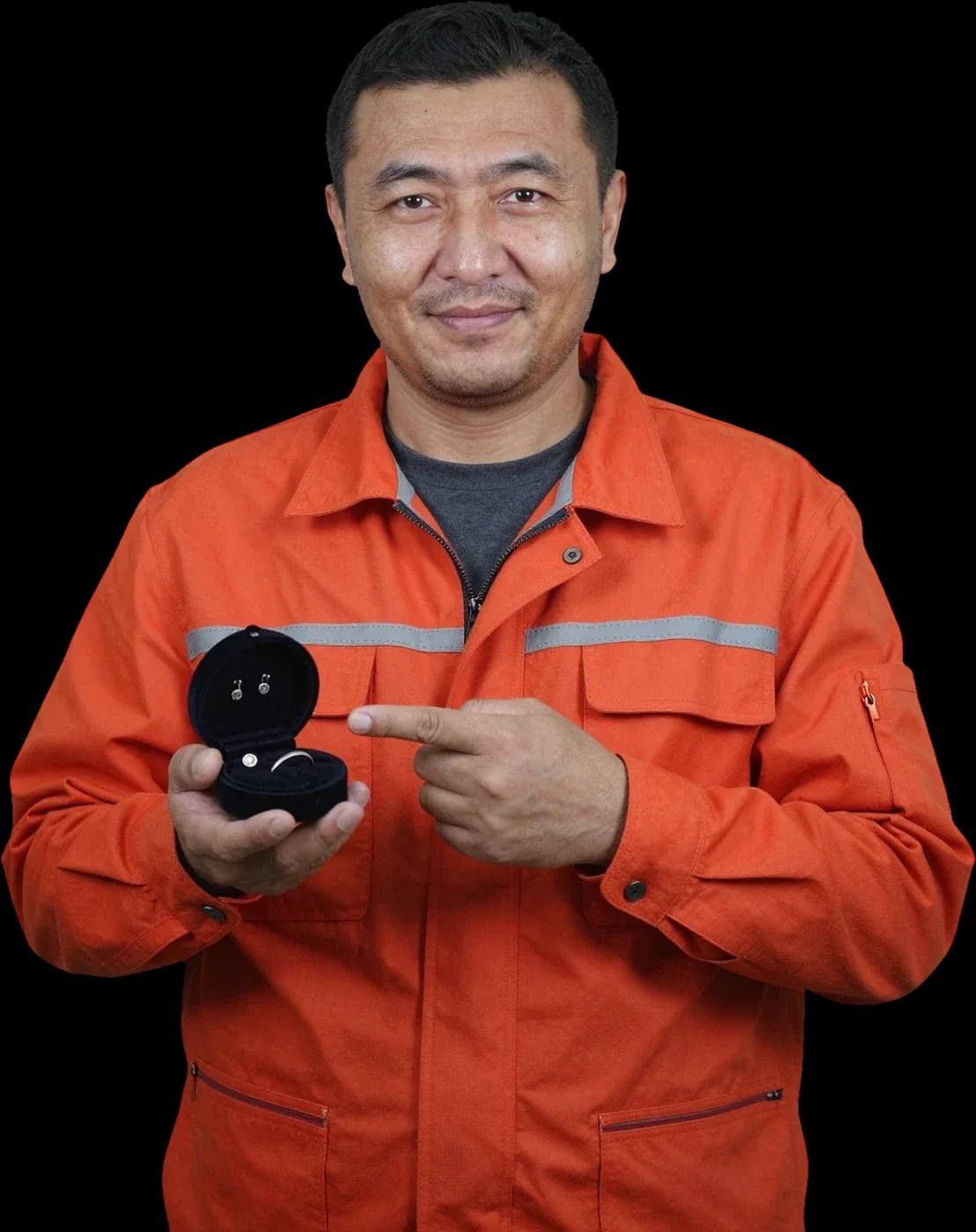
Tech Service provides jewelry repair in Astana as a direct contractor: a technician comes to your home or the work is done at our service center. Diagnostics are free, the technician arrives within 60 minutes anywhere in the city, and there is a 1-year warranty on labor and parts. The technician gives you the price after diagnostics.
What to do when something breaks and how jewelry repair is done
Every piece of jewelry breaks in its own way, and that determines what to do first. Let's go over common cases and what to do about them.
A chain broke or a bracelet snapped
We solder broken chains and bracelets made of gold and silver, and if a link breaks, we replace the damaged link with a new one. Jewelry repair in Astana most often starts with requests like this: thin chains can't handle the load when pulled, and clasps and carabiners loosen from daily removal. The specialist examines the break, checks the strength of neighboring links and the condition of the clasp, then decides whether to solder or replace the element. If the break is at a thin link near the clasp, soldering without replacing the link will quickly lead to another break in the same spot — so we first look at where the piece failed under load, rather than just joining the ends. On thin gold chains, it's wiser to replace the weakened link right away than to come back to the same spot again.
A stone fell out of a ring or earrings
We set fallen stones back into the piece and check whether the other settings nearby still hold. Rings and earrings with precious and semi-precious stones have settings that wear out over years without the owner noticing: first there's a wobble, then the stone falls out during ordinary hand movement. The specialist examines the seat, assesses the condition of the setting itself and neighboring stones, and re-sets them if needed. If the stone is lost, we discuss with you what to replace it with and what size will fit the seat. A stone doesn't fall out on its own — it's due to a loose or worn setting, so we check all nearby stones; otherwise the next one will fall out soon and you'll have to come back.
A ring is bent or cracked
We straighten a bent ring and solder a crack if the metal at the damaged spot still has thickness. This also applies to wedding rings that bend under stress on a thin band: narrow models lose their shape even from a sharp removal from the finger, and a crack appears where the metal has worn down to the base. The specialist looks at the geometry of the piece, checks whether the crack has spread further around the circumference, and assesses the metal reserve along the entire band. If the crack runs through a thin part or the metal is worn, soldering won't last long, and we'll honestly tell you when it's more reliable to redo the section rather than patch it. A technician's visit anywhere in the city takes 60 minutes, so the ring can be examined and assessed at your home.
How jewelry repair proceeds step by step
Jewelry repair follows clear stages, and at each one the client understands how the piece is being handled. Here's the sequence from the first inspection to checking the result.
Free diagnostics and approval of work
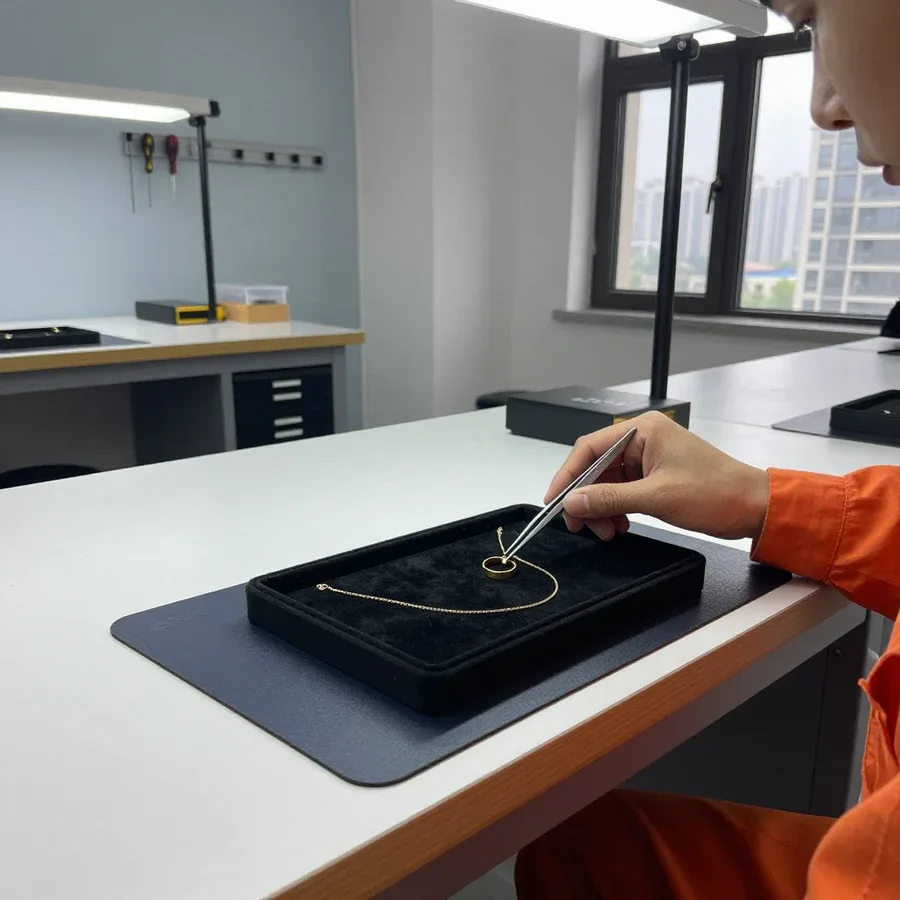
Diagnostics are free, and the technician gives you the price after them, when it's clear which operations the piece needs. During the inspection, they check the condition of the metal, stone settings, clasps and carabiners, note cracks and scuffs, and then explain what work is needed and in what order it will be done. Jewelry restoration in Astana starts with this step, because the appearance of a piece doesn't always show where its integrity is compromised. Work is approved with the client before any action: the technician specifies which part will be soldered, which re-set, and which replaced, and only then begins. It's important to show the technician all damage at once during the inspection, including minor ones the client thinks are unimportant, because a hidden crack near the soldering area can show up after the work is done.
Soldering, stone setting, and replacement of damaged elements
In our work, we solder metal, set stones, and replace damaged elements, and we agree on the scope of work with the client before any action. Soldering and welding metal require precise heating: overheating deforms a thin ring, while underheating produces a weak joint, so the technician selects jewelry solder for the specific alloy and thickness of the piece. Setting and re-setting stones is a separate operation: first, the fit in the setting is checked, then the prongs are tightened so the stone stays secure and doesn't wobble. Replacing chain links, clasps, and carabiners is needed when the metal in the joint is already fatigued and soldering would not last long. Soldering and stone setting require different heating and different tools, so the technician first determines which part of the jewelry is damaged and avoids soldering where replacing the element is more reliable.
Checking the result together with the client
We check the finished piece together with the client so they can see whether the clasp holds, the stone sits properly, and the work area looks good. The result check includes several steps: the technician opens and closes the clasp several times, checks that precious and semi-precious stones are not loose in their settings, examines the seam against the light, and assesses whether the shape of the jewelry is preserved. At this moment, the client holds the piece and makes sure the chain doesn't catch on clothing and the ring fits the finger as before. We provide a 1-year warranty on labor and parts, so it's best to voice any comments about the result right away during this check. It's worth checking not only the repaired area but the entire piece, since after soldering or replacing a link, the load on neighboring elements changes.
Jewelry repair at home and technician visits
You can have your jewelry restored without leaving your apartment or take it to the service center. Let's look at how the two formats differ and when each is more convenient for the owner of a ring, chain, or earrings.
How a technician visit to your home works
We come to the client's home anywhere in the city, and a technician visit takes 60 minutes, so there's no need to go to the workshop. The visiting technician performs free diagnostics right on the spot: checks the clasp, the condition of the links, and the fit of stones in their settings. At the client's home, the specialist discusses the scope of work and explains which operations require heating and precise setting in the service center. This format is convenient when the jewelry is precious as a memory, because the owner doesn't want to let it out of their hands for long. Based on the inspection, the technician outlines the plan, quotes the price after free diagnostics, and agrees with you on which operations will be done at the service center and which will be discussed separately. If the jewelry has multiple damages, the technician immediately notes what can be done on-site and what requires work at the service center.
Service center work without a visit
If it's more convenient to bring the jewelry yourself, we accept it at the service center and perform the restoration there. At the service center, we do soldering and welding of metal, setting and re-setting of stones, straightening of deformed shanks, replacement of clasps — operations that require precise work with metal and stones. A technician visit within 60 minutes anywhere in the city is convenient when the item needs to be inspected on-site, while the service center handles items with multiple damaged elements at once. At intake, the jewelry is examined, free diagnostics are performed, and the work is agreed upon, and the completed repair is covered by a 1-year warranty — both on labor and on parts. You can pay via Kaspi QR, Kaspi Red, bank card, cash, or bank transfer for companies. If the jewelry has multiple damages at once, it's more convenient to examine it entirely at the service center and agree on a single work plan than to deal with each defect separately.
What to choose in your case
| Type of damage | On-site visit | Repair at the service center |
|---|
| Broken chain or bracelet | Inspection and diagnostics on site | Soldering or link replacement |
| Loose or fallen stone | Inspection and setting assessment | Setting and checking neighboring stones |
| Bent or cracked ring | Diagnostics and approval | Straightening and soldering |
| Broken clasp | Clasp inspection | Clasp replacement or repair |
| Multiple damages at once | Inspection and work plan | Full repair of the item |
Warranty and how to choose a technician
Jewelry is often valuable not for its metal but for the memories it holds, so choosing a technician is first and foremost a matter of trust. Here's what to look for and what the warranty covers.
What the 1-year warranty covers
We provide a 1-year warranty on labor and parts, so if the work or a replaced part fails, the issue is resolved under this commitment. Coverage applies to soldering chain links, installing new clasps and carabiners, and setting stones—operations where the result depends on the technician's care and the quality of the part. The warranty on labor and parts works as a whole: you won't have to prove separately that the seam is at fault and not the stone, or vice versa. But any such commitment is only useful when the specialist has explained in advance which operations and parts it covers, so it's worth clarifying this list during the free diagnostics. Ask what exactly is included in the 1-year warranty on labor and parts, and in which cases a claim is appropriate. That way you know the boundaries of the commitment in advance and don't have to figure them out after the repair.
How to tell if a technician can be trusted with your jewelry
A reliable technician first inspects the entire item and explains why they will do it this way and not otherwise, rather than quoting blindly. During the free diagnostics, you can see whether the person handles the jewelry carefully, checks the setting of neighboring stones, and examines the clasp and links near the break—these details show whether they are working with the piece or just the damaged spot. Agreeing on the scope with the client before starting work is another sign: the specialist spells out which part they will replace and which they will leave, and waits for your decision. If they are ready to show exactly where the damage is and how they plan to fix it, that says more about their understanding of the material than any promises, and a refusal to explain details is a reason to be wary.
Technician experience and direct contractor
Our technicians have 4 to 20 years of experience, and Tech Service is a direct contractor, not an aggregator or intermediary. A jewelry specialist who accepts the item and restores it personally is fully responsible for the result. The jewelry stays in the same hands from inspection to final check with the client, and the technician sees the entire history of the item, not just a single operation. All stages of working with the jewelry are coordinated with each other, and the technician sees the item as a whole from inspection to verification. When the same service center that accepts the item also does the work, responsibility for the result isn't diluted between subcontractors, and there's someone to hold accountable for the outcome. A practical tip: ask in advance who will be handling your item so you can be sure there's a single point of responsibility.
Materials and working with customer's gold
Jewelry is made from various metals and with different coatings, and the material determines how the item will behave during restoration. Here's what we work with and what's important to preserve.
Gold and silver
We work with both gold and silver, so we can repair a gold chain or a silver piece, not just items made of a single metal. Gold comes in different purities, silver with or without rhodium plating, and each combination requires its own soldering temperature. Jewelry solder is matched to the specific alloy: too high-melting will burn through a thin link, too low-melting will produce a seam that won't hold up to pulling. Silver oxidizes faster when heated, so after soldering the seam gets additional treatment, otherwise a dark spot will remain on the light metal. Gold and silver behave differently when heated, so the technician selects the soldering mode for the specific metal, otherwise a noticeable mark will be left on the piece. In my view, it's the neatness of the seam that distinguishes work you're not ashamed to show from work where the solder joint is visible at first glance.
Customer's gold jewelry
We take in the customer's gold jewelry, so we can alter or repair a piece you already own. The purity stays the same: we don't replace the metal with another or change the alloy without the owner's approval. Before starting, the technician assesses exactly where the crack or break is and which area will need heating. Alteration is a separate matter: an old ring can be turned into a pendant or resized, and here it's important to understand in advance whether the piece itself has enough metal for the intended work, because that determines whether it can be done without adding new metal. The technician discusses all changes before soldering begins—so the owner knows what the final result will be.
Enamel and engraving
During restoration we preserve enamel and engraving if the damage doesn't affect the coating or inscription itself. Colored enamel on a ring or pendant is a glassy layer that cracks and loses color when overheated, and restoring it is harder than the metal itself. Engraving with a name or date burns from high temperature, and the fine lines of the inscription become illegible. The technician first checks where the heating zone falls relative to the decoration and, if necessary, plans the work so that the metal near the enamel isn't heated directly. Enamel and engraving are the most vulnerable parts of a piece when heated, so the technician decides whether the metal near them can be heated or whether the work should be planned to avoid the coating. The technician warns the owner about risks to the decoration before starting work.
Where to repair jewelry in Astana and how to call a technician
If your jewelry breaks, it's important to quickly figure out where to go and how to call a specialist. We've gathered the key points you'll need before making the call.
How to call a technician in Astana
We cover the whole city: you can call a specialist to your home or bring the jewelry to the service center, and a technician visit takes 60 minutes. The visiting technician performs an inspection and free diagnostics, so the inspection and scope approval happen right at your home. This format is more convenient when you don't want to transport the piece across town and worry about the stones' safety on the way. We're not intermediaries—our own technician comes to your home and sees the job through to the result. Before calling, it's worth photographing the damage and describing how it happened, so the specialist understands the nature of the break in advance and doesn't waste time on a repeat inspection. If the jewelry is precious as a keepsake, tell us in advance: the technician will take that into account during the inspection and discuss every step of the work with you.
Payment procedure and cost after diagnostics
The technician gives you the price after a free diagnostic, once it's clear what work is needed, and you can pay via Kaspi QR, Kaspi Red, bank card, cash, or bank transfer for companies. Diagnostics are free both at your home and at the service center: we inspect the clasp, links, stone settings, and surrounding elements to assess the full scope. The cost depends not only on the type of damage but also on the metal, the presence of stones, and the condition of adjacent elements, so the technician quotes it after the inspection. The technician gives you the price after a free diagnostic so you understand the scope of the upcoming work. You can pay via Kaspi QR, Kaspi Red, bank card, cash, or bank transfer for companies, so you choose how to pay. A thorough inspection helps spot a hidden crack near the soldering area right away, rather than after the piece is back in use.
What to clarify before repair
- Type of damage: describe the circumstances and when it happened — this helps the technician understand the nature of the damage in advance.
- What to preserve: specify whether the enamel, engraving, or a particular stone is important so they aren't touched during the work.
- Warranty: ask what cases are covered by the 1-year warranty on labor and parts.
- Cost: clarify what amount is quoted after the free diagnostic, before work begins.
- Format: decide whether a technician visit to your home or service at the center is more convenient.
What to know before jewelry repair
We've covered the main factors that determine the outcome of jewelry restoration — from the type of damage to the choice of service format and the item's material — so you understand the process before contacting a technician.
- The type of damage determines the approach: a broken chain is soldered or a link is replaced, a fallen stone is reset, a bent ring is straightened.
- Diagnostics come first: inspecting the entire item reveals hidden damage near the work area.
- The format is chosen based on the situation: a home visit is convenient for inspection, while at the workshop it's easier to handle multiple damages at once.
- The warranty matters as a standard: a year on labor and parts provides clear boundaries if something goes wrong.
- Material affects the result: gold, silver, enamel, and engraving require different approaches, and this should be discussed before work begins.






 experience11 years
 experience10 years
 experience11 years
 experience11 years
 experience16 years
 experience8 years
 experience12 years
 experience10 years
 Refrigerator Repair in Almatyfrom 3 000 ₸
 Washing Machine Repair in Almatyfrom 3 000 ₸
 Dishwasher Repair in Almatyfrom 3 500 ₸
 Oven Repair in Almatyfrom 3 000 ₸
 Cooktop Repair in Almatyfrom 3 500 ₸
 Air Conditioner Repair in Almatyfrom 3 500 ₸
 Boiler and Water Heater Repair in Almatyfrom 2 500 ₸
 Freezer Repair in Almatyfrom 6 000 ₸
 Tumble Dryer Repair in Almatyfrom 5 000 ₸
 Coffee Machine Repair in Almatyfrom 2 500 ₸
 Robot Vacuum Cleaner Repair in Almatyfrom 3 500 ₸
 Vacuum Cleaner Repair in Almatyfrom 1 500 ₸
 Microwave Oven Repair in Almatyfrom 2 000 ₸
 Hair Dryer Repair in Almatyfrom 1 500 ₸
 Iron Repair in Almatyfrom 3 000 ₸
 Electric Kettle Repair in Almatyfrom 2 500 ₸
 Mixer Repair in Almatyfrom 2 500 ₸
 Multicooker Repair in Almatyfrom 500 ₸