Регина Ф.Order No. 71503 · 27 December 2025
oursПришёл по совету коллеги, у него тут чинили ноут. Работу закончили раньше срока. Третий месяц — никаких проблем)
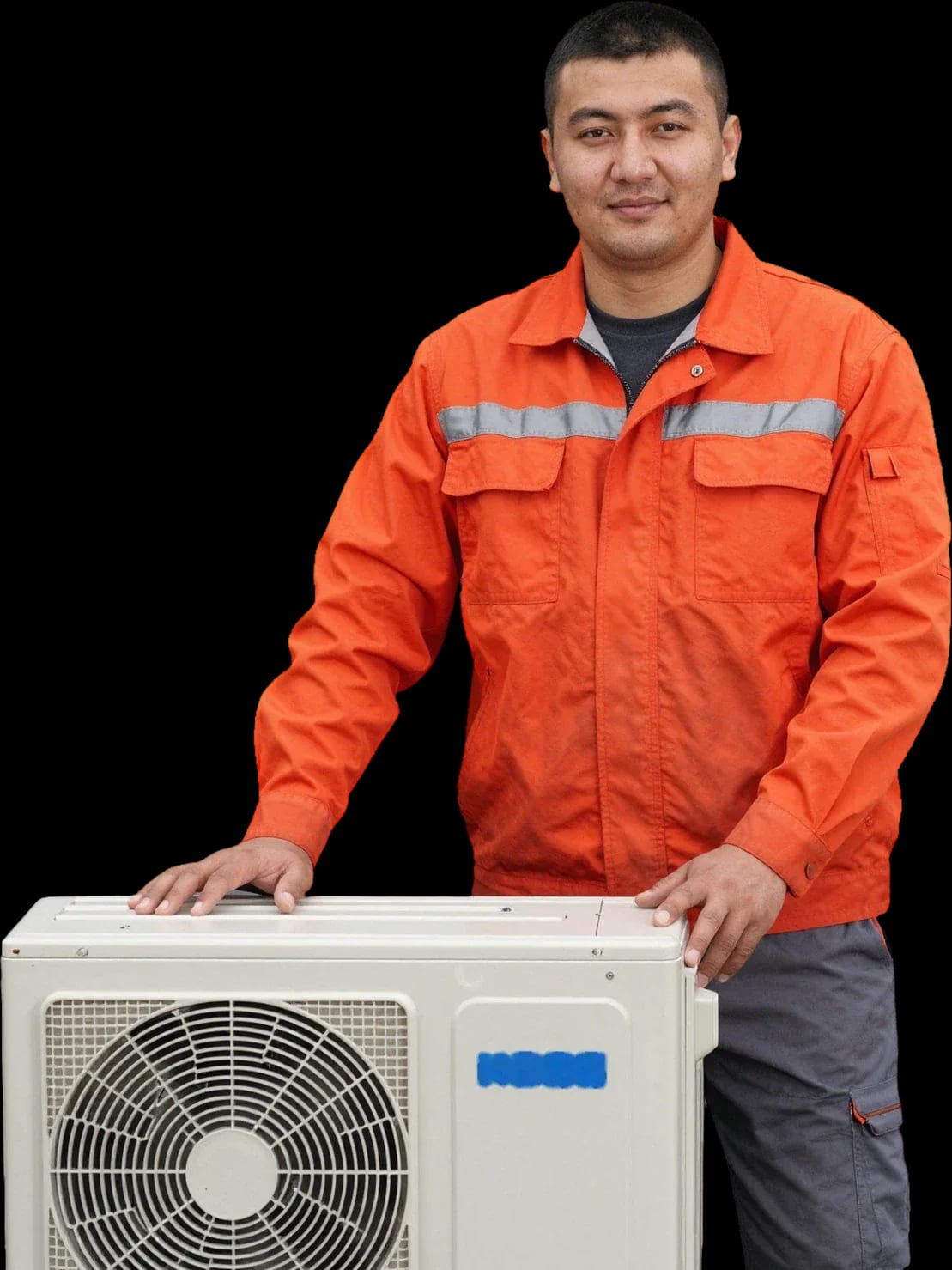
A technician arrives within 60 minutes anywhere in the city. Free diagnostics, final price after inspection.
Our own technicians4 to 20 years of experience




Repair prices
Symptoms customers most often report. The exact cause is identified by the technician after free diagnostics.
power, board, button
from27 500 ₸
lock, actuator, board
from27 500 ₸
seal, hoses, pump
from12 500 ₸
heating element, sensor, thermostat
from12 500 ₸
fan, mount, bearing
from22 500 ₸
code points to a component
from12 500 ₸
compressor, refrigerant, sensor
from12 500 ₸
thermostat, board, relay
from27 500 ₸
1 visittime
from 12,500 ₸cost
 BeforeAfter
Five steps from request to performance check.
We take your request by phone or WhatsApp, clarify the symptom and rooftop model.
The technician arrives anywhere in the city and inspects the rooftop equipment.
The technician explains what the estimate includes and offers parts options to choose from.
You confirm the scope of work and the part, and the technician starts the repair.
The technician explains how to operate the rooftop unit after turning it on and what to watch for.
We reply during working hours
Describe the symptom and rooftop model in your message so the technician brings the right tools.

Warranty question? Call us
+7 (778) 021 11 78 experience10 years
Air conditioner refill technician
 experience2 years
Air conditioner cleaning technician
 experience14 years
Air conditioner chemical cleaning specialist
 experience15 years
Mobile air conditioner technician
 experience15 years
Lead HVAC specialist

Author: Erlan Zh.,Air conditioner refill technician
Published
Updated
Tech Service repairs rooftop units in Astana with its own technicians: on-site arrival within 60 minutes anywhere in the city, free diagnostics, and a 1-year warranty on labor and parts. The technician inspects the rooftop air conditioner on site, identifies the cause and provides the cost after diagnostics. You can pay via Kaspi QR, Kaspi Red, bank card, cash, or bank transfer for companies.
A rooftop unit rarely breaks down suddenly—every symptom has a chain of causes. We break down the most common complaints from facility owners and what's behind them.
Most often, weak cooling is caused by refrigerant leaks, dirty heat exchangers, or reduced compressor performance—not a controller failure. The compressor is responsible for compressing refrigerant in the circuit: when its performance drops, discharge pressure falls, and cooling weakens throughout the building. A clogged condenser prevents heat from being released into the atmosphere, and an evaporator with ice buildup doesn't absorb heat from the space—in both cases, the picture is the same as with low refrigerant. A leak shows up gradually: first the unit runs longer, then it stops reaching setpoint, and an oil trace appears on the pipes. Before calling a technician, check the filters and condenser cleanliness—a clogged heat exchanger produces the same symptoms as low refrigerant but is fixed with routine cleaning.
An error code on the rooftop unit controller points to a component group, not a specific part—the same compressor code can mean either pressure protection or winding wear. The control board collects temperature and pressure sensor signals, detecting when a parameter goes beyond acceptable limits. Then you need to analyze the conditions: a high-pressure fault indicates a dirty condenser or a failed fan; a low-pressure fault indicates a leak; a compressor current fault indicates mechanical wear. Don't replace the board based on the first code: most faults come from the refrigerant circuit, not the electronics. Note the code and the conditions when it appeared (outdoor temperature, mode, time of day)—this speeds up diagnostics and helps the technician arrive prepared.
Water on the roof usually comes from a clogged or frozen drain line, and winter freezing is related to a malfunction in the heat exchanger defrost cycle. The sharply continental climate with frosts and thaws in a single season tests the drainage system: condensate in the pipe freezes, ice blocks the drain, and water overflows the pan onto the roof. Evaporator freezing with a working defrost cycle is almost unheard of—if ice builds up again, look for a fault in the defrost cycle, sensor, or timer. Separately, check the circuit's tightness: a microcrack in a braze joint causes both moisture in the pan and a gradual loss of cooling, and both signs don't appear immediately. If the drain is clear but water keeps appearing, check the pan slope and circuit tightness—a recurring leak almost always points to a second, hidden cause.
| Symptom | Likely cause | What the technician checks |
|---|---|---|
| Not cooling | refrigerant leak, clogged condenser | circuit pressure, heat exchanger cleanliness |
| Water leaking on the roof | clogged or frozen drain | drain patency, pan slope |
| Noisy or vibrating | worn fan bearings | condition of fans and mountings |
| Showing an error code | pressure or sensor protection | controller and sensor readings |
| Won't turn on after winter | freezing, control system fault | defrost, electrical components, setpoints |
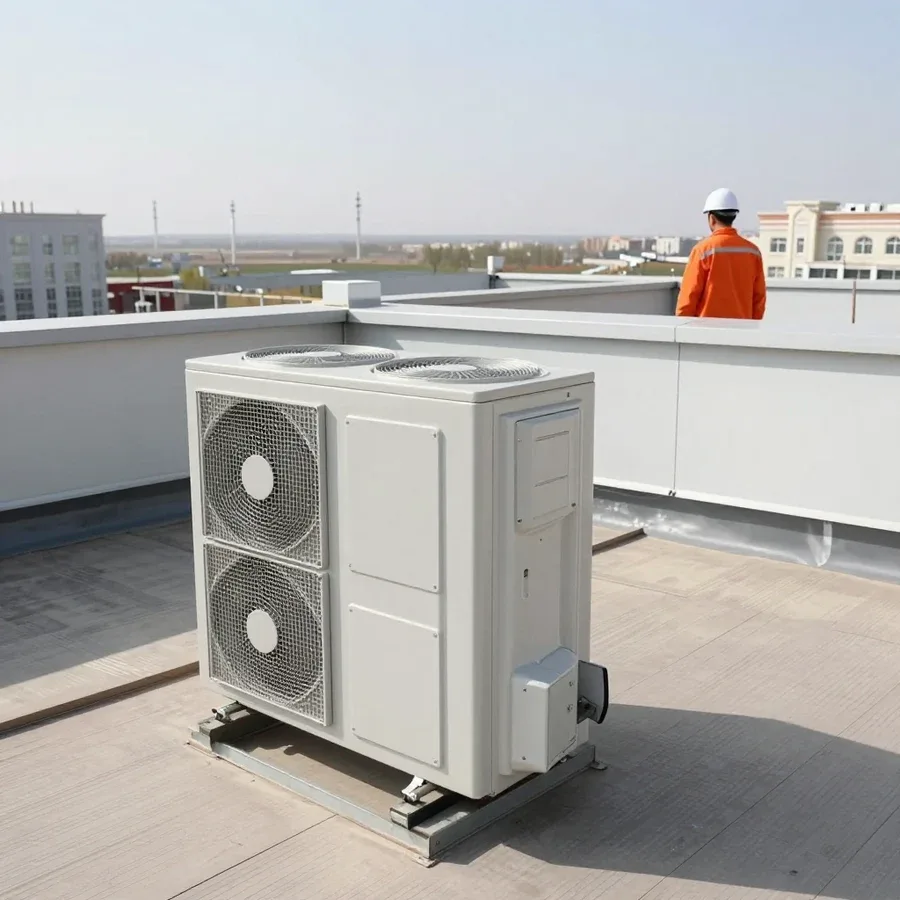
Roofop repair almost always starts on the roof, not in the workshop: first the technician sees the unit in operation and the operating conditions, and only then decides whether to fix it on site or remove the component.
We arrive on site within 60 minutes anywhere in the city, and diagnostics are free — the technician inspects the roofop on the roof, takes readings from the controller, and identifies the cause before any work begins. During the inspection, we check circuit pressure, the condition of filters and heat exchangers, drainage, mountings, and the electrical part: on a roofop these components are interconnected, and one clogged section often explains several symptoms at once. Roofop repair in Astana starts with exactly this kind of inspection, so the technician immediately sees which components need attention. Our technicians have 4 to 20 years of experience, so they recognize typical rooftop air conditioner damage by appearance and readings without disassembling the entire unit. For the inspection, it helps to arrange roof access and provide at least a brief history of the breakdown — this saves time and allows the technician to bring the right tools right away.
We fix most faults right on the roof; removal is needed when the problem is in a component that cannot be properly restored on site. Replacing a contactor, sensors, control board, cleaning and restoring drainage, straightening air ducts and mountings — these are jobs that don't require removing the unit. Roofop maintenance in Astana with on-site visits is convenient because it doesn't stop the building's operation during transportation: the rooftop air conditioner keeps serving the sales floor or warehouse while the technician works nearby. Removal is discussed separately when the cause is in the compressor, heat exchanger, or frame — then the component is removed and taken to the workshop, and on site we agree on how the facility will operate without it. The decision to remove is made after diagnostics and agreed with the owner — sometimes it's simpler and more reliable to remove the component than to try to restore it in the field.
Restoration makes sense when an individual component is worn out but the casing and heat exchangers are in working condition; replacement makes sense when several key components are systematically worn at once. A roofop is installed on the roof of a building and serves large areas, so replacing it means not only a new unit but also lifting equipment, reworking the base and air ducts, and sometimes reinforcing the roof's load-bearing elements. Industrial climate equipment maintenance pays off as long as the compressor, casing, and heat exchange blocks are alive: restoring one component is cheaper and faster than a full replacement cycle. Signs of systemic wear — corrosion on the frame, repeated refrigerant leaks in different parts of the circuit, cracks in the heat exchanger — mean that spot repairs only buy time. You need to count not only the work but also future downtime — an old roofop with recurring breakdowns costs more than it seems at first glance.
Diagnostics is not a formality before the bill but a way to understand exactly what broke. Here's what it includes, in what order components are checked, and what determines the final cost.
Our diagnostics are free: a specialist checks compressor operation, circuit pressure, the condition of heat exchangers, drainage, and controller readings, and then names the cause. The inspection follows the closed refrigerant circuit — from evaporator to condenser — with checks of the electrical part and condensate pan. This walk-through of components takes less time than disassembling each block one by one and immediately shows the overall condition of the unit. Separately, the engineer looks at error codes on the controller and compares them with the actual behavior of the components — the memory log doesn't always match the real fault. On-site diagnostics reveal not only an obvious breakdown but also wear that isn't causing symptoms yet — this allows planning work in advance rather than in emergency mode.
The technician gives you the price after a free diagnostics — it depends on the faulty unit, the scope of work, and the parts needed, not on an average figure for the city. The same symptom on different units leads to different work: a clogged filter, a leak in the circuit, and compressor wear each require a different set of operations and parts. We accept Kaspi QR, Kaspi Red, card, cash or bank transfer for companies, so the payment arrangement is discussed on site. The estimate includes only the operations actually needed to fix the identified cause: replacing a unit and recharging the circuit are separate line items, and they shouldn't be confused. Ask for the price before work begins and get the list in writing — that way it's easier to understand what you're paying for and to compare it with the alternative of replacing the unit.
Recharging isn't something you do on a schedule — it's needed when the circuit is actually low on refrigerant. A refrigerant shortage almost always means there's a leak that needs to be found. Refrigerant circulates in a closed loop between the evaporator and condenser, and in a properly working system its amount doesn't change from season to season. If pressure drops, the first step is to find the leak — at connections, flare fittings, heat exchangers — fix it, and only then top up the circuit to the correct level. Scheduled maintenance also includes cleaning heat exchangers and flushing the drain, checking the electrical system, and tightening connections. Recharging a rooftop unit with refrigerant in Astana without first looking for a leak is work that doesn't address the cause. If a technician suggests simply topping up the circuit without finding the leak, the problem will come back next season.
| Step | What we check | Why |
|---|---|---|
| 1 | Controller readings and error codes | narrow down the units before disassembly |
| 2 | Filters and heat exchanger cleanliness | rule out a simple performance drop |
| 3 | Drain and drain pan | find the cause of leaks and condensation |
| 4 | Circuit pressure and refrigerant | tell a leak from compressor wear |
| 5 | Compressor and electrical components | confirm or rule out the unit as the cause |
For a facility owner, it's not just about how fast the problem is fixed — it's about who's responsible for the result. Here's how our commitments work, what they cover, and why responsibility for a rooftop unit isn't passed on to third parties.
We provide a 1-year warranty on labor and parts — if the same unit fails again after repair, we'll fix it under warranty. This covers the exact component the technician worked on: the compressor, control board, fan, or circuit. The one condition is that the failure must be related to the work performed, not to new damage or external impact. Our commitments only work with a clear list of work, so it's important to agree with the technician on exactly what was repaired and which parts were replaced. Without such a list, any claim turns into a dispute about whose unit it is and when it broke. In my view, honest commitments start not with a piece of paper but with precise wording before work begins.
We take responsibility for the repair ourselves: Tech Service is a direct provider with its own technicians, not an aggregator that passes the request to a third party. Our specialist comes to the site, performs the diagnostics, does the work, and remains accountable for the result. We don't have a "dispatcher — contractor — subcontractor" chain where information about what was actually done to the equipment gets lost at every step. When an intermediary takes the request, you have to look for the warranty from the contractor — with a direct provider, responsibility and obligations are in the same hands. This is especially noticeable if the fault repeats: you don't have to figure out who in the chain made the mistake — the issue is closed by the one who was on the roof.
Our technicians have 4 to 20 years of experience, and this directly affects repair quality — correct diagnostics on the first visit saves the owner both time and money. A specialist with this kind of practice knows by heart the typical symptom combinations for rooftop units: why there's no cooling when the compressor is running, where ice on the evaporator comes from, what's behind a code on the controller. An experienced technician is less likely to replace working components "just in case" — he pinpoints the cause more accurately, which means the scope of work ends up smaller. In our practice, this is noticeable at sites that have gone through several contractors before us: most often the problem wasn't the hardware but an incorrectly set diagnosis. So the length of the warranty isn't the main thing; the main thing is the qualification of the person giving it.
Searching for rooftop unit repair turns up plenty of maps and directories, but they don't always have a real provider behind them. Here's how a direct service differs from an intermediary and why it affects the result.
A direct provider comes to the site and is accountable for the result, while an aggregator only passes the request along — and the quality of work then depends on an unknown contractor. Rooftop unit maintenance in Astana is handled by our own technicians with 4 to 20 years of experience: they also perform free diagnostics and provide a 1-year warranty on labor and parts. An aggregator often takes the request by phone, hands it to a third-party crew, and redirects warranty claims to them — and you have to sort out the quality all over again. We remain the single point of responsibility: the person who came to the roof is accountable for both diagnostics and the repair. Ask who exactly will come and who provides the warranty — if the answer is vague, you're most likely dealing with an intermediary.
We service rooftop air conditioners and industrial climate control equipment at sites in Astana — from household splits to rooftop units installed on building roofs. When working with a rooftop unit, what matters isn't just the cooling unit itself but the whole setup: compressor, condenser, fans, drainage, automation, and the controller that displays the error code. Industrial climate control equipment for stores, business centers, and warehouses is more complex than household units, so a technician needs experience with different brands and configurations — from common models to niche ones. If the equipment is rare or old, it's worth specifying the model in advance — this helps the technician prepare and avoids wasting the visit on clarifications. Give the brand and error code over the phone so the specialist who comes to the site is trained for your type of equipment.
We arrive at the site within 60 minutes anywhere in the city — for a business center or store where a rooftop unit is responsible for the climate, this is critical. In summer, when it's hot outside, a rooftop air conditioner stopping quickly becomes a problem for staff and visitors, so response speed matters more than it seems when choosing a provider. We work with legal entities using Kaspi QR, Kaspi Red, card, cash or bank transfer, and free diagnostics lets you first understand the cause and scope of work. For sites with continuous operation, it's worth discussing in advance which components are more important to keep in reserve — this reduces the risk of downtime in the heat. In our practice, at sites with a constant flow of people, it's the backup circuit and timely calls to a technician that save the most.
The sharply continental climate puts a double load on rooftop units — freezing cold in winter and intense heat in summer. Here's how routine maintenance reduces the risk of breakdowns and extends the life of key components.
A rooftop unit differs from a split system in scale and roof access, and in the local climate it also runs at its limit in both frost and heat — which speeds up component wear. A split system serves one room and mounts on a wall, while a rooftop unit moves large volumes of air through a powerful compressor and heat exchangers that face dust, snow, and temperature swings outside. In cold weather, metal and seals contract; in warm weather, they expand — this cycle repeats dozens of times per season, and microcracks in the circuit's solder joints show up precisely during these transitions. Spring dust storms clog the heat exchanger fins, and summer heat pushes circuit pressure to its peak. The greater the temperature difference, the more important the condition of the heat exchanger and drainage — they are the first to react to seasonal loads.
| Component | What we check | Sign of wear |
|---|---|---|
| Heat exchangers | fin cleanliness and contamination | reduced cooling, overheating |
| Filters | clogging and integrity | weak airflow |
| Drainage | flow and pan slope | water on the roof, condensation |
| Circuit | pressure and refrigerant level | icing, pressure errors |
| Controller and electricals | sensor readings and setpoints | false error codes |
Service frequency depends on the load on the facility and the condition of the equipment — for a rooftop unit running year-round, preventive maintenance is usually scheduled before the hot season and before the cold. Load depends on how much air the unit moves and how dusty the area is: at a site near a busy road, filters clog noticeably sooner than in a quiet suburb. The capital's sharply continental climate stresses the rooftop unit in both frost and heat, so one annual check is often not enough — components wear out between visits. A pre-summer inspection reveals dirty heat exchangers and weak drainage, while a pre-winter inspection checks the condition of seals and the circuit. If the rooftop unit has already had failures, the interval between checks should be shortened — recurring errors indicate faster-than-normal wear.
The observations gathered on rooftop units boil down to a few practical rules — they help you find the cause faster and avoid overpaying for unnecessary work.
Tech Service technicians repair other appliances too — with the same 1-year warranty on labour and parts.
 Refrigerator Repair in Almatyfrom 3 000 ₸
 Washing Machine Repair in Almatyfrom 3 000 ₸
 Dishwasher Repair in Almatyfrom 3 500 ₸
 Oven Repair in Almatyfrom 3 000 ₸
 Cooktop Repair in Almatyfrom 3 500 ₸
 Air Conditioner Repair in Almatyfrom 3 500 ₸
 Boiler and Water Heater Repair in Almatyfrom 2 500 ₸
 Freezer Repair in Almatyfrom 6 000 ₸
 Tumble Dryer Repair in Almatyfrom 5 000 ₸
 Coffee Machine Repair in Almatyfrom 2 500 ₸
 Robot Vacuum Cleaner Repair in Almatyfrom 3 500 ₸
 Vacuum Cleaner Repair in Almatyfrom 1 500 ₸
 Microwave Oven Repair in Almatyfrom 2 000 ₸
 Hair Dryer Repair in Almatyfrom 1 500 ₸
 Iron Repair in Almatyfrom 3 000 ₸
 Electric Kettle Repair in Almatyfrom 2 500 ₸
 Mixer Repair in Almatyfrom 2 500 ₸
 Multicooker Repair in Almatyfrom 500 ₸
Air conditioner errors are codes on the display or flashing indicators that show which component has failed.
5 March 2026 · 12 minutes read
Gas boiler errors are codes on the display or a flashing indicator that point to a specific component: ignition, pressure, draft, sensor, or control board.
10 February 2026 · 11 minutes read
If your air conditioner is leaking, first turn it off and cut the power, place a container under the drip, and move any wiring away from the water.
19 October 2025 · 12 minutes read