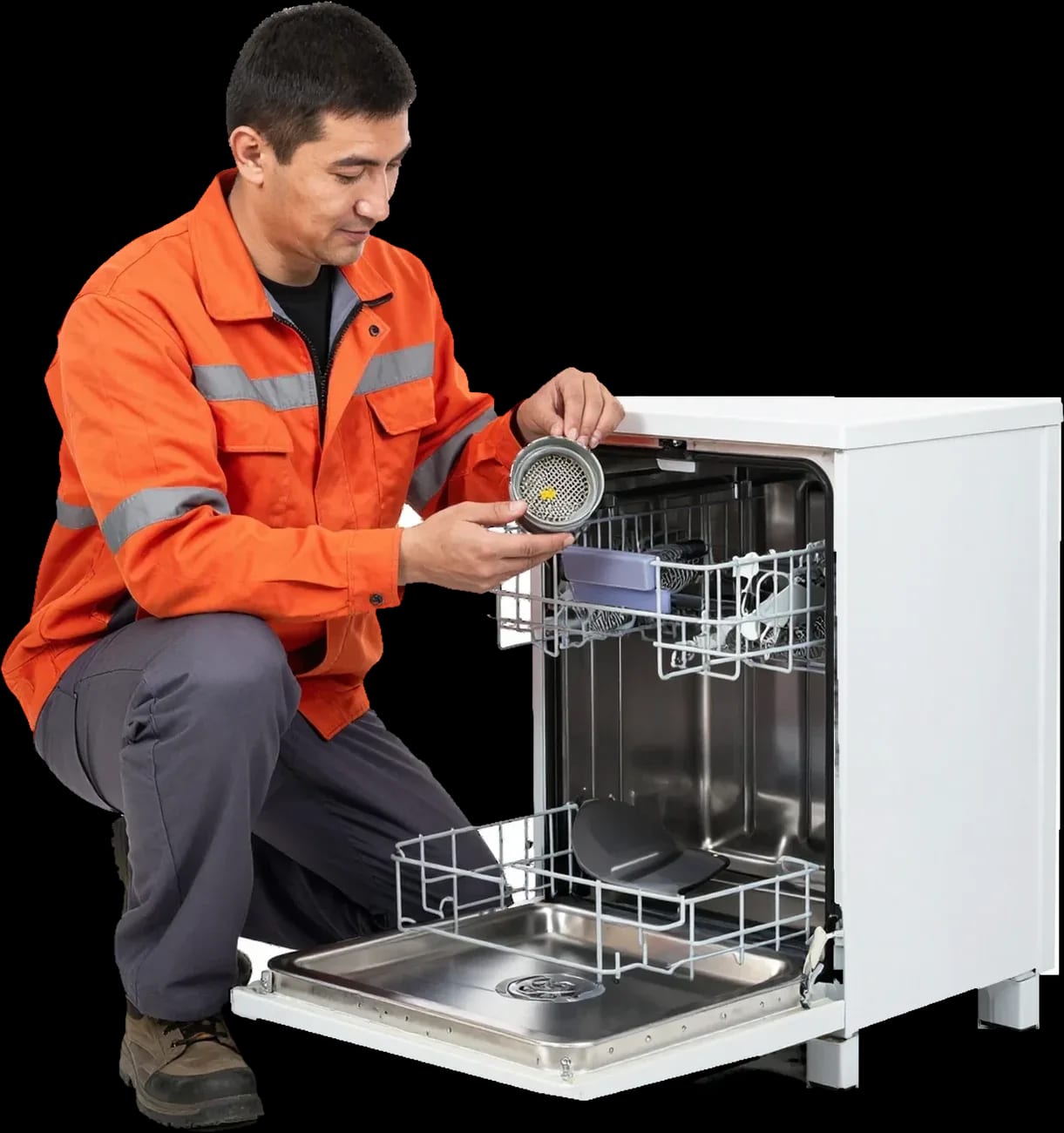

Why Your Dishwasher Won't Drain and What Exactly Breaks
If your dishwasher won't drain, the most common culprits are a clogged filter or drain hose; less often, it's the pump, impeller, or water level sensor. At Tech Service, diagnostics are free, a technician arrives within 60 minutes in the city, and we provide a 1-year warranty on labor and parts.
Draining in a dishwasher is a chain of components: filter, hose, pump, and sensor. If one link gets clogged or fails, water stays in the sump. Let's go through the causes from most common to rare.
Why Water Stays in the Sump
In most cases, the appliance doesn't drain because of a clog: grease and food particles block the filter mesh or the drain hose, and the water simply has nowhere to go. The mesh gets coated with an oily film, crumbs and coffee grounds stick to it, the passage narrows — the pump pushes water, but it flows back into the sump. The same substance mixed with food scraps accumulates in the drain hose, and it can also kink if the appliance is pushed too close to the wall. The buildup grows gradually, so for the first few weeks the machine drains more slowly rather than stopping completely — that slow drainage is the point when cleaning can still solve the problem without a repair. The sooner you remove the mesh and wash off the grease, the better the chance you can avoid disassembling the body and replacing parts.
Drain System Components and Their Typical Failures
| Component | What it does | Typical failure | Symptom |
|---|---|---|---|
| Drain filter | traps food and grease | clogged with greasy mesh | water drains slowly or stands |
| Drain hose | carries water to the drain | clog or kink | water doesn't drain at all |
| Drain pump | pumps water from the sump | wear, winding fault | hums but doesn't pump |
| Impeller | moves water | jammed by a pit or shard | humming without draining |
| Water level sensor | detects water in the sump | reading failure | error, cycle won't start |
| Control module | sends the drain command | board failure | drain doesn't start |
How a Dishwasher Clog Differs from a Washing Machine Clog
In this type of appliance, a clog is primarily grease and food remnants, not lint and threads as in a washing machine, so it's cleaned differently. The oily film settles on the filter mesh and the pump impeller, while solid particles — fruit pits, glass shards, soggy can labels — get stuck in the blades and prevent them from spinning. In a washing machine, drainage is more often affected by lint, pet hair, and small debris from pockets, and rinsing the mesh with water helps there. In a dishwasher, the film solidifies on the mesh and impeller as it cools, so the problem often shows up in the morning after washing greasy dishes the night before — the warm water has drained, but the solidified mass remains.
What to Check Yourself in 10 Minutes
Some causes can be fixed without tools or calling a technician. Below is a check order from simple to complex, so you don't take apart more than needed and don't miss the obvious.
Clean the Filter and Check the Hose
- Remove the filter: unscrew the mesh at the bottom of the chamber and rinse off grease and food residue with warm water.
- Hold the mesh up to the light: clean clogged cells with a brush; grease is easier to remove with dish soap.
- Check the drain hose: disconnect it from the drain and make sure there's no grease plug inside.
- Inspect the hose along its entire length: it shouldn't be kinked or pinched behind the machine.
- Put everything back and start the drain cycle: if the water drains, the cause was a clog and no repair is needed.
How to Tell a Clog from a Pump Failure
If the water stays in the sump and you hear a hum but no draining after you've cleaned the filter and checked the hose, the problem isn't a clog but the impeller or the pump. In the drain pump, the impeller blades spin on the motor shaft: when a thread or a fruit pit gets caught, the shaft jams, the motor hums, and the water stays in the sump. The second scenario is worn windings or a worn pump bushing — then the pump makes noise but doesn't build enough pressure. The third, rarer case is the impeller slipping off the shaft, so the motor runs idle. A hum from a clog is usually steady and goes away after cleaning, while a hum from a jammed impeller repeats every cycle — that's how you tell the two apart before taking anything apart.
What to do about the error on the display
An error code on the display narrows down the causes — most manufacturers have separate codes for draining, the water level sensor, or water intake. Write down the combination and check the manual for your specific model: Bosch uses E codes, Electrolux and Zanussi use i-codes, Miele uses F-codes, and the same number means different things on different brands. A dirty or faulty water level sensor (pressure switch) sends the wrong signal, and the control module doesn't start draining even though the pump is fine. It's worth writing the code down before you turn the machine off: after a power reset it may not come back, and with the recorded combination the technician can find the right unit faster and bring the right parts.
Water is sitting at the bottom right now — what to do first
While the dishwasher isn't draining, the sump stays full, the next cycle won't start, and liquid can leak under the body. Here's how to remove it by hand and what not to do.
How to drain the water manually
- Turn off the power and water supply: it's safer to work with liquid inside the body and near electrical parts.
- Open the door and scoop out the water: use a ladle or a large sponge to empty the chamber and the sump.
- Remove the filter and rinse it: you'll also see if there's grease or food residue on the mesh.
- Check if water flows into the hose: if it does, the clog is probably further down the drain line.
- Don't tilt or turn the machine over: liquid will get into parts not designed for contact and give the technician extra work.
What happens if you leave water in the machine
If you leave water in the sump, the next cycle won't start, and the stagnant liquid will start to smell and leak under the body. A damp chamber with grease and food residue is a perfect environment for bacteria and film on the walls, door seal, and basket rails. In a day or two, a persistent odor adds to the draining problem, and a thin film of water at the bottom gradually seeps through the connections, leaving marks on the floor and kitchen plinth. The control module also registers an unfinished cycle and keeps the program paused. In my opinion, it's not worth delaying the manual drain: the smell appears within a day or two, and then cleaning the chamber and seals gets added to the drain repair — it's easier to remove the water right away.
The door is locked and won't open
A locked door with water in the sump is a safety feature: the machine won't release the lock until it finishes draining, so you remove the liquid first rather than force the lock. The control module keeps the lock engaged based on the level sensor signal: as long as it senses water at the bottom, the unlock command won't go through. You can bypass the lock using the emergency drain filter cable — it releases the mechanical force on the lock but doesn't fix the cause. Don't pull the handle with force: the lock and hinges are designed for normal opening, and after a yank, replacing the lock gets added to the drain repair. A broken handle is a common reason why lock replacement gets added to drain repair. If the door still won't budge after manual draining, the next step is diagnosing the module and sensor.
How to identify the cause by symptom
A symptom often points to the specific unit more accurately than a general "not draining." Below is how to read the machine's behavior: from the sound and timing of the failure to the code on the display.
It hums but doesn't drain
A humming sound with no draining almost always means the pump is running but not moving water — either the impeller is jammed or the hose after the pump is clogged. At that moment the drain pump tries to spin, but the flow hits an obstacle: a foreign object, a cherry pit, a piece of glass, a layer of grease on the hose walls. It's worth checking both areas at once — the pump itself and the corrugated hose to the siphon — because a jammed impeller and a blocked hose produce the same sound. If the hum is intermittent and comes in bursts, the impeller is trying to turn past an obstruction — this isn't full pump wear yet, and the unit can sometimes be restored without replacement. A steady, monotonous hum without bursts, on the other hand, more often indicates that rotation is free but the flow is blocked further down the line.
Doesn't drain completely or only on certain programs
Partial draining or a failure only on certain programs more often points to the water level sensor or control module rather than a clog — a clog would slow draining all the time. The pressure switch detects the remaining water in the sump and signals the module: if the readings are high, the electronics decide there's still water and won't start the next stage. A clogged line doesn't behave this way — it interferes on both the quick cycle and the intensive one. Programs with a short cycle drain less water at a time, so a sensor failure shows up there first — a handy check before disassembly. It's worth being especially alert if the machine stops during rinsing: that's where the electronics compare the actual level with the expected one and interrupt the cycle if they differ.
Symptom and likely cause in one table
| Symptom | Likely cause | What to check |
|---|---|---|
| Water stands, silence | clogged filter or hose | mesh, hose for kinks |
| Hums, water won't drain | impeller or pump | free movement of the impeller |
| Doesn't drain completely | water level sensor | pressure switch readings |
| Error on display | sensor or module | error code by model |
| Doesn't finish the cycle | water lockout | remaining water in the sump |
When to stop DIY repairs
Cleaning the filter and hose is a reasonable limit for DIY repairs. Beyond that are components that require disassembling the body and checking parts — that's a job for a technician.
Where DIY repair ends
- Clog removed but water still stands: the cause is deeper than the filter and hose, and can't be found without disassembly.
- Humming without pumping: the impeller and pump can only be checked during disassembly; they're not visible from outside.
- Machine shows a drain error: the code points to the water level sensor, control module, or a break in the pump circuit.
- Pump or board needs to be removed: without tools and experience, it's easy to damage nearby components, mounts, and body seals.
- Problem repeats after cleaning: a one-time clog doesn't behave this way; a full diagnosis of the entire drain line is needed.
- Water drains slowly and in bursts: this indicates impeller wear, which is only visible after removing the pump.
- Moisture appears under the machine: a leak at the hose connection requires an on-site tightness check.
Warranty case or wear
Food and grease clogs are a usage issue, not a manufacturing defect, so they usually aren't covered by the manufacturer's warranty. Food leftovers and grease build up on the filter and the walls of the line, gradually narrowing the passage — water stops draining not because of a defect, but because of accumulated buildup. Worn parts look different: the pump hums but doesn't pump, the impeller is damaged, the level sensor gives false readings. These are the signs service technicians use to tell normal wear of a component from the consequences of improper use. Before contacting warranty service, it's worth saving the error code and not taking the machine apart yourself — traces of disassembly often become grounds for denying warranty coverage, and they also deprive the owner of the chance to prove the breakdown is a manufacturing defect. Each manufacturer has its own warranty period, and it's useful to check it before visiting a service center.
What the technician checks during diagnostics
During free diagnostics, we check the entire drain chain — filter, hose, impeller, pump, level sensor, and control module — to identify the cause rather than replace parts at random. First, the technician reads the error code from the display and compares it with the fault table for the specific model, then tests the pump and checks whether the impeller rotates. The level sensor is tested separately: it often gets stuck due to grease, and the machine "thinks" there's still water in the tub. The control module is checked last — if it doesn't supply voltage to the pump, replacing the pump won't help. Diagnostics before repair benefits the customer too: sometimes simply cleaning the line is enough, and the pump replacement the owner expected isn't needed. The technician quotes the price after inspection, and we provide a one-year warranty on labor and parts.
Dishwasher repair in Almaty at your home
If the cause goes deeper than a clog, the next important thing is who does the work. Here's how we operate, what warranty we provide, and why this format is convenient for city residents.
How we work
Tech Service is a direct contractor: our technician comes to your home or picks up the machine for service, with no aggregators or middlemen, and arrives within 60 minutes anywhere in the city. Dishwasher repair at home covers most drain-related cases: a clog in the hose, a jammed impeller, a worn drain pump — the technician replaces them on site without taking the machine away. If the appliance needs to be disassembled at home, the technician checks the component after reassembly. Diagnostics are free: first we find the cause, then we quote the scope of work. Being a direct contractor means the same service that sent the technician is responsible for the result — no need to sort out relations between subcontractors or wait for a contractor to coordinate a replacement with whoever issued the request. The main difference from using a middleman is one party responsible for the entire repair, from the first call to checking the drain after reassembly.
Warranty and payment
We provide a 1-year warranty on labor and parts and you can pay via Kaspi QR, Kaspi Red (instalments), bank card, cash, or bank transfer for companies, and the technician quotes the price after free diagnostics. The warranty covers the replaced drain pump, the restored hose, and the fix for a jammed impeller — that is, the entire scope of work, including the parts the technician installed in your presence. Payment can be made in any convenient way: cash, card, or transfer — the customer chooses, and the technician quotes the price after free diagnostics. The warranty on parts is just as important as on labor: if a new pump fails, its replacement is covered by the same warranty period, and you don't pay for the part again. This rule also applies to hoses that are replaced together with the pump.
Why people trust us with dishwasher repair
Our technicians have been working on dishwashers for 4 to 20 years and fix issues on-site, including replacing the drain pump and freeing a jammed impeller. An experienced specialist can tell a hum without drainage by the sound: a steady hum points to a jammed impeller, while an intermittent one suggests the impeller is trying to turn past an obstruction. An error code on the display narrows the search to a specific component. A skilled technician can often identify the faulty part by sound and error code before disassembly — this saves time and reduces unnecessary replacements. In my view, it's the combination of experience and free diagnostics that delivers predictable results: the client pays for the cause being fixed, not for a series of guesses. That's why calling a technician directly rather than through an intermediary is a sensible choice.
When dishwasher drainage problems need attention
Water in the sump almost always comes down to one of five causes, and the check goes from simple to complex: first the filter and hose, then the pump, sensor, and electronics.
- Start simple: a clogged filter and a kinked drain hose account for most cases where water won't drain.
- Read the symptom: a hum without drainage points to the impeller or pump, while partial draining points to the water level sensor.
- Clear standing water right away: it smells, leaks under the machine, and blocks the next cycle from starting.
- Know the limit: once the filter is clean and the hose is clear, you need to open the case and check components on-site.
- Don't delay diagnostics: early calls more often end with a simple cleaning rather than a pump or module replacement.