
Which Hum Is Normal and Which Signals a Breakdown
A washing machine can hum for many reasons, and the first thing to figure out is when the sound appears. A hum during water fill, washing, spin, and drain points to different components. At Tech Service, we come to your home within 60 minutes anywhere in the city, diagnostics are free, and you get a 1-year warranty on labor and parts.
Every washing machine makes some operating noise, and it's important for the owner to tell normal sounds from warning signs. Let's break down what's acceptable and when it's time to call a technician.
Which Spin Sounds Are Normal
Normal spinning usually runs at 800–1600 rpm depending on the model, and at high speeds a steady low hum is normal. During the spin, the drum accelerates, the motor works under load, and water drains through the drain pump — that's the constant background sound without jolts. A steady tone at 800 rpm and a denser one at 1600 rpm is just a difference in speed, not a malfunction. What should raise concern is a metallic rattle, a rhythmic knocking in time with the drum rotation, a whistling, or a sharp howling as the speed increases. Also listen to the pauses between water fills and draining: a short hum from the pump during those moments is normal operation, not a fault. If the sound has changed in tone or become sharper after switching programs, compare how it behaves at low speeds — that makes it easier to tell if the noise increases with speed.
When a Hum Becomes a Sign of a Problem
- Constant growing noise: often points to worn drum bearings, especially if it gets louder toward the end of the spin.
- Metallic rattle: frequently caused by a foreign object in the tub — a coin, a bra wire, a paper clip.
- Intermittent humming during draining: a typical sign of a clog — the pump fails due to debris (coins, lint, small items) and a clogged filter.
- Whistling or howling at high speeds: a reason to check the belt and motor, and on brushed motors — worn brushes.
- Noise with cabinet vibration: drum displacement or an uneven load of laundry.
- Hum that repeats cycle after cycle: a signal that a component is wearing out gradually, and you shouldn't put off an inspection.
Is It Dangerous to Keep Washing If the Machine Hums
If vibration, a smell, or failure to drain is added to the hum, it's better to stop the wash — continuing can finish off a component that could still be repaired. If you suspect drum bearings, every extra wash speeds up shaft wear, and on a sealed tub this moves the repair into a different category: the bearing is only replaced if the tub is serviceable; on a sealed tub it can't be replaced separately. In our practice, diagnostics are free, and a technician arrives within 60 minutes anywhere in the city — it's faster to show the machine to a specialist than to wait for the noise to turn into knocking. We provide a 1-year warranty on labor and parts and you can pay via Kaspi QR, Kaspi Red (instalments), bank card, cash, or bank transfer for companies. Stop the cycle, unplug the machine, and don't run it until it's been inspected.
Why the Washing Machine Hums at Different Stages of the Cycle
The same sound at different stages of the program points to different components. Let's go through water fill, washing, spinning, and draining separately so you don't hunt for the problem blindly.
Hum During Water Fill
During water fill, the drain pump isn't running, so the hum at that moment comes from the inlet valve, a clogged mesh filter, or water pressure. The valve opens and lets water through a narrow opening: with low pressure it sounds longer and louder, with high pressure the sound is sharp and short. The inlet filter mesh at the hose connection gets clogged with rust and sand, water passes with effort, and the cabinet gives off a low tone. If the machine fills in bursts and hums at the same time, check the tap and the pressure in the riser. A faint sound that disappears after the tub is full is most often caused by a clogged mesh — check it before disassembling the machine, not after. Rinse the mesh under pressure and put it back, and if the hum during fill remains after cleaning, check the inlet valve: it opens with a delay and sounds louder than usual.
Hum During Washing
During the wash cycle, the hum usually comes from the motor, the drive belt, or a foreign object that got into the drum. A loose belt starts to squeal and make noise at low speeds, while a foreign object—a bra underwire, a coin, a key—knocks and produces a hum with each revolution of the drum in the same direction. The motor gives a steady, growing hum that changes with the rotation speed. Brushed motors wear out their brushes over time, but inverter motors like Bosch EcoSilence Drive and LG Direct Drive have no brushes—so "brush wear" doesn't apply to them. First, check pockets and the drum for foreign objects, and only then look at the belt and motor.
Humming during spin and drain
During the spin cycle, the hum is usually related to the drum bearing, shock absorbers, or an unbalanced load, while during draining it's the pump and a clogged filter. The bearing produces a growing whine that intensifies with speed—typically 800–1600 rpm depending on the model. An unbalanced load shows up as jerking and knocking of the cabinet, while worn shock absorbers cause the drum to sway. The drain filter is located at the bottom front, behind the service flap, and debris in it is the first cause of pump humming. If the noise during spin increases with speed and is accompanied by cabinet vibration, start by checking the balance and shock absorbers, not by disassembling the drum. First, redistribute the laundry evenly and run the spin again: if the hum and knocking are gone, the unit is fine; if they remain, check the shock absorbers and only then the bearing.
How to tell bearing hum from pump and motor hum
Three components produce a similar sound to the ear, but they behave differently. We explain how to use the stage and character of the sound to narrow down the likely cause.
Step-by-step listening test
- Drain: if the machine hums specifically during water pump-out, listen to the pump—it turns on in short cycles and doesn't run at all during water intake.
- Spin: a sound that grows with drum speed points to the bearing, not the pump; typically 800–1600 rpm depending on the model.
- Wash: a steady low noise during low-speed rotation points to the motor or drive belt, while a metallic grinding points to the bearing.
- Water intake: at this stage, the sound comes from the inlet valve, not the drain pump—the pump isn't involved here.
- Sound character: a steady low tone and metallic grinding point to different components, so note not just "loud" but exactly how the machine sounds.
How to check the pump impeller
Check the pump impeller for free rotation, not with a multimeter—a meter won't show a jammed pump. We unplug the machine, remove the service flap at the bottom front (placing a towel underneath), and check whether the drain pump impeller rotates freely. Debris—coins, lint, small objects—is exactly what stops the impeller, and a clogged filter finishes off the unit. If the impeller turns stiffly or is clogged, the cause is a blockage or pump wear, and this can be confirmed without disassembling the drum. The pump doesn't run during water intake, so checking it at that stage is pointless. After cleaning, check that the impeller rotates freely: if movement is restored, keep the unit rather than replace it. Scale is not linked to pump wear: it's debris that kills the impeller.
Why the bearing isn't always replaced separately
The drum bearing is replaced only if the drum is serviceable (split-type); on a sealed drum, the bearing is not replaced separately. On a split drum, the part is pressed out and a new one installed; on a sealed drum, the assembly is replaced together with the drum, or the repair isn't cost-effective. Bearing replacement is the longest job because it requires removing the drum and tub, so it's scheduled separately from other repairs. Bearing noise increases with speed—typically 800–1600 rpm depending on the model—and doesn't go away after cleaning the filter. The technician quotes the cost after free diagnostics, when it's clear whether the drum is split-type and whether opening the assembly makes sense. The warranty on labor and parts is 1 year, so before disassembling the drum, the technician explains exactly what they propose to replace.
It hums and won't drain—what to do right now
When your washing machine hums and won't drain, you need to act before the technician arrives. Here's what to check yourself and how to drain the water safely without flooding your neighbors.
What to check before the technician arrives
- Drain filter: it's located at the bottom front behind the service panel — open it and unscrew the filter, placing a flat container and a towel underneath.
- Foreign objects: coins, lint, bra underwires, and small items left in pockets most often get stuck in the filter.
- Pump impeller: after cleaning, check with your finger whether the drain pump impeller spins freely — a jammed part causes noise.
- Flexible hose: inspect the corrugated hose for kinks and bends — a pinched section blocks drainage just like a clog.
- Error on the display: note the code the machine shows — it will help the technician identify the faulty component faster.
How to drain the water safely
Unplug the machine, drain the water through the emergency drain hose behind the service panel at the bottom front, with a towel underneath. The emergency drain is the thin tube next to the filter: remove the cap, point the end into a basin, and keep it below the tub level until the water stops. The order is: first cut the power, then drain. Water from the emergency drain can be hot, so drain it carefully into a container and don't unscrew the filter while it's running — otherwise the remaining water will spill onto the floor. Put the towel down in advance, keep the basin steady, and don't tilt the hose upward. If water won't come out even through the emergency drain, don't take the pump apart yourself — that's a job for a specialist.
Hums during drain and smells
Humming during drain along with a smell usually points to a clogged filter and pump, not a motor failure. The smell comes from stagnant water and debris in the drain system: lint, detergent residue, and small objects get trapped in the filter and start to rot. The drain pump doesn't run during water intake, so it can't hum at that stage — if the sound occurs specifically during draining, check the pump impeller. After cleaning the filter, make sure the impeller spins freely: a multimeter won't show a jammed pump; you check it by hand. If the humming and smell persist after cleaning, the cause is deeper — in the hoses or the pump itself — and then you can't avoid disassembly.
Error code on the display when humming
If the machine hums and shows a code, that signal narrows down the causes. Here's how to read the panel's hints and why the meaning depends on the model.
Drain and water intake codes
| Code | Likely cause | What to check |
|---|---|---|
| E18 or F18 | Drain problem | Filter, hose, pump |
| E17 or F17 | Water not filling | Tap, mesh filter, valve |
| 5E (SE, E2) | Drain on Samsung | Filter, hose |
| E20 | Drain on Electrolux | Drain pump |
| F05 | Drain on Indesit, Hotpoint | Filter, pump |
Motor and leak codes
On older Bosch series, code F21 indicates a motor issue, and F23 indicates water in the base tray (Aquastop). F21 with humming during the wash cycle is checked along with the drive belt and brushes of the commutator motor: inverter Bosch EcoSilence Drive and LG Direct Drive have no brushes, so there they check the board and winding. F23 requires inspecting the base tray before restarting — the sensor triggers as leak protection, and the unit blocks water intake. On models without a screen, the signal is shown by indicators, and the meaning depends on the model — the technician cross-checks it with the table for your machine. In my opinion, F23 is more dangerous than a noisy motor: restarting with water in the base tray adds a puddle on the floor to the noise, so it's better not to turn the machine on before inspection and leave the door ajar to let the tub air out.
Codes from other brands and a note on the model
Other brands have their own drain signals: Samsung 5E (SE, E2), Electrolux E20, Indesit and Hotpoint F05, and the meaning depends on the model. We cross-check the panel hint with the table for the specific machine, because the same code on different generations can point to different components: F05 on Indesit is related to draining, while similar-looking symbols on other series refer to water intake or heating. The part is selected by part number or model code — on Bosch, the E-Nr is on the plate inside the door. Owners often recall the signal from memory and mix up the series letter, so we ask for a photo of the panel before the visit. Such a photo saves one visit and immediately sets which component to check first, and also shows which code was on at the moment of the hum, not after a restart.
What you can actually check yourself, and when to call a technician
Some causes can be fixed without disassembly — by the owner. Others require a technician and checking components by model code. We explain the boundary and separately cover a new machine that hums from the first run.
What you can check without disassembly
- Shipping bolts: on a new machine, remove them before the first run, otherwise the drum bangs against the housing during spin.
- Load imbalance: one large item or a bunched-up blanket shifts the drum — distribute the load evenly.
- Drain filter: it's at the bottom front behind the service flap; debris, coins, and lint clog it and cause a hum during draining.
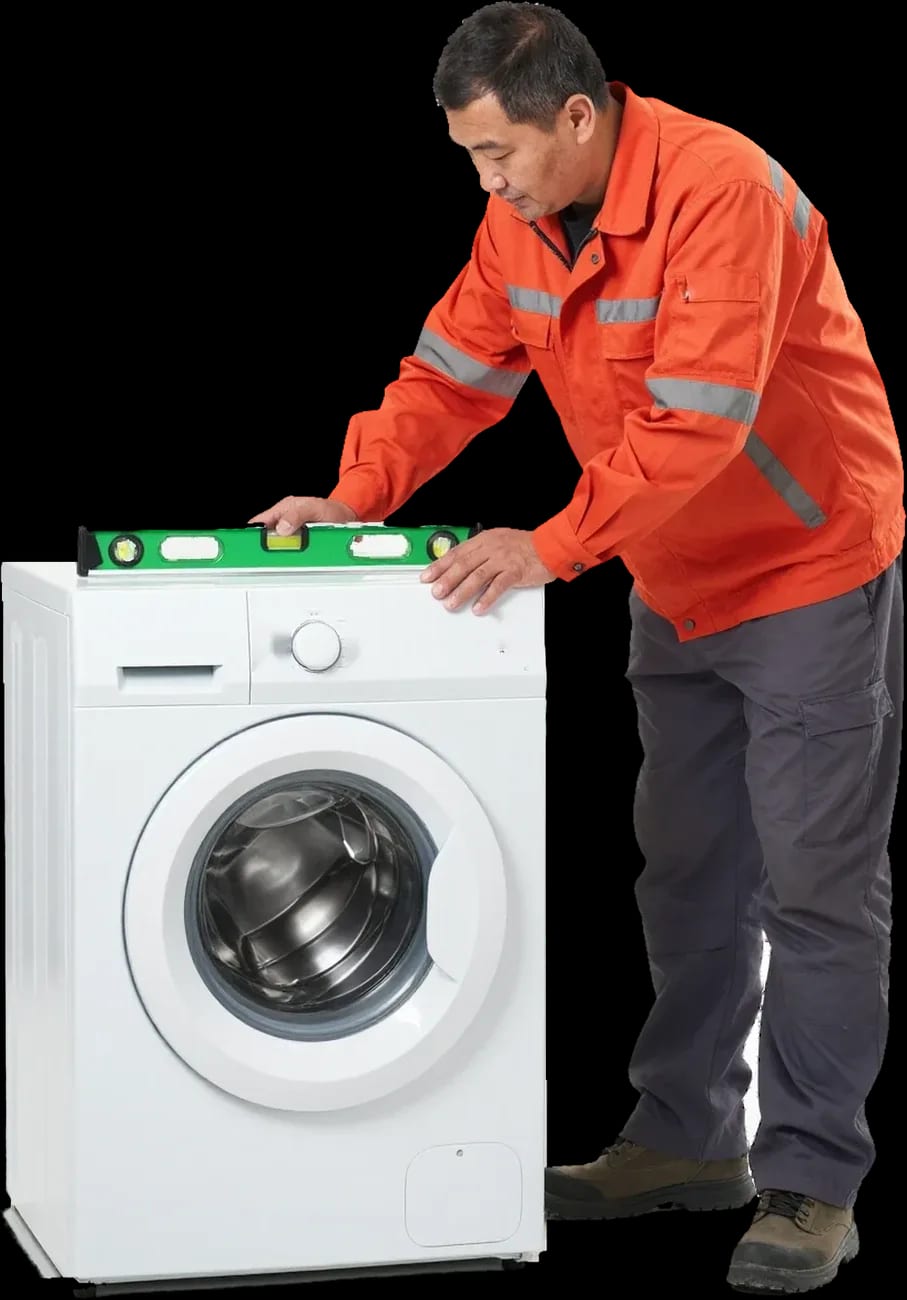
- Level installation: rock the body diagonally — wobbling is fixed by adjusting the feet with a level.
- Hose and tap: check that the inlet hose isn't pinched and the water supply tap is fully open.
When you need a technician
A technician is needed when the hum is related to the drum bearing, drain pump, heating element, or motor, because these components require disassembly and cross-checking with the model code. The bearing is replaced only if the tank is serviceable, and this is the longest job: the tank and drum are removed entirely. For brushed motors, brush wear is checked, while inverter motors like Bosch EcoSilence Drive and LG Direct Drive have no brushes at all. A multimeter won't show a jammed pump — the technician checks whether the impeller spins freely. The part is selected by part number or model code; on Bosch, it's the E-Nr on the plate inside the door. If the machine hums but drains and spins, you can continue washing for a short while, but don't put off diagnostics — component wear increases with every cycle.
How we work in Almaty
At Tech Service, we arrive at your home within 60 minutes anywhere in the city, diagnostics are free, and the technician gives you the price after the diagnostics. We work as a direct contractor with our own technicians with 4 to 20 years of experience. The technician inspects the component on site, checks the model code, and tells you exactly what's humming — the bearing, pump, or motor. He selects the part by part number, not by eye. If the needed part isn't on hand, the technician gives you the delivery time and agrees on a day for a follow-up visit, so you're not left with a disassembled machine. We provide a 1-year warranty on labor and parts and you can pay via Kaspi QR, Kaspi Red (instalments), bank card, cash, or bank transfer for companies. If the hum has turned into grinding, don't delay the inspection: on a serviceable tank, the bearing is replaced, while on a sealed tank, the assembly is replaced together with the tank.
Quieting a noisy washing machine
We've gathered the key things a owner of a humming machine should keep in mind: what to start with when assessing the sound and which actions are safe before the specialist arrives.
- Cycle stage: a hum during fill, wash, spin, and drain points to different components, so first note at which moment the sound appears.
- Spin speed: the drum usually spins up to 800–1600 rpm depending on the model, and a warning sign is a change in sound, not its volume.
- Pump check: a multimeter won't show a jammed pump; here you check whether the impeller spins freely after removing the filter.
- Emergency drain: water is drained through the hose behind the service flap at the bottom front, after unplugging the machine and placing a towel.
- Error code: the code's meaning depends on the model generation; cross-check it with the table for the specific machine, not a general guide.