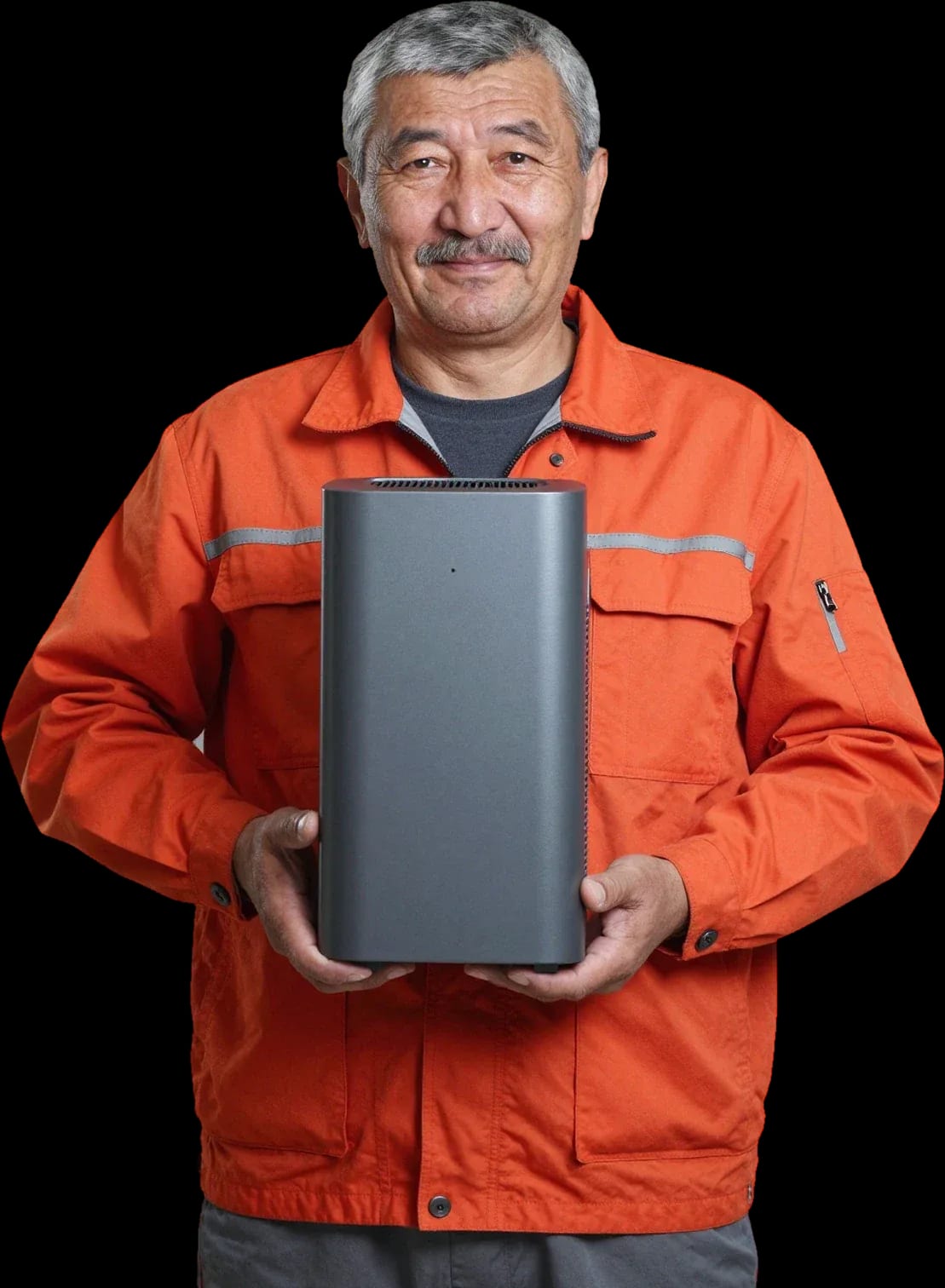
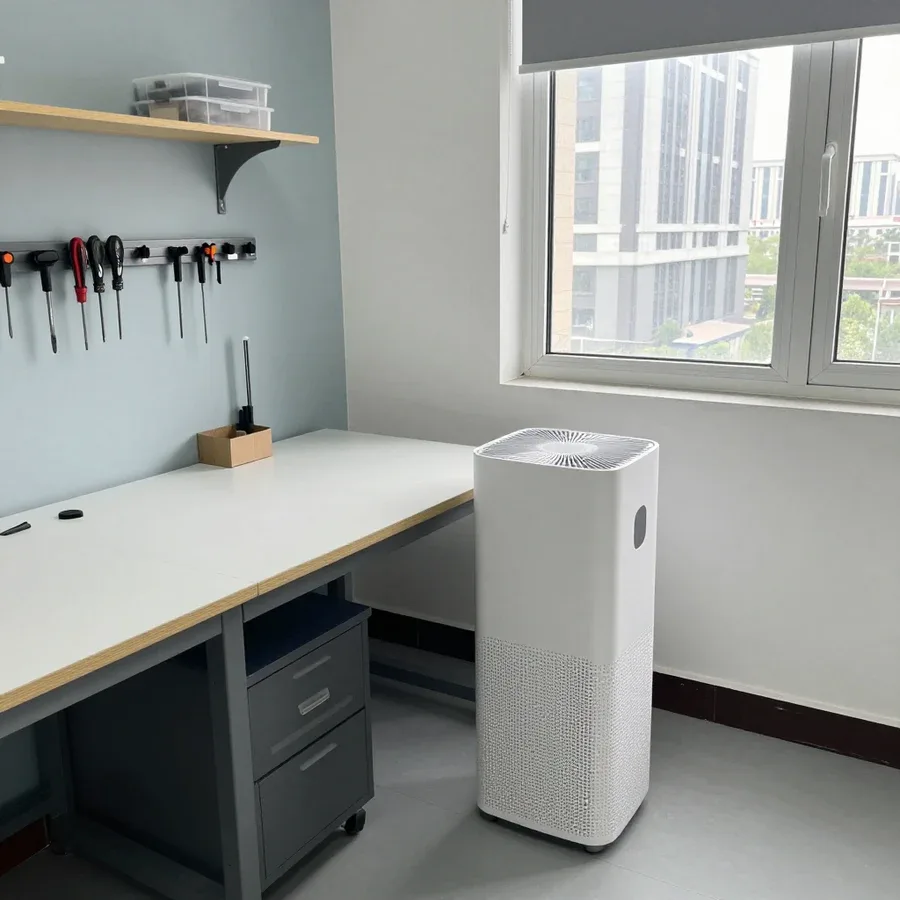
Tech Service repairs air purifiers in Astana as a direct service provider: our technician comes to your home within 60 minutes or the unit is repaired at our service center. Diagnostics are free, there is a 1-year warranty on labor and parts, and our technicians have 4 to 20 years of experience. The technician provides the price after diagnostics.
Why an air purifier stops working and what each symptom means
An air purifier rarely fails completely—usually one component gives out, and the symptom points directly to it. Let's look at three common complaints and what's behind them.
The purifier won't turn on or turns off by itself
Most often the power supply or a contact in the power circuit is to blame, less often the control board; our technician checks the power circuit first. If the unit doesn't respond to the button but the power indicator is on, the cause is in the contact group or fuse, while a complete lack of response points to the power supply. Another scenario is when it turns off after a few minutes of operation: here the issue is not the button but overheating or motor protection. Moreover, protection kicks in even with a clogged filter, when the fan doesn't get enough air for cooling. The control board is suspected when the unit turns on but doesn't start the motor and doesn't send signals to the panel. For this complaint, the technician disassembles the power circuit component by component rather than replacing parts at random. If the purifier turns off by itself at regular intervals, first check the temperature sensor and motor cooling—this changes the repair scenario compared to a failure to turn on.
The purifier hums, squeaks, or blows dust without cleaning
Noise and squeaking usually come from the fan, while 'dust at the outlet' means a clogged HEPA filter or a misread PM2.5 sensor, and we distinguish these causes during diagnostics. Humming at low speeds often comes from a worn bearing, rattling from a foreign object in the impeller, and squeaking appears when the shaft bushing is dry. When the unit runs quietly but the air at the outlet is dusty, the technician checks the HEPA filter for remaining life and the air quality sensor for correct readings. Moreover, after contamination, the PM2.5 sensor overstates concentration and turns on turbo mode unnecessarily, causing the motor to wear out faster. The housing and air ducts are also on the list: a crack in the seal lets air bypass the filter. If after replacing the filter the purifier still blows dust, check the tightness of the housing and air ducts—air is bypassing the filter, and a new HEPA filter won't help here.
Error code on the display and smell from the purifier
An error code on the display points to a specific component—most often the control board or a sensor—while an unpleasant smell comes from a clogged carbon filter or a dirty ionizer. Based on the indication, the technician narrows it down: a communication error indicates a ribbon cable between the panel and the board, a sensor error indicates a dirty PM2.5 sensor, a motor error indicates the fan or its winding. A burning or musty smell appears when the carbon filter has exhausted its life and no longer traps volatile substances, and deposits build up on the ionizer and UV lamp. Moreover, in units with an ionizer, an ozone smell is noticeable when the emitter is damaged, and that's no longer about the filter. We don't clear the code with a reset: the error will return if the cause isn't fixed. The technician first finds the component, then checks the indication—a reset without repair only hides a control board fault.
How air purifier repair works at home and at the service center
Some faults are fixed on site, while others require a test bench at the workshop. Here's how a service call works and what is resolved on-site versus what is taken to the service center.
How to call a technician and what happens at your home
We send our technician within 60 minutes anywhere in the city. They run free diagnostics and give you the price before any work starts. The technician arrives with tools and checks the power supply, motor, sensors, and filters right at your place — that's exactly why people in the capital order air purifier repair this way, without disassembling or transporting the unit. On-site visits usually cover the power supply, fan, replacement of consumables, and sensor calibration. If the control board needs soldering or the internal components need a deep clean, the technician will arrange service at the workshop and take the device with your approval. The price is quoted after free diagnostics, before any work begins — so you decide whether to go ahead or just get a consultation.
What we fix on-site and what at the workshop
| Fault | Where we fix it | What the technician does |
|---|
| Power supply, power contact | on-site | checks the power circuit, replaces the unit |
| Fan, squeaking, noise | on-site | services the motor, checks the mounting |
| Clogged filters, odor | on-site | replaces consumables, cleans components |
| PM2.5 sensor, false readings | on-site | inspects and calibrates the sensor |
| Control board, error codes | at the workshop | diagnoses and repairs the board |
| Deep cleaning of air ducts | at the workshop | disassembles the housing, cleans components |
How diagnostics and post-repair checks work
Diagnostics are free and come first: the technician checks the power supply, motor, sensors, and filters, then runs the device again after the work. Troubleshooting starts from the symptom: if the device won't turn on, we check the power circuit and contact; if it hums, we check the motor and fan mounting; if it shows incorrect data, we check the PM2.5 sensor and its calibration. The post-repair check includes verifying the indicators and airflow — that way you can see whether the symptom is gone, not just whether the device turns on. We provide a 1-year warranty on labor and parts, so if the same issue comes back, we handle it first. In my view, a load test after reassembly matters more than the part replacement itself: it shows whether the unit holds up at medium and high speed.
Warranty, diagnostics, and transparent repair
The main fear with climate control equipment is that the device will break again after someone works on it. Here's how the warranty, free diagnostics, and pricing work, so that fear doesn't stop you from making a decision.
What the 1-year warranty covers
We provide a 1-year warranty on labor and parts, meaning we stand behind both the quality of the work and the parts installed. If the same fault reappears within this period or a replaced component fails, we deal with it without charging for labor again. The warranty covers the specific type of work performed and the parts we supplied. For climate control equipment, the parts warranty is especially important: filters, air quality sensors, and fans wear out under constant use, and those are the most common reasons for callbacks. In my view, a year is enough time for a part to prove itself under real load, not just in the first days after installation. Keep the work document: it makes warranty claims faster and avoids disputes about what was replaced.
Why diagnostics are free and when the price is quoted
Diagnostics are free with us, and the technician gives you the price after that — once the cause and scope of work are clear. This approach protects you from surprises at the end: first we figure out why the purifier won't turn on or is humming, then we outline the plan and the cost, and only after you agree do we start work. The technician comes to your home and checks the device on site — you don't pay for the inspection or troubleshooting, even if you decide to decline the repair. The cause may be simple: a clogged filter, a misaligned sensor, a loose contact. Then the scope of work is small. If a component needs replacing, the estimate includes the part and the labor to install it — the numbers are given before any work begins, so you can make an informed decision. In our experience, this approach removes half the stress: you see the logic, not just a number out of nowhere.
What to do if the appliance is still under the store's warranty
If the purifier is still under the store's warranty, it's best to contact them first — doing repairs yourself or hiring a third-party technician may void that warranty. The store runs its own check and offers a replacement or service under the terms of purchase, and that's the simplest route while the warranty is valid. But the store warranty doesn't cover everything: consumables — filters, pre-filters — are usually excluded, as is mechanical damage after a fall or careless cleaning. Moreover, consumables have a short warranty period or aren't covered at all. If the breakdown falls into that category or the warranty has already expired, going directly to a service provider is still a viable option: the technician comes to your home and gives you the price after free diagnostics. Before you call, check with the store exactly what their warranty covers — it will save time for both you and the technician.
Repair the purifier or buy a new one
The question of whether to repair or replace isn't decided by the age of the device, but by which component has failed and how repairable it is. Below are the criteria our technicians use to distinguish justified restoration from a reasonable replacement.
When repair is justified
Restoration makes sense when a single component is broken — power supply, fan, sensor, or filters — while the housing and circuit board are intact. The power supply fails after voltage spikes, the fan motor wears out due to bearing wear or accumulated dust, the PM2.5 sensor gets dirty, and the HEPA filter simply reaches the end of its life. Each of these components can be replaced separately without touching the rest of the circuit: after replacing the motor or sensor, the device returns to its original purification performance, not half of it. In our experience, air purifier repair in Astana often comes down to just one component — the rest of the device remains functional. Climate control equipment is more repairable than it seems: replacing the motor or sensor restores the device's working characteristics without loss of purification, so it's too early to write off the unit.
When replacement is smarter than repair
Replacement is smarter when several key components are damaged at once, or when the housing and air ducts can't be restored. If the motor burned out along with the control board and the air ducts are deformed from overheating, restoration would involve almost the entire device — then a new purifier turns out to be more honest than the old option. Cracks in the housing break the airtightness of the air path, and air bypasses the filter, while warped air ducts prevent the required airflow even with a working fan. The decision is made after diagnostics, not based on a phone description — the same external symptom can mean either a simple fix or a replacement. The same humming noise can indicate either a bearing that takes a couple of minutes to replace or a destroyed component that's easier not to restore.
How the technician helps you decide
After the free diagnostics, we explain which component has failed and what a repair will achieve, so the client decides based on facts, not guesses. A Tech Service technician identifies the cause of the breakdown by the symptom, takes the unit apart, checks the power supply, motor and sensors, and shows exactly what has failed. Then they quote the repair cost and give an honest answer on when replacing a single component will get the unit working again and when the investment isn't worth it. An honest assessment saves money: sometimes it's cheaper to replace one component than the whole unit, and the technician says so directly, even if the repair brings the service less. The decision is up to the owner — our job is to give the full picture, not to push them into buying a new air purifier.
Air Purifier Care and Breakdown Prevention
Half of the calls we get aren't about breakdowns but about maintenance — clogged filters and dirty sensors. Here's what to check and how often to keep the unit running as it should.
How Often to Change Filters
The pre-filter is cleaned most often; the HEPA and carbon filters are replaced as they get dirty — the manufacturer's guidance and how intensively the unit is used set the schedule. The pre-filter catches large dust and pet hair and can be removed for washing or dry cleaning every two to four weeks, depending on the load. The HEPA filter traps fine dust particles, pollen and some allergens, and its lifespan averages six months to a year of continuous use. The carbon layer handles odors and volatile compounds, and it's replaced when it stops catching unwanted smells. In dusty air, a filter clogs faster than the stated interval, so rely on the unit's indicator and on smell, not just the calendar: if the purifier has gotten louder or the airflow from the grille has weakened, it's time to change the filter even if the interval isn't up yet.
Why Cleaning Didn't Improve After a Filter Change
If the purifier still cleans poorly after a filter change, the cause is usually the PM2.5 sensor or a housing that isn't closed tightly, and we check this during diagnostics. The air quality sensor gets clogged with dust over time and reads high — the unit "thinks" the air is dirty and runs in the wrong mode. The second common source is a skewed or loosely closed cover and a HEPA filter that isn't seated properly: air goes through the gap past the filter, and cleaning effectively doesn't happen. During servicing, our technician removes the sensor, blows it out and compares its readings against a reference, and also checks how the housing and air ducts fit. If the readings haven't changed after replacing the consumable, the filter isn't the issue — the electronics need checking.
Cleaning Components and Caring for Sensors
We clean internal components and air ducts during servicing, and we check the sensors so their readings stay accurate. Dust settles on the fan blades, in the channels and on the intake grille, and over time it reduces performance and adds noise. Regular cleaning extends the motor's life: clogged air ducts make the fan work under overload, and it fails earlier than it should. The air quality sensor needs special attention — its sensing element must not be rubbed or wetted, only carefully blown out. Our servicing includes cleaning the housing from the inside, checking the fan and calibrating the sensor so the operating modes match the real air conditions in the apartment. A dust-clogged sensor reads high and makes the unit run the air at maximum speed — that's extra motor wear and more noise, which residents notice before they notice a drop in cleaning performance.
Who to Trust with Climate Control Equipment Repair in Astana
In the climate control equipment service market, aggregators, independent specialists and direct contractors sit side by side. Here's how they differ and why it affects the result.
Direct Contractor or Intermediary
Tech Service is a direct provider: our own technician comes to you, not a contractor from an aggregator, so we stand behind the work and the warranty. Our dispatcher takes your request, we arrive within 60 minutes anywhere in the city, and the 1-year warranty covers both labor and parts. With a middleman, responsibility gets blurred between the platform and the contractor: the platform points to the contractor, the contractor points to the platform, and a warranty case turns into a back-and-forth of messages. With a direct provider, the warranty and quality are tied to one company — there's someone to hold accountable, and obligations aren't passed on to a third party. In our experience, clients who come after using an aggregator most often complain about unclear warranty terms. Before you order, ask who exactly will come and who provides the warranty in writing — that settles half the disputes before work even starts.
Brands and equipment we work with
We service air purifiers and related climate control equipment from various brands, including Ballu, Xiaomi, Deerma, Boneco, Dreame, Kitfort, REDMOND, and Scarlett. Besides purifiers, we also take on humidifiers, air washers, and dehumidifiers — their components are similar, and faults often show up the same way. Different brands have their own error codes and sensor designs, so we tailor our approach to the model rather than using a one-size-fits-all template. For example, with Xiaomi and Dreame, diagnostics often come down to air quality sensor readings, while with Ballu and Boneco it's the damper mechanics and pump. Because of differences in firmware and connectors, there's no universal disassembly algorithm. When you call, give the model and brand right away: that way we bring the right tools in advance and don't waste the visit on clarifications.
Technician experience and payment
Our technicians have 4 to 20 years of experience, and you can pay via Kaspi QR, Kaspi Red, bank card, cash, or bank transfer for companies. Experience matters especially with climate control equipment: delicate sensors and tight housings require careful disassembly, and a beginner's mistake costs more than the repair itself — a torn connector or damaged sensor membrane turns a simple replacement into a hunt for a rare part. Diagnostics are free with us, and we quote the price after diagnostics, once the cause is clear. What's more, you get a specific fault with solution options, not a guess. In my view, it's smarter to pay once for careful work by an experienced person than twice — for fixing someone else's mistake. Ask about experience and payment terms before the visit: those are the two things that immediately show the provider's level.
Air purifier repair when breathing easy matters
Diagnosing an air purifier breakdown comes down to a few recurring scenarios. Below is a short summary to help you understand in advance what you're dealing with and what to look for when choosing a provider.
- The symptom points to the component: power, motor, filters, and sensors fail in different ways, so diagnostics start with the owner's complaint, not with taking the device apart.
- Home or service center: some faults are fixed on site, while control board repairs and deep cleaning of components are done in the workshop, where the device is delivered after inspection.
- A clear plan before work: free diagnostics and a price quoted afterward give the owner the full picture upfront, with no surprises along the way.
- Warranty on the result: a one-year warranty on labor and parts removes the fear of a repeat breakdown — if the fault returns, it's fixed under our obligations.
- Prevention is cheaper than repair: regular filter replacement and cleaning of components extend the device's life and reduce the likelihood of needing service in the city.