Tech Service repairs Stinol refrigerators in Astana at your home and in the shop. A technician arrives within 60 minutes anywhere in the city, diagnostics are free, and we provide a 1-year warranty on labor and parts. We give the price after a free diagnostic and accept payment via Kaspi QR, Kaspi Red, card, cash, or bank transfer for companies.
Why Your Stinol Refrigerator Stopped Cooling and What It Means
A symptom is not a diagnosis. One sign won't pinpoint the faulty component, but a combination of signs lets the technician narrow down the causes before even leaving for the call.
Stinol Refrigerator Not Cooling but Light Is On
If the light is on but there's no cold, power is reaching the refrigerator, and the cause is almost always in the cooling circuit or the component that controls it. The compressor may hum without building pressure, the start relay may click without kicking the unit on, and the thermostat may not close the circuit at all. A refrigerant leak looks different: the motor runs nonstop, but the condenser on the back grille stays only slightly warm instead of hot. Stinol refrigerator repair in Astana starts with measuring pressure in the circuit and checking the start component—these two steps rule out half the possibilities. Check if the compressor is running by ear and whether the condenser on the back grille is hot—this free check will narrow down the causes before the technician arrives.
Freezer Works but the Fridge Compartment Is Warm
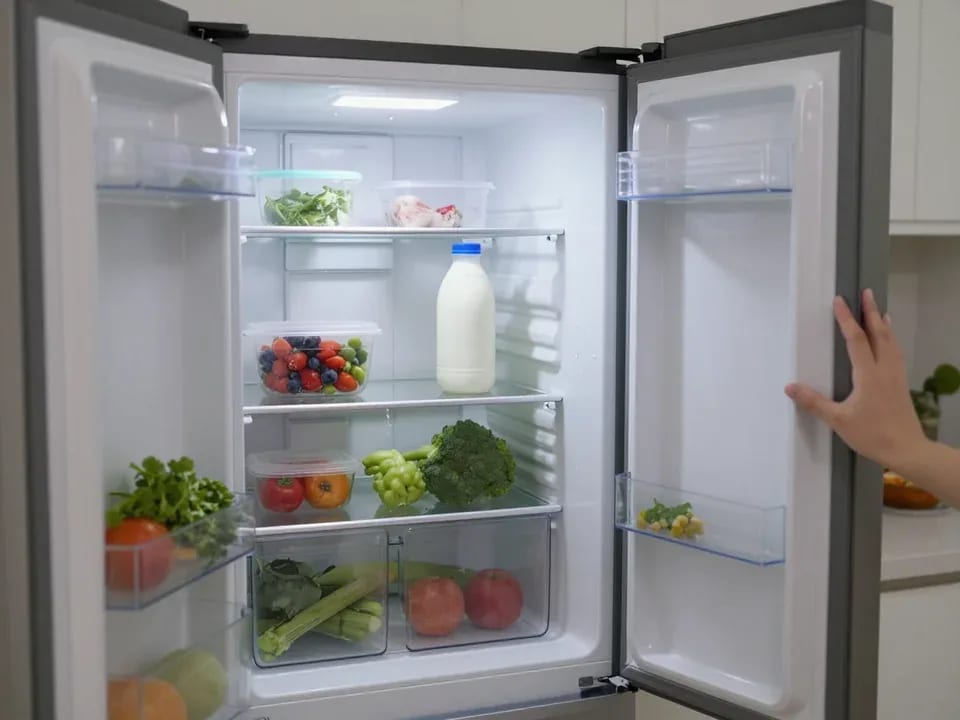
When the freezer stays cold but the upper section is warm, the problem is usually a clogged capillary tube, a refrigerant leak, or a faulty defrost system. A blocked capillary cuts off refrigerant flow to the upper evaporator, so cold remains only in the freezer. A defrost failure builds frost on the evaporator, airflow stops, and the fridge compartment warms up even with a working compressor. Another possibility is a faulty thermostat that doesn't signal the upper compartment to cool, even though the unit is fine. The temperature difference between compartments in a working two-door Stinol doesn't exceed a few degrees according to the specs, but in practice a gap of ten degrees or more points to a circulation problem. In two-door Stinol models with one compressor, cold is distributed through the circuit, so 'half working' always signals a circuit issue, not a weak thermostat.
Humming, Clicking, Not Turning Off, or Not Starting After Defrosting
- Clicking with humming: the start relay doesn't hold the winding, the compressor tries to start and goes into protection.
- Running without stopping: the thermostat doesn't open the circuit or there's not enough refrigerant, so the unit compensates for the lack of cold.
- Silence after defrosting: moisture got into the start component, the compressor protection tripped, and restarting immediately only makes it worse.
- Humming without cold: the motor runs but doesn't build pressure—a sign of compressor wear or a refrigerant leak.
- Starting and stopping in jerks: the relay trips to protection after a couple of seconds, and without replacing the start component the motor won't reach operating mode.
What a Flashing Indicator and Stinol Error Code Tell You
The indicator is a hint from the refrigerator itself. Once decoded, the technician arrives with the right parts and doesn't waste time searching for the cause.
Red Indicator Flashing on the Stinol Panel
A flashing red indicator on a Stinol signals a temperature rise in the compartment, not a specific fault—it's an alert that needs to be interpreted along with other signs. On electromechanical models, the red light comes on when the sensor detects a deviation from the set mode: the compressor may run nonstop or may be silent. On two-door Stinol models with two thermostats, the indication is often separate—one signal for the fridge and one for the freezer—and a dark icon shows which compartment is out of range. Also check if the control has been moved: a accidentally turned thermostat knob produces the same picture as a fault. If the indicator came on after loading warm food or leaving the door open for a long time, give the refrigerator a few hours—if the component is working, the alert will clear itself.
Error Code on the Display of an Electronic Stinol
On Stinol models with electronic controls, the code on the display points to a specific sensor or component, and decoding it immediately sets the direction for diagnostics. The alphanumeric combination on the panel is most often related to the NTC temperature sensor: there are several in the compartments, and each is responsible for its own circuit, so the same symptom can produce a different code depending on which sensor is faulty. Some combinations are shown by the control board when there is an open circuit or short in the sensor circuit, others when readings deviate from the setpoint. It also happens that the display flashes segments or shows a combination that isn't in the code table: then the cause is the control board itself or the ribbon cable contacts. Write down the code and accompanying signs before the technician arrives — it's harder to determine the cause from a single digit without context than from the code together with the symptom.
What to do before the technician arrives
- Don't reset the error: clearing the code from the panel deprives the technician of a clue that would help find the cause faster.
- Write down the code: record the combination on the display or the flashing pattern of the red indicator on paper or in a photo.
- Check the door: make sure the seal fits tightly and the door closes completely without effort.
- Don't load warm food: don't put hot items in the compartment and don't open the door unnecessarily before diagnostics.
- Don't disassemble the panel: opening the control unit without experience more often adds faults than helps.
Which Stinol components fail most often
Stinol of the classic Lipetsk school has a narrower set of typical failures than modern No Frost models, and this helps the technician find the cause faster. Below are the components we most often check on site.
Compressor, relay, and thermostat
We most often replace the start-protection relay and thermostat, and only touch the compressor after checking the start unit and circuit tightness. The start-protection relay is mounted on the compressor and trips under overload: if it clicks and the motor doesn't start, the cause is usually the relay, not the compressor itself. The thermostat controls the off cycle — when it wears out, the compartment either doesn't get cold enough or the fridge runs without pauses. On two-compressor models, we check each circuit separately because failure of one motor doesn't stop the second, and this can be confusing during initial diagnostics. We test the compressor winding for resistance to distinguish a seized shaft from electrical breakdown. Before replacing the compressor, the technician checks the relay and thermostat — sometimes a 'dead' compressor turns out to be fine, and the relay is to blame.
Seal, hinges, and loss of cold
If a Stinol doesn't hold cold after replacing the seal, the cause is usually a loose fit or misaligned hinges, not the seal itself. The door seal hardens and cracks over time, warm air leaks through the gap into the compartment, and ice builds up around the perimeter. Door hinges sag under the weight of the shelves — the door skews, and even a new seal doesn't fit evenly. We check the fit around the entire perimeter, not just at the handle: a feeler gauge or a sheet of paper shows where a gap remains. On models with a magnetic latch, we also check whether it has come away from the door panel. A new seal needs time to settle, and the hinges must be adjusted after installation — otherwise the door doesn't fit evenly and cold escapes at the joint.
Refrigerant and cooling circuit
- Leak detection: the technician checks welds, the evaporator, and solder joints, where refrigerant most often escapes.
- Filter drier: if the system is opened, it is replaced because the old one absorbs moisture and clogs the capillary tube.
- Pressure test: a pressure check confirms the leak is fixed before charging with new refrigerant.
- Charge by weight: refrigerant is filled strictly to the model's specification; too little or too much disrupts the cooling cycle.
Comparison of typical Stinol repairs
| Work | What we check | Component |
|---|
| Start relay replacement | compressor startup, clicking sounds | start relay |
| Thermostat replacement | shut-off cycle, temperature | thermostat |
| Compressor replacement | sealing, start relay | compressor |
| Door seal replacement | door fit, frost around the perimeter | door |
| Hinge adjustment | how tightly the door closes | door |
| Leak detection and refrigerant recharge | circuit sealing | cooling circuit |
| No Frost repair | heating element, timer, defrost sensor | defrost system |
How Stinol refrigerator repair at home in Astana works
We repair Stinol refrigerators at your home or at our service center — you choose the format, and the process is the same: request, diagnostics, approval, repair, warranty.
Technician visit and free diagnostics
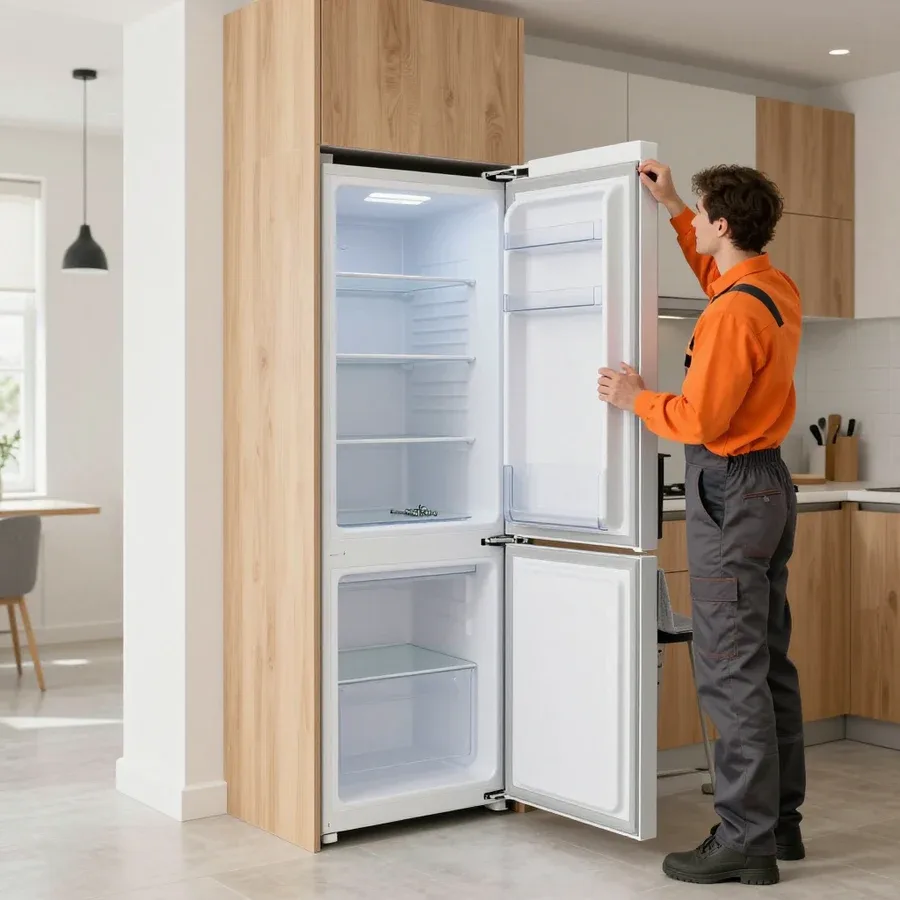
We come to your home anywhere in the city within 60 minutes, and diagnostics are free — the technician arrives, finds the cause, and only then quotes the cost of work. The visiting technician brings tools for the specific series: on Stinol models with electronic controls, the module and sensors are checked separately; on mechanical models, the thermostat and compressor start relay. The check takes about half an hour: the technician listens to how the motor starts, checks the temperature in both compartments, and tests the circuit. Repair of Stinol refrigerators in Astana starts with this check, because the symptom "not cooling" can be caused by a refrigerant leak, a stuck relay, or an electronics fault. We start Stinol refrigerator repair in Astana with this check, so it's worth describing the symptoms and error code in advance — this helps the technician bring the right parts and avoid a second visit.
Approval of work and the repair itself
After diagnostics, we agree on the list of work and the cost with you, and only after your approval do we start — at your home or at the service center if the circuit needs complex repair. In most cases, the fault is fixed on site: we replace the relay, thermostat, door seal, or sensor without taking the unit away. If the situation requires evacuation and recharging of the circuit, the technician may take the refrigerator to the service center — such work is not always done on site, especially when access to soldered connections and full moisture removal from the system are needed. We explain in advance which component we are replacing and why, rather than just naming the total. You can pay via Kaspi QR, Kaspi Red, bank card, cash, or bank transfer for companies — cash, card, transfer. Approval saves both time and money: you know exactly what you are paying for and can decline unnecessary work.
Direct service provider, no middlemen
Tech Service is a direct service provider: our own technician comes to you, not a contractor from an aggregator, so we are responsible for the quality of work and the warranty. Our experience ranges from 4 to 20 years on household appliances, and each technician knows Stinol inside out: the same relays, the same modules, the same typical circuit leaks. Being a direct provider means the technician knows the service history of your refrigerator and, on a repeat visit, works on the same components instead of starting from scratch. We provide a 1-year warranty on labor and parts. We are not middlemen: the same service that takes your request sends the technician, so you don't have to explain the symptoms to a third party and wait for the information to reach the person doing the work.
Warranty, diagnostics, and terms of service
Warranty and transparent terms are what set a direct service apart from a one-time technician. Below is what you get when you book Stinol service.
1-year warranty on labor and parts
We provide a 1-year warranty on labor and parts — if a component fails again due to our work, we'll come back and fix the problem. The commitment covers the entire scope of work performed: compressor replacement, relay, thermostat, refrigerant leak repair, and cooling circuit restoration. Replacing the door seal or hinges is also covered — if the door starts letting cold air escape again after a few months, the follow-up visit and adjustment are on us. The coverage applies to parts as well, so when replacing a compressor or relay, you're protected not only against technician error but also against defective components. In my opinion, this is the point Stinol owners check most often: the brand is old, and the question "what if it breaks again" comes up on almost every order. Before work begins, ask which components are covered by the warranty — that way it's easier to make a claim if the breakdown recurs.
How the price is formed and how to pay
The technician gives you the price after a free diagnostic — you don't pay anything before that, and you can pay for the work in any convenient way. The diagnostic is done at your home: the specialist checks the compressor, start relay, thermostat, and sensors, finds the cause, and only then tells you the list of work and the final amount. The price depends on the component and the scope of work, so it's impossible to give it over the phone before inspection — the exact amount only appears after the check. You can pay via Kaspi QR, Kaspi Red, bank card, cash, or bank transfer for companies, so you can pay however you like. The diagnostic remains free whether or not you agree to further work. From experience: when a technician cheerfully quotes an exact price for compressor replacement over the phone without seeing the unit, that's a reason to be wary — the figure depends on the model and the condition of the circuit.
Technician experience and how we work
Our technicians have been working with refrigerators for 4 to 20 years, so they know the design of classic Stinol lines as well as No Frost and electronic models. This range of experience is no accident: a technician with more experience handles complex cases, while a specialist with four years of experience performs standard work. Experience with a specific brand matters on older Stinol units — they have components that aren't found in modern models, and the technician needs to know how they're built. We service appliances at your home or in the shop: we arrive within 60 minutes anywhere in the city, and when a breakdown requires in-shop service, we take the unit in. Tech Service is the direct contractor, so our own technician comes to you, not an intermediary. For Almaty residents, this saves time: no need to call back a dispatcher and explain the problem twice. If you're unsure about qualifications, ask about experience with your specific model — the technician will answer before work begins.
Key points on Stinol refrigerator repair
Repairing a Stinol refrigerator comes down to accurate diagnostics: the symptom, error indication, and condition of components give the technician a map of the breakdown. Below are brief takeaways to help you decide without unnecessary expense.
- A symptom is not a diagnosis. "Not cooling" sounds the same for a refrigerant leak, a burnt-out relay, and a stuck thermostat, and only a combination of signs tells them apart.
- Error indication saves time. An error code or a specific blinking pattern immediately narrows down the components, and the technician arrives with the right parts instead of guessing.
- Stinol components are predictable. Relays, thermostats, door seals, and the cooling circuit are most often affected, and the compressor is replaced only after checking the start unit.
- The work process is transparent. Diagnostics, approval, repair, and warranty are stages where it's clear what the owner is paying for.
- Preventive maintenance extends life. Regular defrosting, door seal care, and hinge checks reduce the risk of repeat calls, and an accurate description of the symptom speeds up finding the cause.