Tech Service provides laptop cleaning in Astana with a technician visit in 60 minutes anywhere in the city or at our service center. The service includes disassembly, cleaning the fan and heatsink, and replacing thermal paste and thermal pads. Diagnostics are free, there is a 1-year warranty on labor and parts, and you can pay via Kaspi QR, Kaspi Red, bank card, cash or bank transfer for companies.
When your laptop really needs cleaning
Cleaning is needed based on symptoms, not the calendar. Below we list the signs owners notice and explain how to tell ordinary dust buildup in the cooling system from a more serious problem.
Symptoms that mean it's time to clean the cooling system
- Fan noise: the fan spins louder than usual even in a browser because dirt on the blades throws it off balance.
- Hot chassis: under load the bottom panel and keyboard area get noticeably hot, and airflow from the vent is weak.
- Throttling: the processor drops its clock speeds, the interface lags, and video stutters even though the device is technically working.
- Spontaneous shutdowns: the laptop turns off during a game or rendering when overheating protection kicks in.
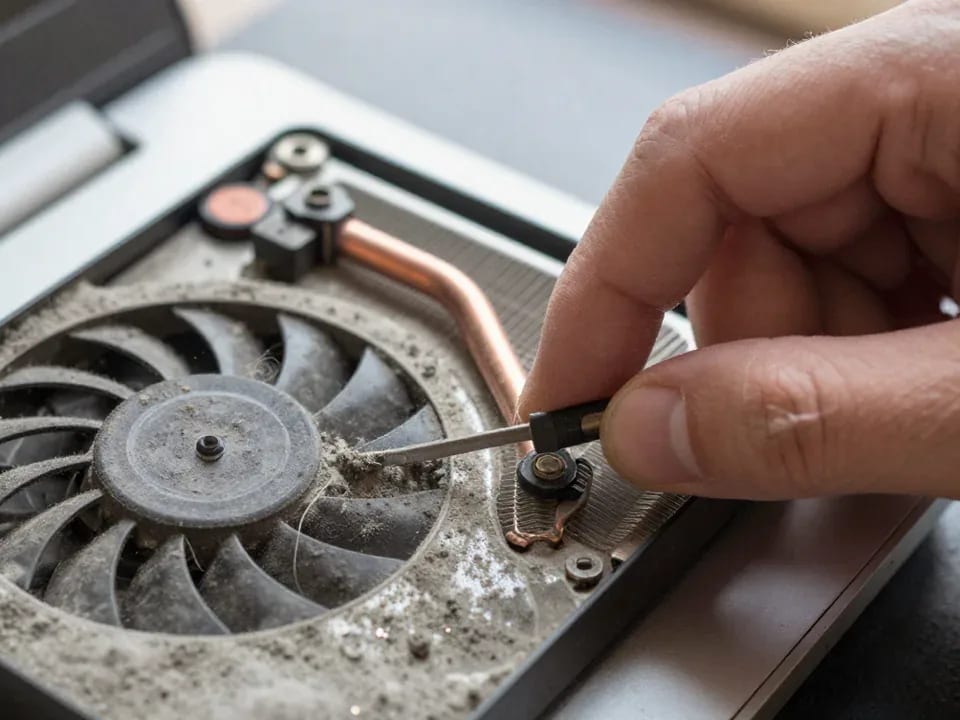
- Dust at the vent: you can see a gray layer at the exhaust, and the heatsink looks like dense felt.
- Rising temperatures: sensors show values 10–15 degrees higher than usual under the same load.
Why overheating is dangerous and what happens if you don't clean for years
Constant overheating leads to throttling and freezes, and the motherboard and chips are at risk when heat isn't dissipated. A dust-clogged heatsink stops radiating heat, the fan runs at maximum speed and still can't push air through the fins. The processor and graphics core reduce their clock speeds, system response drops, and under prolonged load emergency shutdown occurs. High temperatures damage power capacitors, VRM circuits, and the PCB itself: first you get intermittent errors, then component failure. The turbine-like sound under load and a hot chassis remain the only signal the owner gets used to ignoring for years, while what wears out is not the dust but the solder joints and traces on the board—that's why a second blow-out no longer restores previous temperatures once heat has stopped being removed from the die. Timely laptop cleaning in Astana helps stop this process before overheating affects board components.
What cleaning includes and how it differs from thermal paste replacement
We break down exactly what the technician does during full laptop servicing and show the difference between a simple cooling system blow-out and a full service with thermal interface replacement.
Step-by-step scope of work for full servicing
- Disassembling the case: we remove the bottom cover and disconnect the battery to reach the cooling system without risk of short circuit.
- Cleaning the fan: we blow out compacted lint from the blades that causes the fan to lose speed and hum.
- Cleaning the heatsink: we blow out the fins and air ducts where dust clogs into dense felt-like plugs.
- Replacing thermal paste: we remove the dried layer from the chip and apply new paste, restoring heat transfer to the fins.
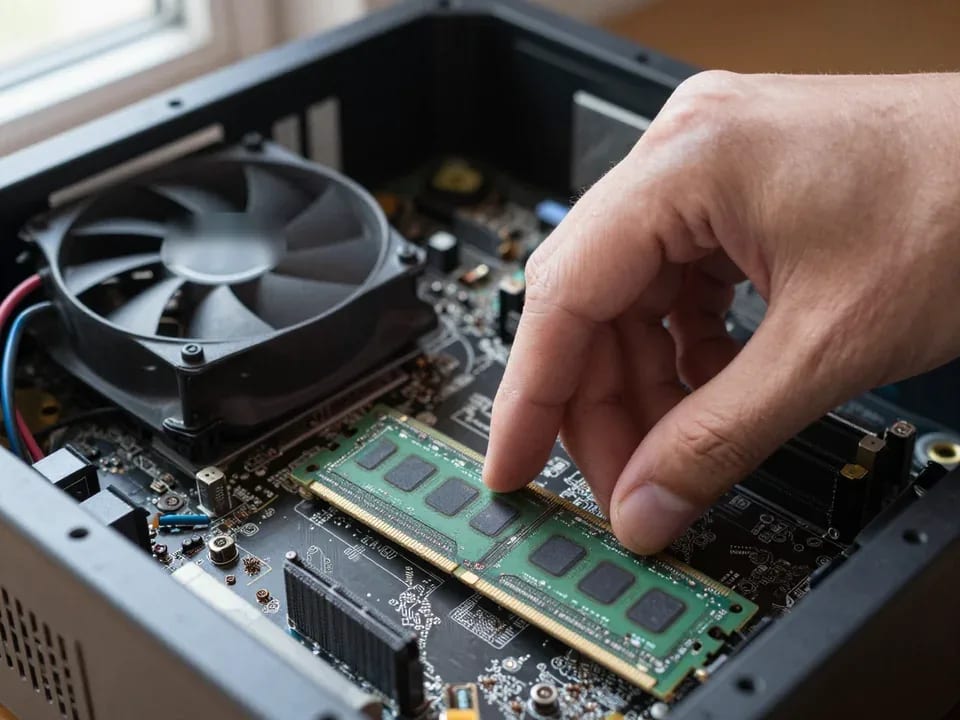
- Replacing thermal pads: we replace hardened pads on memory and power circuits if they have lost elasticity.
- Reassembly and testing: we put the device back together, turn it on, and check temperatures under load to confirm the cooling works.
Dust cleaning or thermal paste replacement—what your case needs
| Service option | What we do | When it's needed |
|---|
| Cleaning only | Blow out the fan and fins, leave the thermal paste as is | The paste is still working, but the cooling system is clogged with dust |
| Cleaning with new thermal interface | Full disassembly, blow-out, fresh paste | The paste has dried out, temperatures rise under load |
| Full service | Plus fresh thermal pads on memory and power components | Gaming laptops, MacBooks, three years old or more |
How full service differs from just replacing thermal paste
We only do full service with the case removed, because dust gets compacted between the fins and you can't remove it by blowing from the outside—the cooling system stays partially clogged. We determine the scope of work after free diagnostics: if the paste is still working, a blow-out is enough; if it has dried out, we replace it along with cleaning. The price for laptop cleaning depends on the scope of work, and the technician gives you the exact amount after free diagnostics. Gaming models and MacBooks generate more heat and have more thermal pads, so clogged fins show up as a sharp drop in performance, not just fan noise. On such devices, the technician separately checks the condition of the thermal pads on memory and power circuits: if they have hardened, heat dissipation is impaired even with fresh paste. That's why we include both cleaning and thermal interface replacement in the estimate upfront—otherwise temperatures will start creeping up again in a few months.
How an on-site visit works
We walk you through the customer journey from request to warranty—how the technician arrives, how diagnostics are done, and how work is approved before service begins.
From request to warranty—how an on-site visit works
- Request: you describe your laptop model and the symptom—noise, overheating, or throttling under load; the technician clarifies details over the phone.
- Arrival within 60 minutes: we come to you anywhere in the city or perform the service at our workshop if that's more convenient.
- Free diagnostics: the technician disassembles the laptop, checks the condition of the cooling system, and shows you where dust has built up.
- Work approval: after diagnostics, you decide whether thermal paste and thermal pads need replacing, and only then does the work begin.
- 1-year warranty: we give a one-year warranty on labor and parts—this is the final step that wraps up the entire order.
How long cleaning takes with a technician
We give you an exact time after diagnostics, because duration depends on the laptop model and whether thermal paste and thermal pads need replacing. Disassembling the case takes longer on thin ultrabooks with tight layouts than on gaming models with a large chassis—there, accessing the heatsink and fan requires removing additional modules. If the thermal paste has dried out over the years and turned into a crust, it's removed with a solvent and a new layer is applied, and thermal pads are replaced in areas where they've lost elasticity. Reassembly and post-service checks include a stress test: it shows that temperatures are back to normal and the fan isn't droning. If you're in a hurry, mention it when you place your request—we'll plan the visit so that disassembly and reassembly don't stretch over multiple visits.
How often to clean your laptop and what happens if you put it off
Cleaning frequency depends on operating conditions, not on the laptop's age. We break down guidelines by scenario and explain why cooling maintenance matters.
Cleaning frequency guidelines for different conditions
| Operating conditions | Frequency guideline | What to watch for |
|---|
| Home, desk, no pets | Every 1.5–2 years | Temperature rise under load |
| Cat or dog nearby | Once a year | Fur on the ventilation grille |
| Laptop on the floor | Every 8–12 months | Dust in the heatsink and on the fan blades |
| Dusty rooms, construction site | Every 6–9 months | Noise from the cooling fan |
| Gaming and heavy software | Once a year | Throttling and hot chassis |
Do you need cleaning if the laptop is quiet but several years old?
No noise doesn't mean the cooling system is clean: dust builds up gradually, and a preventive cleaning stops overheating before it becomes noticeable. A clogged heatsink reduces cooling efficiency, but the cooling fan spins quieter for a while—noise appears when the system is already working at its limit. Over a few years, a layer of dust and dried thermal paste add up to consistent laptop overheating under load: first frequency drops, then freezes. It's convenient to combine prevention with a scheduled check—this way dust and dried thermal paste are detected before the device starts freezing. Before servicing, we run free diagnostics and show exactly where dust accumulates—in my view, this answers the main question: service now or wait.
Why DIY cleaning is risky and when it's better to call a technician
We explain why a vacuum cleaner and hairdryer don't replace a full cleaning, and in which cases disassembling it yourself costs more than calling a technician to your home.
Why a vacuum cleaner and hairdryer don't replace cleaning
A vacuum cleaner and hairdryer don't remove the compacted layer from the heatsink and don't replace thermal paste, and the airflow can push dirt deeper into the chassis. In the heatsink, grime clogs the gaps between fins, and cooling efficiency drops: air no longer passes through the channels, and the heatsink stops dissipating heat from the processor. The hairdryer blows air inside but only removes the top layer, while the felt at the exhaust stays in place. Static electricity and overheating from the hairdryer are dangerous for the motherboard: the hot air flow dries out the thermal paste, and it loses its properties prematurely. In our experience, after a DIY procedure the laptop runs quieter for a couple of days, then returns to its previous hum. If the heatsink is clogged, blowing out the debris is useless—you need to disassemble and remove the cooling system.
Can you clean a laptop if it's still under the manufacturer's warranty?
Preventive maintenance isn't related to parts replacement under the manufacturer's warranty, but before disassembling, it's worth checking the terms so you don't lose your right to warranty service. Most manufacturers cover defects in assembly and components, not preventive maintenance, so the procedure itself doesn't void it. Another matter is opening the case: if after DIY disassembly a chipped latch, stripped screw, or damaged cable is found, warranty service will be denied, and the reason will be traces of opening. A technician disassembles the laptop case carefully, removes the cover without chips, and works on the cooling system without touching the seals on components. For city residents, it's easier to call a specialist to your home than to risk the warranty to save on disassembly. Before contacting, check with the seller what opening conditions are specified in your warranty card.
Warranty and trust in the service provider
Warranty obligations, the provider's status, and payment procedure—three questions a laptop owner asks before a specialist arrives. We explain what obligations we take on, why we work directly, and when the cost is announced.
What the 1-year warranty on labor and parts covers
We give a 1-year warranty on labor and parts, so if the symptom returns after service, the issue is handled under warranty. The coverage includes the cooling system service itself, replacement of thermal paste and thermal pads — the materials the technician installs during service. The 1-year term applies to both the work performed and the parts installed: on a new visit, you don't need to prove that the cause is related to the service — just describe the symptom. Our technicians have 4 to 20 years of experience, so they are well familiar with the typical effects of overheating. Separate warranty coverage for the procedure and for the parts matters because on a repeat visit it's clear which part is covered — the work itself or the replaced thermal paste and thermal pads.
Direct provider, payment, and cost after diagnostics
- Direct provider: we are not an aggregator or an intermediary — our own technician comes to your home and performs the laptop service.
- Free diagnostics: before work begins, the technician inspects the cooling system and identifies the cause of overheating; there is no charge for the inspection.
- Cost after inspection: the price is quoted after free diagnostics, once the scope of work and required materials are clear.
- Payment: you can pay by Kaspi QR, Kaspi Red, card, cash or bank transfer — cash, card, or transfer, whichever is convenient for the owner.
- Responsibility for the result: for warranty questions, the client deals with the same service that maintained the laptop, not with an intermediary.
Laptop cleaning benefits explained
Here are the key things to keep in mind before contacting us: what signs indicate cleaning is needed, what the work involves, and why you shouldn't put off preventive maintenance.
- Symptoms matter more than the calendar: fan noise, a hot chassis, and freezing under load are reasons to check the cooling system, not to wait for a "due" date.
- A full cleaning means disassembly: the cover is removed, the radiator and fan are cleaned of dust, and thermal paste and thermal pads are replaced on the CPU and GPU.
- A home visit saves time: the technician arrives within 60 minutes in the city, and you don't need to take the laptop to a service center.
- The warranty establishes responsibility: a year on labor and parts means the provider is accountable for the result and doesn't disappear after payment.