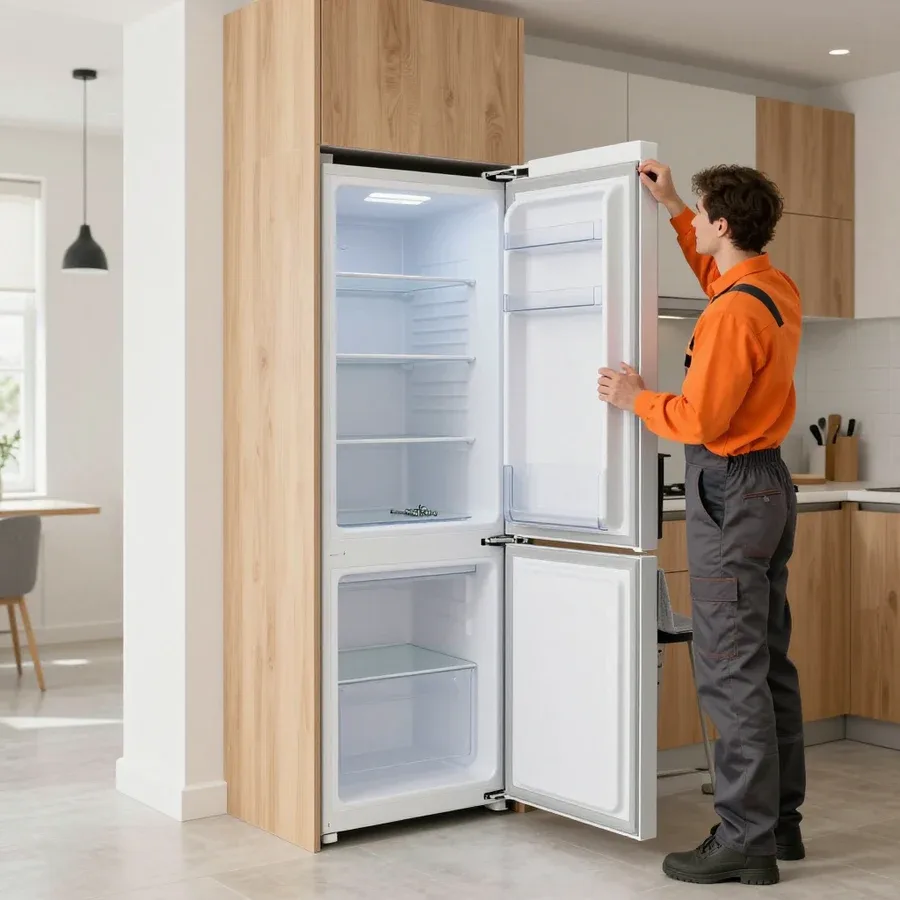
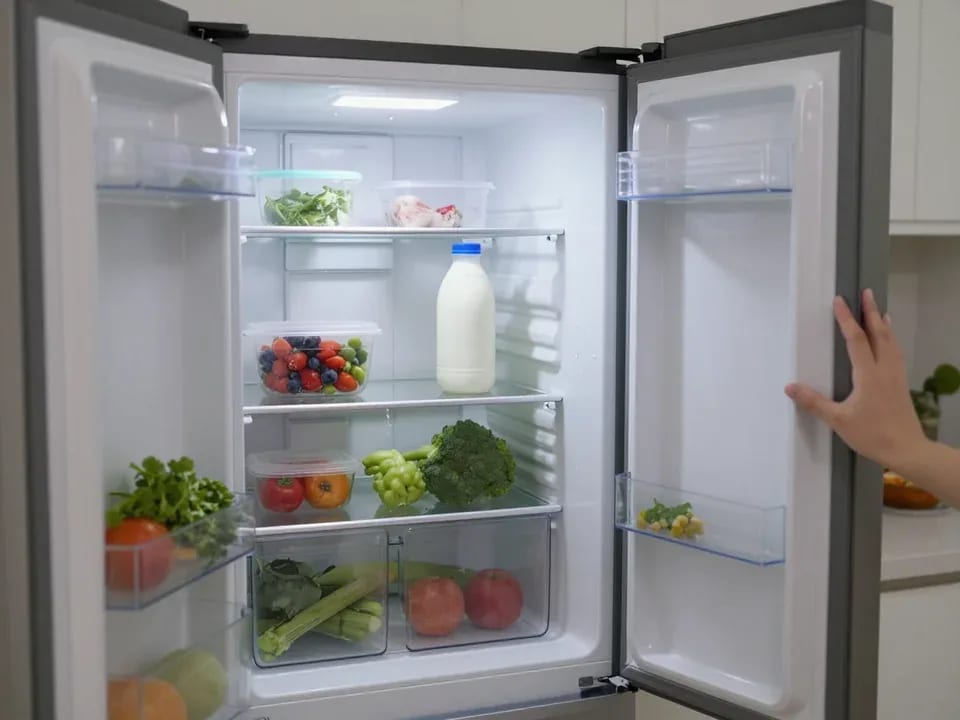
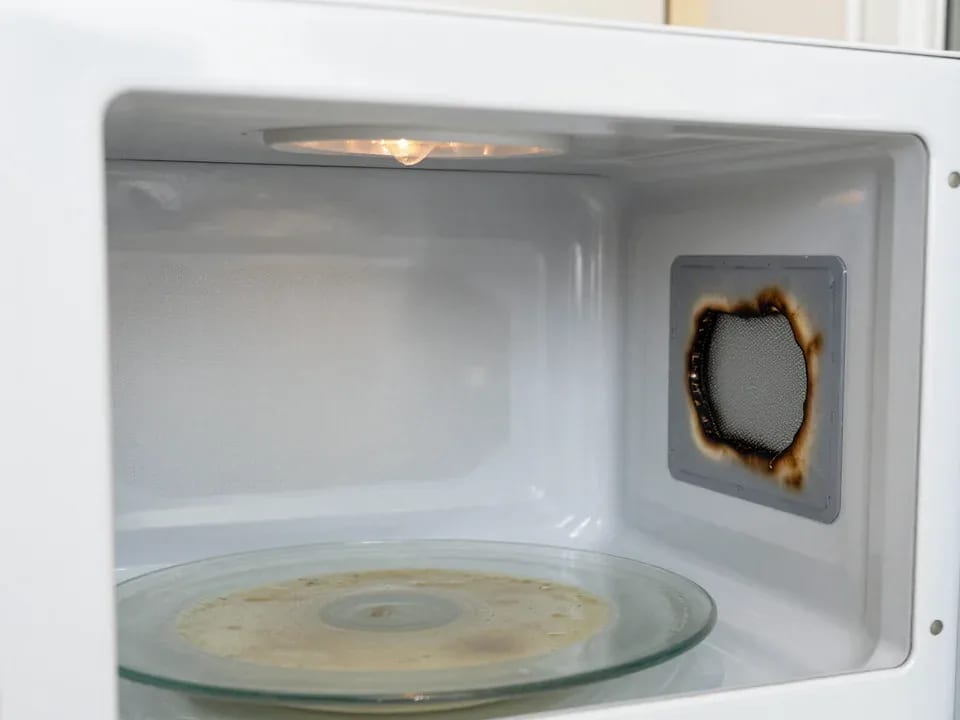
Tech Service repairs Siemens refrigerators in Astana with its own technicians who have 4 to 20 years of experience. A technician arrives at your home within 60 minutes anywhere in the city, diagnostics are free, and there is a 1-year warranty on labor and parts. The technician quotes the price after diagnostics, and you can pay via Kaspi QR, Kaspi Red, bank card, cash, or bank transfer for companies.
Why a Siemens refrigerator stops cooling and other common breakdowns
Siemens is more complex than many brands: the inverter compressor, control board, and NTC sensors work as a single system, so "not cooling" can mean both a refrigerant leak and an electronics failure. Let's go over the most common scenarios.
Siemens refrigerator not cooling but the light is on
If the light is on but there's no cold, most often the culprit is either the inverter compressor or the inverter power board — the motor simply isn't getting a start command. The Siemens inverter compressor is controlled by the inverter power board, which reads the NTC sensors in both compartments and in the freshness zone. When the control board loses the signal from at least one sensor, it blocks the motor from starting to avoid running it idle. Externally, it looks like a working refrigerator with lighting and silence in the motor compartment. Diagnostics should start not with the compressor but with the board and NTC sensors: if the electronics don't see the actual compartment temperature, they won't issue a command to run, and replacing the motor won't help. If you need Siemens refrigerator repair in Astana, our technician will check the board and sensors on site.
Siemens refrigerator clicks and won't start
Clicking when trying to start on Siemens inverter models usually means the board is trying to spin up the compressor, but the protection trips again and again. The inverter power board sends a pulse to the windings, the motor doesn't reach operating speed, and the protection cuts the start — hence a series of short clicks with equal pauses. The superFreezing relay in this circuit is responsible for the fast-freeze mode, and if its contacts stick, it can also send false commands to the board. Tech Service services Siemens inverter refrigerators, and in our practice such failures are more often due to the board than the motor itself. A single click when turning on is normal, but a series of clicks with a pause and no cold is a reason not to wait: repeated start attempts load the board and can take it out along with the compressor.
Ice buildup in the No Frost freezer and a loose door
Ice in the No Frost compartment appears when the defrost circuit fails — the defrost heater, thermal fuse, or sensor is to blame, and frost along the door contour indicates a worn seal. The defrost heater heats the evaporator on a cycle, the thermal fuse protects it from overheating, and the sensor tells the board when the ice has melted and heating can stop. If at least one element of the circuit fails, the evaporator gets covered in frost, air stops flowing into the compartment, and the freezer holds cold unevenly. The magnetic seal ensures a tight door closure, but over time it loses elasticity, and the hinges sag and pull the door away from the body. If the seal doesn't fit snugly, moist air enters the compartment, and the defrost system can't remove it in time — so first check the door seal, and only then dig into the defrost circuit.
What Siemens error codes on the display mean
The Siemens display doesn't show a code for no reason — each one points to a specific component. Below we explain what E20, E21, and the alarm signal mean, which zone to check first, and when you already need a technician.
Error E20 and E21 — what's the difference
| Code | Which component it points to | Primary check zone |
|---|
| E20 | Temperature deviation in the refrigerator compartment | NTC sensor, door seal |
| E21 | Deviation in the freezer compartment | NTC sensor, defrost circuit |
| ALARM | Temperature exceeded in the compartment | Load, door, compressor start |
ALARM indicator blinking — what to do
An alarm signal usually means the temperature inside the compartment has risen above the safe limit. It's not always a breakdown—sometimes the indicator clears itself once conditions stabilize. NTC sensors send readings to the control board, and when they go out of range, it triggers flashing. The cause can be a door that isn't closed tightly, a warm load after defrosting, or a compressor that failed to start. First, check that the seal fits snugly and that the air duct isn't blocked with food, then let the compartment run for a few hours with the door closed. If the flashing doesn't stop after the compartment has been left like that for several hours, there's no point in checking further yourself—the indicator points to a component you can't see without instruments. If you need Siemens refrigerator repair in Astana, a technician will come to your home and determine the cause on site. Our technician arrives within 60 minutes anywhere in the city, and diagnostics are free, so a Tech Service specialist will identify the cause on site and provide a 1-year warranty on labor and parts.
How a Siemens refrigerator repair at home works
A home repair isn't just 'arrive and swap parts'—it's a sequence of steps from finding the cause to checking the result. Here's what the specialist actually does and why the order matters.
Diagnostics and finding the cause
We start with free diagnostics: we check the board, NTC sensors, and compressor circuit to find the cause rather than replace the first suspicious part. On site, the specialist tests the motor windings, measures the resistance of the thermistors in the fridge and freezer compartments, and inspects connector contacts for oxidation. The combined data shows exactly where the circuit breaks: in the electronics, in a sensor, or in the unit itself. A city call takes up to 60 minutes, so we do most of the check right in your kitchen without transporting the appliance. With inverter Siemens models, diagnostics go from electronics to mechanics: if you go straight for the compressor, you might miss a board fault that caused the shutdown. This order saves time and parts—we rule out cheap causes first, then move to expensive components.
Board repair or component replacement
We repair the Siemens control board at the component level when the fault is local, and if the inverter power module is burned out, we discuss replacing the unit. The specialist opens the block, checks the traces for microcracks, tests the power switches and capacitors, and assesses the condition of connectors and solder joints. For a local defect, we replace the specific element, not the whole module. Component-level board repair is often cheaper and faster than replacement, but the decision depends on the condition of the traces and power section—we present the option after opening the block. If the board is flooded or the traces are burned over a large area, replacing the unit is more reliable. The work and parts come with a 1-year warranty, and payment is accepted in any convenient way. Before agreeing to a replacement, ask which elements failed: this helps understand whether the fault will recur.
Refrigerant recharge and result check
If the cause is a leak, we trace it along the circuit, replace the filter drier, and recharge with R600a, then after the work we check that the compartments reach operating temperature. The specialist pressure-tests the circuit, finds the leak point on the evaporator or in the connections, fixes the pinhole, and vacuums the system before charging. R600a is isobutane, and charging requires precise dosing: underfilling or overfilling can also damage the compressor, so the volume is set according to the specific model's specification. The final check isn't just 'it cools': we monitor temperature pull-down in both compartments and the compressor cut-off cycle. The 1-year warranty covers both the recharge and replaced components, so if a leak recurs, it's handled under one claim. Ask for the exact refrigerant weight after charging—it shows whether the model's dosage was followed.
What to check yourself before the technician arrives
Some faults can be resolved without a specialist visit, and a proper self-check helps avoid calling one unnecessarily. Let's go over which components to inspect before calling and where the DIY zone ends.
Self-check checklist before calling
- Power and outlet: make sure the plug is firmly seated in the socket and the outlet itself works — plug in another appliance to test it.
- Thermostat: check whether the setting was accidentally turned to minimum or off — a light touch on the knob can cause the same symptoms as a breakdown.
- Door: inspect the magnetic seal and the door frame around the entire perimeter for gaps, misalignment, and dirt that prevent a tight fit.
- Loading: overloading blocks air circulation, and the compartments stop cooling evenly throughout.
- Defrosting: after defrosting, give the appliance a few hours to reach operating mode before concluding there's a fault.
Won't turn on after defrosting
If your Siemens won't turn on after defrosting, it's usually the protection kicking in or the compressor failing to start, and repeated attempts to turn it on only make things worse. The start relay and motor windings are connected to the control board, so short on-off cycles don't let the motor spin up and overload the electrical system. A long period without power also matters: condensation on contacts and cooled oil in the crankcase change the starting conditions. The motor may hum and click but never reach operating mode — it sounds like a start attempt that cuts out after a couple of seconds. A technician arrives within 60 minutes anywhere in the city, checks the start circuit and board, and diagnostics are free. Don't remove the back panel and try to 'nudge' the compressor — if the start fails, this can cause a short circuit, and the root cause will still be unknown.
Which Siemens models we repair and where we work
We work with various types of Siemens — from compact two-compartment models to large and built-in units. Below are the lines and systems customers most often call about and what that means for the repair.
Siemens refrigerator lines and types
| Model type | Repair specifics | What we check first |
|---|
| Two-compartment and combi | Classic design | Motor-compressor, NTC sensors |
| Built-in | Difficult access | Electronics, door seal |
| Large two-door | Massive body | Board, circulation fans |
| Inverter iQ300, iQ500, iQ700 | Electronics take priority | Inverter board, power unit |
On-site visits in Astana and home service
A technician arrives at your home within 60 minutes anywhere in the city, and if the situation requires a workshop repair, we discuss it separately. We provide free on-site diagnostics: the specialist opens the unit, tests the sensors and control module, checks the power unit, and only then names the cause. In our experience, built-in models and Side-by-Side units more often require an on-site visit — they're inconvenient to remove and transport unnecessarily, so we handle most work on location. We cover the entire city — travel to your address doesn't affect the service order. You can pay via Kaspi QR, Kaspi Red, bank card, cash, or bank transfer for companies. Most breakdowns can be fixed on-site, but complex electronics issues are sometimes better finished in the workshop — the technician will tell you right after diagnostics.
Warranty and trust in the service
Warranty commitments and how we work are what set direct service apart from a middleman. Here's exactly what our warranty covers and why it matters for Siemens refrigerator owners.
What the 1-year warranty covers
We provide a 1-year warranty on labor and parts — the replaced compressor and the technician's work are covered for a year. If the unit fails again due to our fault during this period, we will come and fix the issue under warranty. The commitment covers all installed parts: compressor, thermostat, sensors, control module. In our practice, warranty cases most often involve the compressor — the most heavily loaded component in a Siemens refrigerator. Coverage for the part and for the installation go together, so a repeat failure is handled by the service that performed the work. The replaced unit and the work done remain under warranty, so a repeat failure claim is handled by the service that did the repair.
Direct contractor or intermediary
Tech Service is a direct contractor: our technician comes to you, not an intermediary who passes the request to a third party. Our specialist takes the request, performs the free diagnostics and the repair work, and is responsible for the result. Our technicians have 4 to 20 years of experience, and arrival within the city takes up to 60 minutes. When you go through an aggregator, the warranty is provided by an unknown contractor, and if the problem recurs, there is often no one to hold accountable — a direct service takes responsibility for the result itself. Payment is accepted in any convenient way. The technician quotes the price after free diagnostics, once the cause is clear. This format matters for Siemens owners: the board and compressor in these refrigerators are rarely replaced, and when the work is done by one person from diagnostics to startup, there is someone to make a warranty claim to.
When a Siemens refrigerator repair makes sense
The signs and error codes collected in this article help you understand faster what is happening with the refrigerator, but the final conclusion still comes from on-site diagnostics.
- Electronics or compressor: if a Siemens isn't cooling while the light is on, the cause is more often the board, sensor, or motor rather than a single minor part.
- Codes as a guide: E20, E21, and ALARM narrow down the search area but show the direction for checking, not a ready diagnosis.
- Self-check: some "breakdowns" are resolved by checking the power, door, and defrosting, while complex cases require instruments and a technician.
- Inverter models: repair starts with the board and sensors, not with replacing the motor — this avoids unnecessary work.
- Warranty: the term for labor and parts remains the main guideline when choosing a contractor, more important than arrival speed.