Tech Service repairs refrigeration units in Astana as a direct contractor, without middlemen. Our technician arrives at your vehicle or site within 60 minutes anywhere in the city, or the unit is repaired at our service center. Diagnostics are free, you get a 1-year warranty on labor and parts, and our technicians have 4 to 20 years of experience.
Why the refrigeration unit isn't cooling and what an error code means
A refrigeration unit rarely breaks down out of the blue—every symptom has a likely cause. Here's what typical complaints mean and how to use them to figure out which component to check first.
The refrigeration unit isn't cooling even though the compressor is running
Most often the compressor runs but cooling doesn't hold due to a refrigerant leak or a clogged filter drier—the circuit loses refrigerant and the unit just circulates it without effect. The compressor hums steadily, the belt and clutch are fine, but the temperature in the cargo area or chamber keeps rising. Less often, the filter drier itself is at fault: it gets clogged with wear particles, refrigerant flow drops, and cooling capacity falls even without refrigerant loss. Our technician first checks the circuit pressure and filter condition rather than adjusting control unit settings. If the compressor hums steadily but the temperature climbs, don't top up refrigerant by guess—first the technician finds the leak, otherwise the charge will escape through the same hole in a few days.
Refrigerant or oil is leaking from the unit
An oily stain or hissing on the pipes indicates a loss of circuit integrity—a crack in a solder joint, worn seals, or damaged piping. Refrigerant itself escapes as gas and leaves no trace, but oil in the refrigeration system circulates with the refrigerant, so a wet spot on a pipe, fitting, or near the compressor is a clear sign of a leak. Piping damage can occur from vibration while driving, after a bad loading, or due to corrosion on old lines. We fix the leak on site: find the hole, solder or replace the pipe section, vacuum the circuit, and only then recharge. An oil trace is the most reliable leak marker: it helps the technician find the hole faster than pressure drop, so the job takes less time.
What an error code on the display means
A code on the display points to a specific component—a sensor, control unit, or power circuit—and is decoded according to the unit's model, not by guesswork. The same set of characters means different things across manufacturers: for one brand it's a temperature sensor failure, for another it's an open circuit in the fan or a communication fault with the control unit. That's why we check the code against the factory documentation for the specific model rather than guessing from generic online tables. It's worth saving the recorded error code until the technician arrives: it speeds up diagnostics, and sometimes the code gets erased after a power restart. Take a photo of the screen and don't reset the error manually—that way the technician sees the original cause, not the aftermath of a glitch.
How refrigeration unit repair works and what the warranty covers
Refrigeration unit repair follows clear steps—from free diagnostics to a warranty on labor and parts. Below we break down each step and the result you get.
Repair stages from diagnostics to pickup
- Free diagnostics: the technician finds the cause—refrigerant leak, compressor failure, control unit fault—and records it before disassembly.
- Cost approval: after the check we outline the scope of work and cost, and only start repairs with your consent.
- Repair: the technician replaces the worn component, solders the circuit, or reflashes the controller depending on the diagnosis.
- Unit check: the reassembled unit is started, and we monitor circuit pressure and reaching the operating temperature mode.
- Pickup with warranty: you get the unit with a 1-year warranty on labor and parts, and the technician explains what to watch for in the first days.
- Second fault: if another defect is found during disassembly, it's discussed before work, not presented as a fact afterward.
What warranty covers labor and parts
We give a 1-year warranty on labor and parts — that's our standard for refrigeration units. The same term applies to a replaced compressor, circuit brazing, and a rebuilt control unit, so you don't have to figure out separately which item is covered. Our technicians have 4 to 20 years of experience, and over that time we've developed a clear process: we install either a new or a verified part, and after assembly we run the unit under load. A parts warranty separate from labor matters because if something breaks again, you don't have to prove whether the defect is in the part or the assembly; both are covered by the same term. For the owner, this means a repeat visit for the same issue doesn't turn into an argument about who's to blame.
Repair or replace the unit
Restoration usually makes sense when a single component is worn out but the housing and circuit are intact; replacement makes sense with through corrosion of the circuit or several failed components at once. The compressor, control unit, and sensors are replaceable items, and restoring one of them gets the unit back in service without buying a new one. Through corrosion of the piping or cracks in the evaporator, on the other hand, make the work short-lived: a patch lasts until the next season, and the refrigerant leaks out again. In practice, we advise looking at the condition of the circuit rather than the age of the unit: if it's intact, replacing a component is noticeably easier than installing a new system. The decision should be made after diagnostics, not based on the year of manufacture: the component being replaced is often cheaper and faster to restore than to replace the entire system.
Technician visit to your vehicle or site in Astana
A refrigeration unit most often fails where it stands — with a vehicle in a parking lot or at a warehouse. Here's how on-site work goes, what we do during a visit, and why a direct contractor is more convenient than an intermediary.
How a visit to your vehicle or site works
A Tech Service technician arrives at your vehicle or site within 60 minutes anywhere in the city and performs diagnostics on the spot. Diagnostics are free: the specialist checks the circuit, electrical system, and unit components to find the cause rather than replacing parts at random. The mobile technician works with both transport refrigeration units in parking lots and stationary refrigeration units at sites — access and connection point don't matter. Based on the inspection, you get a conclusion: what failed, what restoration options are possible, and which one makes more sense in your situation. If the breakdown requires in-shop work, the technician will tell you right after diagnostics so you don't drive the vehicle around blindly and lose time to downtime.
On-site repair or in the shop
| On-site at the vehicle or site | In the shop |
|---|
| Finding and fixing refrigerant leaks | Compressor disassembly and restoration |
| Filter-drier replacement | Circuit brazing and pressure testing |
| Electrical diagnostics and repair | Component testing under load |
| Unit adjustment and performance check | Repair after complex disassembly |
Why a direct contractor, not an intermediary
Tech Service is a direct contractor: our own technician comes to you, not a dispatcher from an aggregator who passes the request to a third party. Our specialists have 4 to 20 years of experience, and a 1-year warranty applies to both labor and parts. With an intermediary, the service history is lost between you and the technician — on a repeat call, a different person inspects the unit, and previous findings have to be re-established from scratch. With a direct contractor, responsibility for the result and the warranty is unified: the person who diagnosed and serviced the unit also handles the warranty claim. In my view, for a refrigeration unit this matters more than the speed of submitting a request — the unit operates under load, and a repeat visit to a familiar component saves time.
What units and brands we repair
Refrigeration units differ in purpose and brand, and that determines the set of works. Below is what we take on and how servicing transport units differs from warehouse ones.
Transport and warehouse units
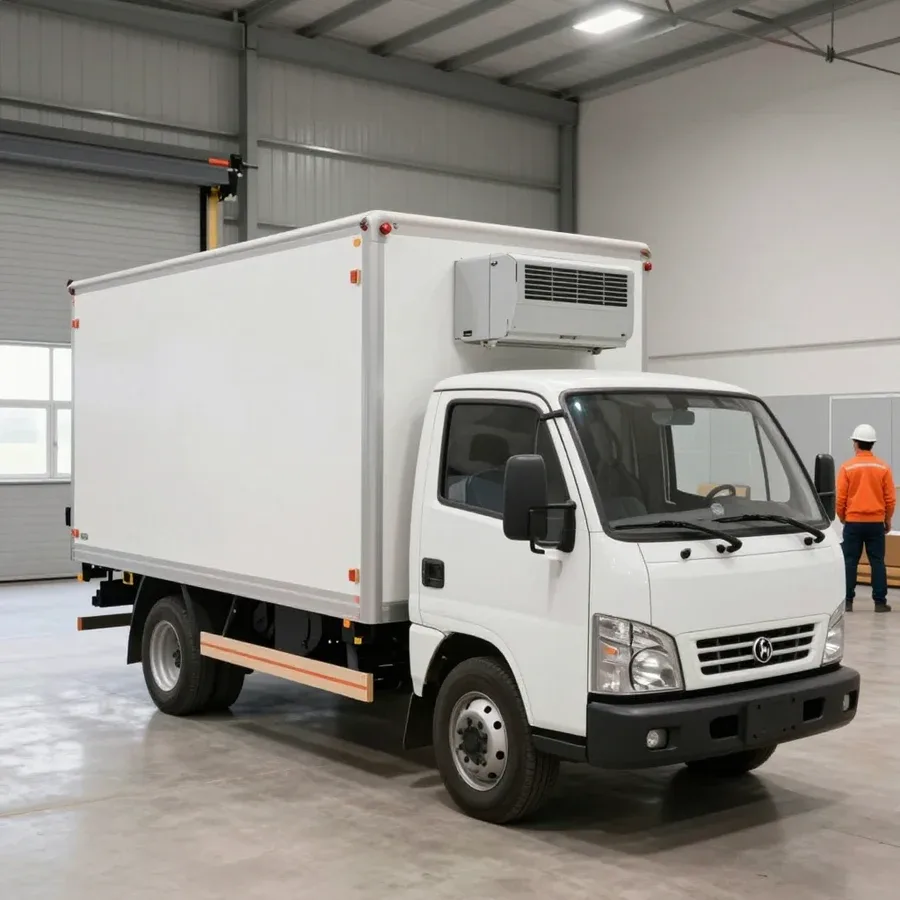
We service transport refrigeration units on cargo vans and refrigeration systems for warehouses and stores. A transport unit is mounted on the van chassis: the compressor is driven by the engine or a separate electric motor, the condenser sits on the roof, and the evaporator is inside the cargo area. Warehouse refrigeration systems, or WRS, run on 380 V, serve cold rooms and refrigerated warehouses, and maintain the set temperature continuously, not just during a trip. That's why failures differ: in transport units, mounts and circuit tubes are the first to give out; in stationary ones, contactors, automation, and the compressor that has run thousands of hours. Transport equipment works under vibration and on the move, so it suffers more from vibration and circuit leaks; warehouse units are stationary, so electrical issues and compressor wear come to the fore.
Which brands we service
- Carrier: we service transport and warehouse models, check the circuit and the electronic control unit.
- Thermo King: typical requests are circuit leaks and controller faults; we check error codes on the display.
- Elinzh: we work with units on domestic vans, more often checking electrics and starting automation.
- Zanotti: we service compact low- and medium-capacity models for delivery vehicles.
- Terrafrigo: we take on warehouse and transport models, diagnose the compressor and evaporator.
What we check during diagnostics
| Component | What we check |
|---|
| Compressor | Inlet and outlet pressure, noise, heating |
| Evaporator | Frosting, airflow, tube condition |
| Condenser | Fin contamination, fan airflow |
| Filter drier | Clogging, temperature difference at inlet and outlet |
| Control unit | Error codes, connectors, sensor readings |
Prevention and maintenance of refrigeration units
Most refrigeration unit breakdowns build up gradually and show up at the worst possible moment. Prevention costs less than emergency repair: here's what maintenance includes and how often to do it.
What preventive maintenance includes
- Checking circuit pressure: the technician connects gauges and compares readings with the norm for the specific unit model.
- Cleaning the evaporator and condenser: we remove dust, lint, and oil film from the heat exchanger fins so air flows freely.
- Compressor check: we check starting currents, heating, and valve operation — a worn component shows signs before it fails.
- Filter drier: we inspect for moisture and contamination, replace if necessary to keep moisture out of the circuit.
- Mounts and tubes: we check connections for vibration and chafing, tighten clamps after rough roads.
How often to service the unit
Service frequency depends on load: the more intensively the unit works, the more often it needs prevention, not just once a year "by the calendar." For equipment that runs almost non-stop, it makes sense to check the refrigerant circuit and compressor every few months; with light seasonal use, an inspection before the busy period is enough. A simple guideline: count operating hours, not calendar months — the compressor wears in proportion to time under load, not time since purchase. Ambient temperature also affects intensity: summer heat in Astana makes the unit run longer on each cycle, so the condenser gets dirty faster in hot weather. A sign that it's time for early maintenance is when the unit takes longer to reach operating temperature or turns on more often; it's cheaper to catch this before a breakdown than after.
How to extend the unit's life
A clean condenser, a working filter drier, and no leaks in the circuit extend the unit's service life. Dust on the heat exchanger fins reduces heat transfer, the compressor runs longer and wears out faster, and a filter drier saturated with moisture stops protecting the refrigerant circuit from corrosion and ice plugs. Check the mounts and the condition of the tubes after every rough road — vibration loosens connections, and a microcrack appears at the point of wear. Also keep an eye on the doors and seals of the refrigerated compartment: a loose fit forces the unit to run nonstop and speeds up wear on components. On overloaded routes with frequent on-off cycles, components wear out faster, so such equipment gets a closer look and scheduled checks aren't put off until a clear failure appears. A small refrigerant leak is more dangerous than a sudden breakdown: the system runs 'on the edge,' the compressor wears out faster, and you only find out when expensive repairs are needed.
Cost, payment, and choosing between repair and replacement
The question 'how much will it cost' is answered after an inspection, not over the phone. Here's what determines the final amount, how the pricing works, and when restoration will be simpler than installing a new system.
What affects the cost of work
The technician gives you the price after free diagnostics — it depends on the faulty component, the scope of work, and the parts needed. During the inspection we check the refrigerant circuit for leaks, test the compressor, and look at the electrical system and sensors: each component requires its own set of actions. Fixing a leak and recharging is one scope of work; replacing the compressor with vacuum evacuation and recharging is quite another. Add to that the difference in parts: a transport unit on a chassis and a stationary cold room are built from different components, and finding the right part for a specific model affects the total. Access to the component is another line item: on some bodies the compressor comes out easily, on others you have to remove trim and move lines aside. The same complaint 'not cooling' can lead to a simple recharge or a compressor replacement, so it's impossible to give an honest price before inspection.
How payment works
You can pay via Kaspi QR, Kaspi Red, bank card, cash or bank transfer for companies, and the cost is agreed before work begins. After the free diagnostics, the technician explains what exactly failed, which parts are needed, and what scope of work is involved — and only starts with your approval. You can pay in cash, by card, or by transfer; the choice is yours, it doesn't matter to us. The pre-agreed amount doesn't change during the work unless a second fault is found — and that is also discussed before we proceed. This approach eliminates surprises at the end: you pay exactly for what you approved, not for 'extra findings' after the unit is disassembled. If during disassembly it turns out the component can't be restored, the technician stops and agrees on an option with you again — no silent replacement with a more expensive part.
When restoration is more cost-effective than replacing the unit
Restoration is more cost-effective when one component has failed and the rest are working; replacement makes sense with through corrosion of the circuit or multiple failures at once. Through corrosion of the refrigerant line means the metal has lost strength along its entire length — soldering in one spot won't help, leaks will appear nearby. Several failures at once (compressor, sensors, electrical system) add up to a scope comparable to installing a new system. You should count not by the age of the equipment but by the number of components to replace: if it's one or two, restoration is usually faster and simpler than installing a new system. Age alone is a weak argument: a well-maintained unit with a sound circuit keeps working, while a young one with corrosion needs replacement. Another guideline is the condition of the frame and mounts: if they're intact, restoration preserves the mounting points and connections without modifying the body.
Refrigeration unit repair and what to keep in mind
Here are the key points that help you find the cause of a breakdown faster, prepare properly for the technician's visit, and avoid paying extra for unnecessary installation work.
- "Not cooling" symptom: most often points to a refrigerant leak or a clogged filter-drier, not a compressor failure.
- Error code on the display: narrows the search to a specific component, so it's worth writing down before the technician arrives.
- Work stages: free diagnostics, cost approval, repair, and checking the installation under load.
- On-site visit: saves downtime, and complex components are better serviced at the workshop.
- Preventive maintenance: costs less than emergency repair and extends the life of the compressor and circuit.






 experience11 years
 experience10 years
 experience11 years
 experience11 years
 experience16 years
 experience8 years
 experience12 years
 experience10 years
 Refrigerator Repair in Almatyfrom 3 000 ₸
 Washing Machine Repair in Almatyfrom 3 000 ₸
 Dishwasher Repair in Almatyfrom 3 500 ₸
 Oven Repair in Almatyfrom 3 000 ₸
 Cooktop Repair in Almatyfrom 3 500 ₸
 Air Conditioner Repair in Almatyfrom 3 500 ₸
 Boiler and Water Heater Repair in Almatyfrom 2 500 ₸
 Freezer Repair in Almatyfrom 6 000 ₸
 Tumble Dryer Repair in Almatyfrom 5 000 ₸
 Coffee Machine Repair in Almatyfrom 2 500 ₸
 Robot Vacuum Cleaner Repair in Almatyfrom 3 500 ₸
 Vacuum Cleaner Repair in Almatyfrom 1 500 ₸
 Microwave Oven Repair in Almatyfrom 2 000 ₸
 Hair Dryer Repair in Almatyfrom 1 500 ₸
 Iron Repair in Almatyfrom 3 000 ₸
 Electric Kettle Repair in Almatyfrom 2 500 ₸
 Mixer Repair in Almatyfrom 2 500 ₸
 Multicooker Repair in Almatyfrom 500 ₸