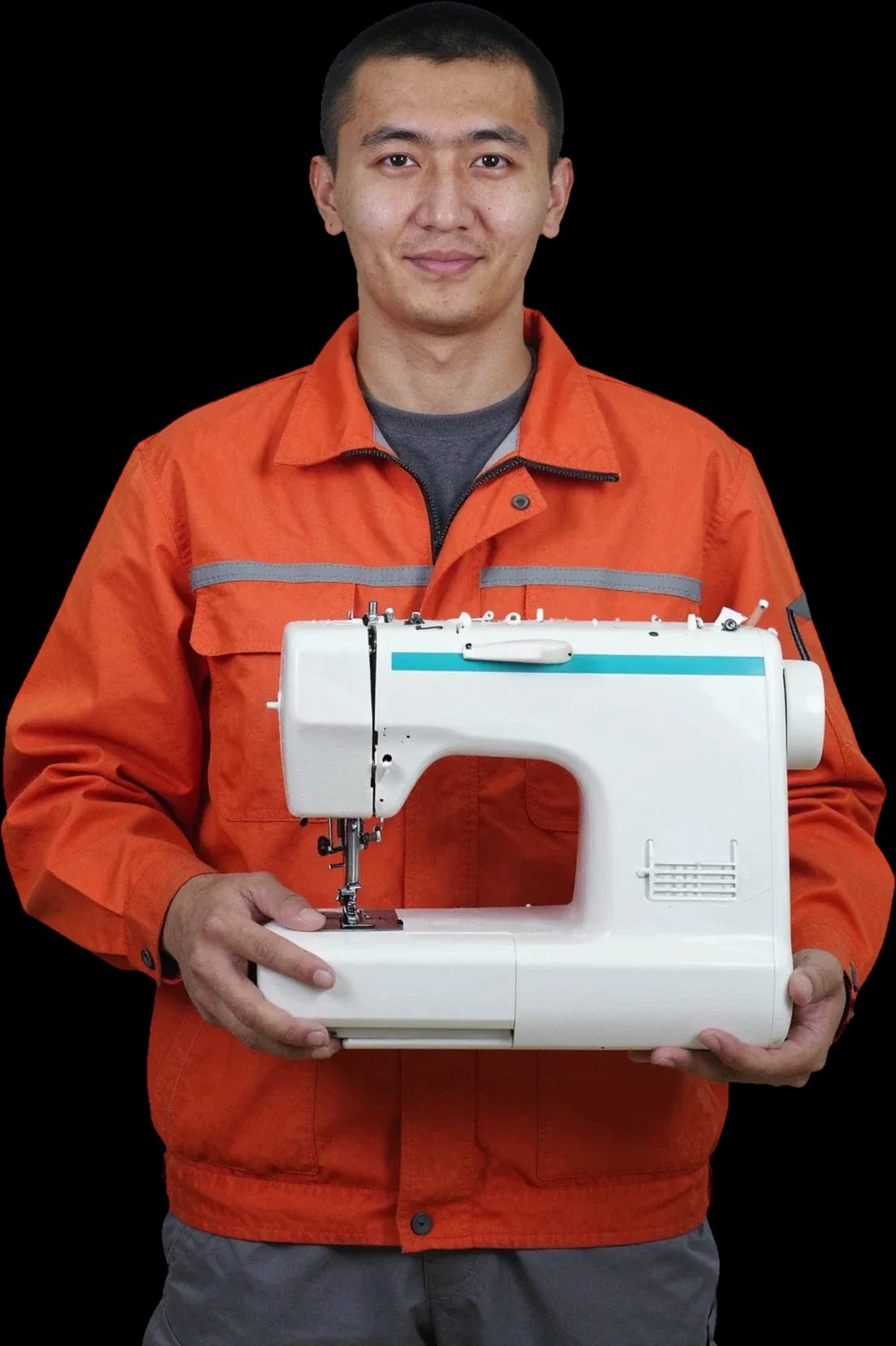
Tech Service repairs household sewing machines in Astana: our technician comes to your home or takes the machine to the service center. Diagnostics are free, we provide a 1-year warranty on labor and parts, and we can be at your door anywhere in the city within 60 minutes. The technician gives you the price after diagnostics, and you can pay via Kaspi QR, Kaspi Red, bank card, cash, or bank transfer for companies.
Why a sewing machine breaks down and when you need sewing machine repair
Most breakdowns show up as a symptom the owner describes in their own words: it won't stitch, it breaks the thread, it chewed up the fabric. Let's look at what's behind each complaint and when you can't fix it without a technician.
The machine won't stitch or skips stitches
Skipped stitches are most often caused by a dull or wrong needle, incorrect thread tension, or a worn shuttle that no longer catches the bobbin thread. A needle with a dull point doesn't pierce dense fabric but leaves a puncture from which the shuttle can't pick up the loop. A misadjusted tension dial gives a loose bobbin thread, and the stitch sits loosely. A worn shuttle wobbles in its race, so it catches only intermittently, and the needle bar gradually shifts relative to the needle plate hole. Before calling a technician, try replacing the needle and rethreading the top thread according to the diagram — this rules out half of the false breakdowns. If the stitch still doesn't recover, the problem is in the mechanics and the units need adjustment.
It breaks the top or bottom thread
A break almost always points to incorrect tension, a burr in the shuttle assembly, or the wrong thread and needle size for the fabric. A tight top thread snaps at the needle eye, while a loose bottom thread tangles in the bobbin case and breaks under the plate. A burr on the shuttle hook catches the fiber and cuts it at the same spot. A thread too thick for a thin needle won't pass through the channel and breaks with every stitch. Also check that the needle size matches the fabric weight: knits and denim need different sizes, and matching the needle to the fabric eliminates some breaks before the technician even arrives. If the break repeats at the same spot in the seam, note that spot — it will immediately tell the specialist where to look for a burr or a misadjusted setting and speed up diagnostics.
It chewed up the fabric, makes noise, knocks, or won't turn on
- Fabric chewing: a misaligned feed dog or a loose presser foot doesn't feed the fabric evenly, and it gets pulled under the plate.
- Knocking and noise: worn gears and a stretched belt create play that you hear as a rhythmic knock during operation.
- The machine won't turn on: a faulty motor, pedal, or power cord interrupts the current, and the motor doesn't start.
- The seam pulls to one side: a skewed feed dog pulls the seam off course, and the line goes wavy instead of straight.
- The pedal doesn't respond: a break in the pedal circuit or a stuck contact leaves the machine without speed control.
Sewing machine repair at home or at the service center and how diagnostics work
Let's look at both options: when a specialist comes to you and when it's easier to bring the machine to the workshop, and what the free diagnostics include before work begins.
When the technician comes to your home
We travel to your home anywhere in the city within 60 minutes, and we fix most household breakdowns right on the spot. Sewing machine repair at home in Astana covers typical cases: incorrect thread tension, skipped stitches, chewed fabric, noise in the shuttle assembly, and broken top or bottom thread. The specialist brings tools, checks the machine on site, and adjusts the stitch on your fabric — so you can see how it performs on thin knit or heavy denim. Home service is more convenient when the machine is heavy or built into a table — hauling it to the service center is riskier than having a technician come to you. Before the visit, describe the symptom over the phone: from your description, the specialist will know in advance whether the job can be done on site.
When it's better to bring the machine to the service center
You bring the machine to the workshop when a repair requires disassembling components, replacing the shuttle and gears, or working on the mechanism in a way that can't be done neatly at home. Sewing machine repair in a workshop covers more complex cases: worn gears, shaft play, replacement of worn parts, and a complete overhaul of the mechanism with subsequent adjustment of clearances. At the workbench, the technician disassembles the unit, inspects the parts, replaces worn components, and reassembles it with precise synchronization of the needle and shuttle. If the breakdown affects the electric drive or requires a complete disassembly, repair at the service center is smoother — there's space and the right conditions for complex work. Let us know when you contact us — we'll tell you whether it's better to bring the machine in or have a technician come to your home.
What free diagnostics includes and how to prepare your machine
- Stitch and tension: we check how the machine stitches on your fabric and adjust the upper and lower thread tension.
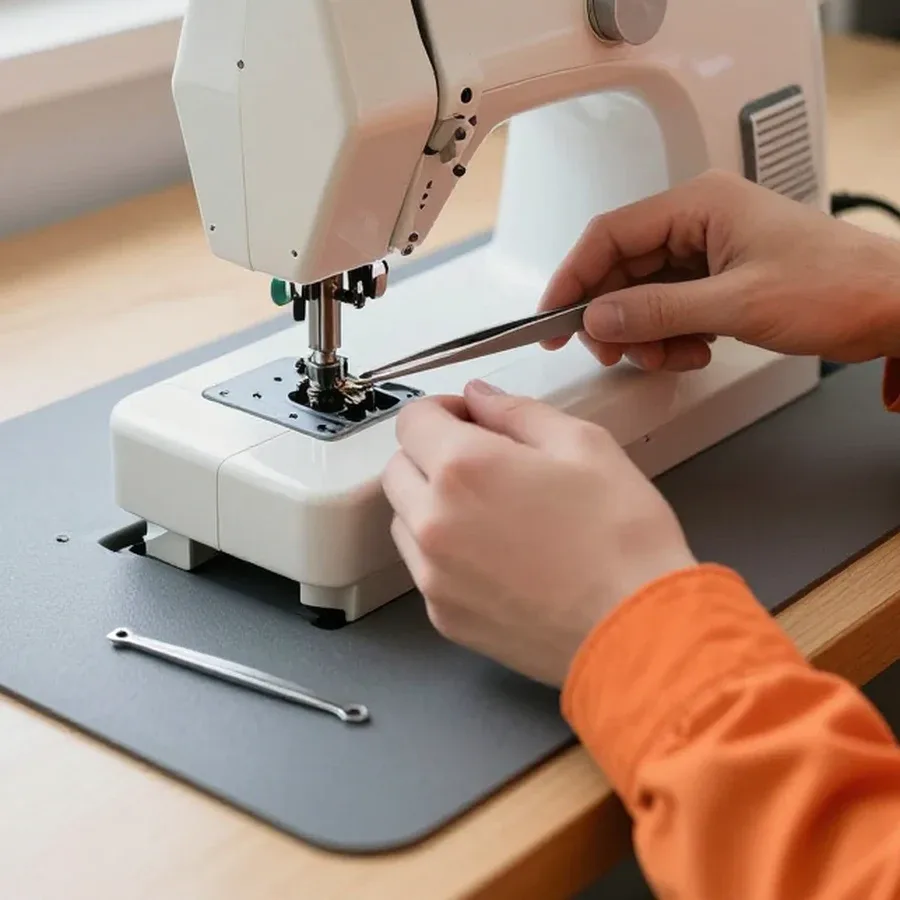
- Shuttle assembly: we inspect the shuttle, bobbin, and needle plate for burrs, play, and signs of wear.
- Feed mechanism: we check the feed dog and presser foot — the fabric shouldn't drift to the side or get stuck.
- Electric drive and startup: we check how the motor starts and whether there's any unusual noise or overheating.
- Adjustment after inspection: we identify the cause of the breakdown and the scope of work, and provide the cost after free diagnostics.
- Preparing for the visit: remove the fabric and thread from the machine and have a bobbin ready — this makes the check faster and more accurate.
Warranty and who to trust with the repair
Before starting, it's important to understand who is responsible for the result and what you get if the problem comes back. We explain the warranty, the role of the direct contractor, and the experience of our technicians.
What warranty applies
We provide a 1-year warranty on labor and parts, so if the stitching goes off again after service, you come back to us instead of looking for a new technician. The coverage also applies to replaced parts — shuttle, gears, belt, bobbin case — if they were changed during the repair. On household machines from Janome, Brother, Singer, Bernina, and Chayka, components wear gradually, and repeat failures most often occur in the first year after intervention. The warranty on parts is just as important as the warranty on labor — a worn shuttle or gear doesn't fail immediately, and the year covers exactly the period when a defective part shows up. If you contact us again, the technician will check what has already been replaced and won't charge for the same work twice.
Direct contractor or intermediary
Tech Service is a direct contractor with its own technicians, not an aggregator or intermediary, so the same service that came to you is responsible for the result. The technician comes to your home anywhere in the city or accepts the machine at the service center, and you know in advance who will be working on it. With an aggregator, there's a platform between you and the technician, and if a breakdown happens again, it's unclear who to claim against — with a direct contractor, that issue is eliminated. In my opinion, this is the main difference: you talk to the person who actually handled your machine, not a dispatcher who forwards the request. If you contact us again, the technician remembers what has already been replaced and adjusted.
Technician qualifications and experience
Our technicians have been working with household sewing machines for 4 to 20 years, so they can usually name the likely cause just from the symptom. Skipped stitches, thread breakage, knocking, or jammed fabric — each symptom points to a specific component, and an experienced specialist can tell a misadjusted thread tension from a real breakdown of the shuttle or feed dog. Such a technician arrives with a set of tools and common parts, not just to 'take a look' and leave for a spare part. Experience of 4–20 years helps distinguish adjustment from breakdown right on the spot — this saves you time and eliminates unnecessary work that could have been avoided. Diagnostics are free, so checking the cause doesn't add any separate conditions to your request.
What the cost consists of and when repair is more cost-effective than a new machine
We break down how pricing works without numbers: what factors affect the final amount, what the technician's work consists of, and when the expense is justified versus when it makes more sense to buy a new machine.
How the cost is formed
The technician quotes the price after a free diagnostic, once the cause and scope of work are clear, so you don't pay for guesswork. First, we check the unit that failed: the shuttle, the thread tension regulator, the fabric feed mechanism, or the electric drive. Diagnostics are free, and based on the results you get the specific cause of the breakdown and a list of what needs to be done — adjust, clean, replace a worn part. We take into account the age and model of the machine: mechanical designs require one set of operations, electronic programmable ones another, and this directly affects the final amount. You can pay via Kaspi QR, Kaspi Red, bank card, cash, or bank transfer for companies, including cash and card. Ask for the cause and the list of actions before work begins — that way you understand what you're paying for and can compare the cost with buying a new machine.
Repair or a new machine
Investing is justified if the breakdown affects a single unit — the shuttle, tension, or fabric feed — rather than the entire mechanics at once. A worn shuttle causes skipped stitches and thread breakage, a misadjusted tension regulator leads to looping stitches, and a clogged feed dog jams the fabric — each of these cases is solved by replacing one part or making an adjustment. If the machine is simple and reliable, replacing one unit gets it back in service for a long time, and there's no point in spending on a new model. The picture is different when several elements are worn at once: the shuttle wobbles, the belt pulls, the gears knock — then the total scope of intervention grows, and it's worth weighing a purchase. We look at the electronics separately: if the control board fails but the mechanics are intact, restoration is still worthwhile, while a dead drive combined with worn units makes the investment questionable. Cleaning and lubrication extend the mechanism's service life and delay the moment when parts replacement becomes inevitable.
What affects the final cost
| Situation type | What we check | Scope of work |
|---|
| Stitch is off | thread tension, needle | adjustment |
| Skipped stitch | shuttle, bobbin case | adjustment or replacement |
| Fabric jamming | feed dog, presser foot | adjustment |
| Knocking and noise | gears, belt | parts replacement |
| Won't turn on | electric drive, cord | unit diagnostics |
Old mechanical machines and the Chaika — repair or replace
We address a common question: do we take in old mechanical machines, and when is it worth fixing them instead of replacing with a new one.
Do we take in old mechanical machines
We service old mechanical machines, including the Chaika, and restore thread tension, even stitching, and smooth mechanism operation. With such models, the sequence matters: first we clean and lubricate the units, then adjust the shuttle mechanism, and only then set the upper and lower thread tension. The Chaika and its analogues are valued for their repairability — parts are available, the mechanism is open and can be adjusted without complex electronics, so restoring old machines is standard practice here, not an exception. Our technician arrives at your home within 60 minutes in the city and performs diagnostics for free, and there is a 1-year warranty on labor and parts. Old machines have a simple, repairable mechanism — with careful adjustment they last a long time more, if the units aren't completely worn out.
When it's worth fixing an old machine
An old machine is worth fixing if the problem is in the settings, thread tension, or a single worn part, while the body and main mechanisms are intact. Typical cases include knocked-off thread tension, a shuttle clogged with dust and thickened grease, a stretched spring, or a worn presser foot. Replacing one worn part and adjusting the mechanism brings the machine back to working condition without major expense. Cleaning and lubrication extend the life of the mechanism: thickened oil and fabric lint slow down movement, causing the machine to skip stitches and break thread. Mechanical models rarely break down seriously—more often they just haven't been serviced in a long time, and after cleaning and adjustment they sew evenly again. In our practice, such neglected machines come up all the time: servicing is enough to get them running again.
When it's easier to buy a new one
It makes more sense to buy a new machine if several parts of the old one are worn at once and restoration doesn't give lasting results. This refers to cases where the seats are worn out, the shaft or body is bent, and replacing worn parts leads to more replacements. Before making such a decision, it's worth getting a diagnosis—sometimes a "hopeless" machine only needs cleaning and adjustment, not replacement. We offer free diagnostics for sewing machines and honestly tell you when adjustment is justified and when investment doesn't make sense. Our experience ranges from 4 to 20 years per technician, and over this time we've learned to distinguish a tired mechanism from a machine that just needs care. The final verdict is given by the technician after inspection, not over the phone.
Which machines we service and how to care for them
We explain which machines and brands we work with and how to care for your equipment to prevent breakdowns. We'll cover the categories we accept for service, as well as cleaning, lubrication, and care rules.
Which types of machines and brands we service
- Household mechanical machines: classics with manual thread tension adjustment—Singer, Chaika, old Soviet models with metal bodies.
- Electronic and computerized: Brother, Janome, Singer with displays and program sets—control boards, sensors, stepper motors.
- Sewing and embroidery: combined models with embroidery units—we clean the mechanics, check unit synchronization and hoop positioning.
- Overlockers and coverstitch machines: loopers and differential feed—we adjust thread tension and eliminate skipped stitches in seams.
- Model not listed: based on the symptom, the technician will tell you if we service such a machine.
How often to clean and lubricate the machine
Clean and lubricate your sewing machine regularly during active use, and at the first signs of knocking or stiff movement—immediately, without waiting for a breakdown. With daily use, clean the shuttle mechanism and feed dog of dust and thread scraps every few weeks, and lubricate the mechanism with special oil according to the manufacturer's instructions. Dust and thickened grease are a common cause of "sudden" knocking; regular care removes it before it wears out gears and bushings. In my opinion, most complaints about noise and stiff fabric feed could have been prevented by routine cleaning once a month. Apply lubricant drop by drop to the points specified in the model's manual, rather than pouring it into the body—excess collects dust and turns into an abrasive paste.
Prevention that extends the machine's life
- Change the needle: a dull or bent needle breaks thread and hits the shuttle—install a new one after the first skipped stitches.
- Thread correctly: thread outside the guides and a raised presser foot cause loops and breaks—check the path according to the diagram on the body.
- Clean the shuttle mechanism: thread scraps and dust under the shuttle disrupt clearance and cause skipped stitches—blow out the bobbin area after each project.
- Don't pull jammed fabric: a jerk bends the needle bar and misaligns the shuttle—free the fabric by raising the presser foot and cutting the thread.
- Stop at knocking: an unusual sound signals gear wear—early diagnosis costs less than replacing the unit.
Sewing machine repair what you should know
Diagnosing sewing machine problems comes down to a few practical conclusions: from reading the symptom to deciding whether to repair the unit or replace it. Below is a short summary that helps you make a decision without unnecessary costs.
- The symptom points to the cause: a skipped stitch, thread breakage, or knocking narrows down the likely faults even before disassembly.
- Home vs. service center: adjustments and cleaning are done on-site, while work involving disassembly of components is done in the workshop.
- Warranty matters more than a cheap one-time visit: a one-year warranty on labor and parts covers a repeat breakdown of the same component.
- Cost comes after diagnostics: the final price depends on the component and parts, not on a blind price list.
- Old mechanical machines: after cleaning and adjustment, they often get back in working order and keep serving.