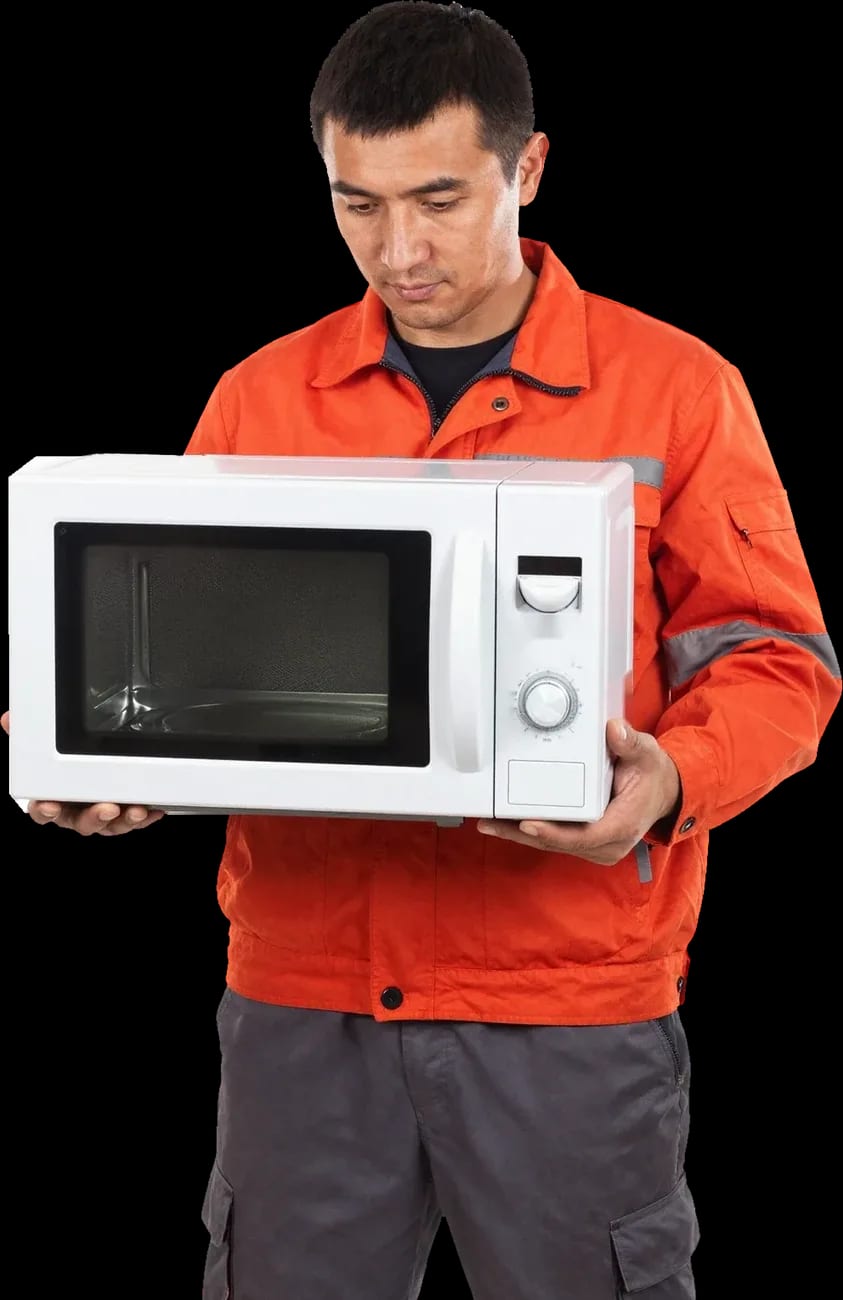

Why the oven turns on and spins the turntable but doesn't heat food
If your microwave isn't heating but the light and turntable still work, the problem is usually one of the high-voltage components — the magnetron, diode, capacitor, or fuse. Tech Service in Almaty offers free diagnostics, a technician arrives within 60 minutes, and we provide a 1-year warranty on labor and parts.
The appliance lights up, rotates the turntable, and hums, so the controls and motor are working. Heating is a separate high-voltage circuit, and that's where failures most often occur.
What it means when the light is on but food stays cold
The light, fan, and turntable run on the low-voltage side, while heating comes from a separate high-voltage block, so the oven "works" but doesn't heat. The control panel sends the command, the turntable motor spins the plate, and the fan circulates air — all these components draw little power and keep working even if the magnetron is faulty. The magnetron itself generates microwaves only when the high-voltage section is intact: the transformer, capacitor, diode, and fuse must all be in good shape. If even one element fails, the motor and light stay on but heating stops completely. Sometimes the microwave doesn't heat even though all external signs of operation are present. If after 2-3 minutes at maximum power the plate is still cold and the body and ventilation grille haven't warmed up either, the issue isn't the setting but the high-voltage section.
Why the oven stopped heating after a power surge or works intermittently
A power surge in the mains most often blows the fuse or damages the high-voltage diode, while "intermittent" operation usually points to a dying magnetron or a poor connection in the circuit. Old wiring in homes without a stabilizer causes regular spikes when neighbors' appliances turn on and elevators operate, and the protective element takes the hit first. The diode breaks down under reverse impulse, after which heating either disappears completely or becomes noticeably weaker. If the appliance turns on intermittently, don't wait until it stops heating altogether — on a worn component the load on other parts increases, and repairs become more expensive. You can't check this at home without disassembling, but it's useful to note how often failures occur: with that history, a technician can pinpoint the culprit more accurately.
What it means if the oven doesn't heat and clicks
Clicking when turned on is the relay and protective elements working, and if the oven doesn't heat at the same time, the likely cause is the fuse or high-voltage diode. The relay clicks when power is supplied to the transformer, and the sound itself doesn't indicate a breakdown — that's how the oven should work. It's alarming when there's a click but no heating: that means the command to the high-voltage section is being sent but the circuit is broken. The high-voltage capacitor and diode are connected in series in this circuit, and a breakdown of one element cuts off the entire line. A fuse that looks intact doesn't mean the circuit is fine — if it blows again after replacement, you need to look for the component causing it, not the protection.
How to tell which component failed from the oven's behavior
External signs can narrow down the suspects, but only diagnostics gives a precise answer — below we break down how different symptoms relate to specific components and what to do next.
Magnetron, diode, or capacitor — what breaks most often
Most often it's the microwave generator that fails to heat, followed by the high-voltage diode and storage capacitor, while the fuse is usually just a consequence of their breakdown. The magnetron emits energy into the chamber, and the high-voltage diode supplies it with high voltage: if the diode breaks down, alternating voltage instead of direct voltage reaches the emitter, and it loses power within weeks. The charge storage works in the same circuit, and its breakdown often occurs together with the diode. The fuse in such a circuit blows first and masks the real cause. Replacing one component "at random" is pointless: if the cause is the diode, the new part will quickly fail through the same circuit. Our technician tests the entire high-voltage circuit, not just the blown part — so a diode breakdown doesn't go unnoticed and there won't be a repeat failure.
Table of symptoms and likely causes
| Symptom | Likely cause | What to do |
|---|---|---|
| Light is on, turntable spins, food stays cold | Magnetron or diode | Service diagnostics |
| Oven won't turn on at all | Fuse, door interlock | Check the door, then call a technician |
| Sparks near the wall, spots on the plate | Mica plate | Stop using it, call a technician |
| Heats intermittently or weakly | Worn emitter | Diagnostics before it fails completely |
| Clicks but doesn't heat | Diode or capacitor | Don't turn it on, call a technician |
Can you test the magnetron with a multimeter at home
A multimeter is only for de-energized circuits, while the emitter and the high-voltage capacitor carry dangerous voltage, so testing these parts at home is unsafe. The meter will show coil resistance but won't detect a broken high-voltage diode or assess the emitter's remaining emission — that takes experience and special equipment. Even after unplugging, the capacitor holds a charge that can shock you, so you shouldn't open the case without discharging it and without experience. Checking the fuse with a multimeter is fine — it's the only part you can really test without opening the high-voltage section. Free diagnostics settles the question faster and safer than taking measurements under voltage yourself. A technician arrives anywhere in the city within an hour, so there's no point putting off the check until the weekend.
What you can check yourself and what's deadly dangerous to touch
Some causes can be fixed without tools or experience, but there are parts you must not touch until they're discharged. The line between a DIY check and a technician's job runs along the high-voltage section.
What you can actually do yourself in five minutes
- Cookware: remove metal, foil, and gold-rimmed plates — they cause sparks and block waves from reaching the food.
- Mode: check that microwave power is on, not just grill or defrost — the magnetron doesn't run in those programs.
- Door: close it firmly and make sure the interlock engages cleanly, without play or misalignment.
- Mica plate: inspect it for scorching and grease splatters, wipe it gently with a soft cloth without removing it from its mount.
- Outlet: plug the appliance directly into the wall, bypassing extension cords and adapters, to rule out voltage drops under load.
Why you shouldn't open the case or touch high-voltage parts
Dangerous voltage remains inside the case even after unplugging, because the high-voltage capacitor holds a charge and doesn't discharge instantly. The magnetron, high-voltage diode, and capacitor are connected in a circuit carrying several thousand volts, and accidentally touching the contacts with the cover off can cause a fatal shock. Besides the shock risk, careless reassembly can compromise the case shielding, and the oven starts leaking radiation during operation. That kind of repair is more dangerous than the original fault: the appliance seems to work, but radiation escapes the chamber. That's why opening the case and checking the high-voltage section is left to an experienced technician who discharges the capacitor — you shouldn't go in there yourself, even just to take a look.
Why the oven still doesn't heat after replacing the fuse
The fuse is a safeguard, not the cause. So if it blows again after replacement, or the appliance turns on but doesn't heat, the component tripping it is faulty. Most often the protection is tripped by a shorted high-voltage diode or a capacitor that has lost capacitance, while the magnetron itself may still be intact. The opposite also happens: the fuse is fine, the turntable spins, the light is on, but there's no heat—then the magnetron or its power circuit is to blame. Our technicians start by finding the root cause, not by replacing the protection again, because otherwise the repair turns into an endless parts swap with no result. Diagnostics are free, and we provide a 1-year warranty on labor and parts, so if a breakdown recurs after the technician's visit, it's handled under warranty.
Red flags: sparks, burning smell, clicking and humming
Some symptoms mean the oven can't be used until it's repaired. Here's which signs require immediate action and which can be calmly discussed with a technician.
What to do if the oven sparks and doesn't heat
If sparking occurs, unplug the appliance immediately and don't turn it on until it's inspected, because sparks burn through the mica plate and damage the waveguide. The mica plate shields the waveguide from grease splashes and food residue, and once holes burn through, grease gets into the channel. Metal cookware, foil, and gold-rimmed cutlery cause the same effect in seconds: the discharge strikes the cavity wall and leaves pinpoint melts. Sparks often appear after cleaning the cavity—then the culprit is a damp or warped plate. Don't dry or flatten such a part: replace it with a new one, because even a microcrack will collect grease again and cause a discharge. After sparking, inspect the inner walls for melting—if the metal is damaged, the repair costs more.
Burning smell and humming: when to turn off the oven immediately
A burning smell, loud humming, and clicking indicate overheating or a high-voltage circuit breakdown, so turn off the oven and don't use it until diagnosed. A metallic hum often comes from the magnetron whose magnet is degrading, while clicking comes from the high-voltage block where a diode or capacitor is breaking down. The ventilation system runs in vain if the grille is clogged with dust and grease: heat can't escape, and the windings get hotter. After turning it off, take a sniff—if the smell persists, check the vents; a clogged grille is often the cause of overheating. However, the smell of burnt plastic from wiring or a melted connector means you shouldn't just turn off the oven but also check the outlet and plug: it's the poor contact point that's heating up.
Is it dangerous to use an oven that doesn't heat?
Don't use a non-heating oven: if the cause is a breakdown, the next time you turn it on there may be sparks, smell, and damage to neighboring components. A worn magnetron takes the high-voltage diode and capacitor with it—they work as a pair, and one shorted element overloads the others. Diagnostics determine which component stopped heating the food and prevent guesswork part replacement. Externally, the appliance may look fine: the turntable spins, the light is on, the timer counts down—and that lulls your vigilance. But if microwave radiation enters the cavity through a burnt plate, it's not just the food that suffers. Even a "harmless" lack of heat eventually turns into a more expensive repair, because one worn component drags down the others. It's easier to stop at the first symptom than to deal with the consequences.
Cookware, modes, and other non-breakdown causes
It's not always about components: sometimes the appliance doesn't heat because of the cookware, the selected mode, or a weak power supply, and you can fix that yourself. Let's look at three situations where the cause lies in how you use it.
Which cookware interferes with heating and causes sparks
Metal, foil, and dishes with metallic rims reflect microwaves and cause sparks, so food stays cold and the oven can break down. A thin layer of foil on the edges of a dish can cause arcing, leaving small burn marks on the inner walls. Plates with gold rims behave the same way: the decorative layer is metal, not paint. In grill and convection modes, metal pans are acceptable, but they must not be used in microwave mode. Glass and ceramic without decoration are best, and plastic should be checked by its labeling—not all plastic can withstand the heat. In my opinion, it's easier to keep a separate set of dishes just for the microwave than to check the rims on plates every time.
Why food heats only at the edges
Uneven heating is more often caused by large dishes, overcrowding, or a faulty turntable motor, not the magnetron. When a plate is wider than the turntable and touches the walls, it doesn't rotate, and the waves hit one area—the center or edge stays cold. A tightly packed oven has the same effect: neighboring dishes shield each other, and the power barely reaches the middle. Check that the turntable moves freely and the roller rest is in place, and that there are no crumbs or dried grease on it. If the turntable doesn't rotate or rotates in jerks, food will heat in spots even if the high-voltage parts are working. The magnetron is not the issue here—it's replaced when heating stops completely, not when it's spotty.
How to extend the life of your oven and avoid breakdowns
- Cleaning: wipe the cavity and mica plate after cooking, and don't let burnt residue build up—it absorbs moisture and grease.
- Ventilation: leave a gap around the body and don't block the grille so hot air can escape freely.
- Dishes: use glass and ceramic with non-metallic decoration—this way waves reach the food and don't cause sparks.
- Power: plug the appliance directly into the outlet, avoiding extension cords and power strips to prevent voltage drops.
- Modes: don't use grill and convection unnecessarily—they put more stress on components than regular heating.
How to get repair in Almaty and when it's more cost-effective than a new oven
If self-checks don't help, diagnostics is the next step—here's how repair works in Almaty and when it's more cost-effective than buying a new oven.
How repair works at home and in the service center
We arrive at your home within 60 minutes anywhere in the city, provide free diagnostics, and quote the price after it; if necessary, we take the oven to the service center. The technician inspects the cavity, checks the high-voltage components, waveguide, and control panel to accurately identify the cause of the malfunction rather than replacing parts at random. Some issues—magnetron, high-voltage diode, fuse—can be fixed on the spot if the design and access allow. For more complex work, the device is transported to the service center. A built-in oven is opened just like a regular one—the specifics of removing it from the niche are discussed on site to avoid damaging the furniture. Before the visit, specify the model and symptoms so the technician can determine the cause faster.
Warranty, payment, and why a direct contractor is more cost-effective
Tech Service provides a 1-year warranty on labor and parts, accepts payment via Kaspi QR, Kaspi Red, bank card, cash, or bank transfer for companies, and works as a direct contractor—no aggregators or intermediaries. Our experience ranges from 4 to 20 years on various types of household appliances, so the technician identifies the fault themselves rather than passing the request to a third party. The cost of work and parts is quoted after free diagnostics, before repair begins—so you know in advance what the restoration will cost. A direct contractor is responsible for the result, so if the problem recurs, you return to the same technician instead of starting the search anew. The warranty covers both the replaced component and the work itself: if the oven stops heating again within a year, contact us under warranty.
Repair or a new oven—which is more cost-effective
Repair is usually the better choice when the body and control panel are intact and only one high-voltage component has failed — replacing that part gets the oven working again. Appliances stop heating for various reasons: a failed magnetron, a blown diode, a leaking capacitor, or a burnt waveguide — and in most cases this can be fixed by replacing a single component. A new oven makes sense when the cavity is damaged, the waveguide has burned through, or the electronics with the control board have fried, and restoring it would involve several components at once. If the waveguide, cavity, or electronics are damaged, Tech Service technicians will honestly tell you that repair isn't worth it — and won't push the job. Focus on the number of faulty components: one part — repair it; three or more — consider a new oven.
Fixing a microwave that won't heat
Here's a quick summary of the whole topic — why food stays cold when the oven is running and what steps lead to a working appliance.
- Light and turntable don't mean heating: if food stays cold, the problem is in the high-voltage circuit, not the control board.
- Symptoms narrow it down: sparks, clicking, and intermittent operation point to different components, but only diagnostics gives the exact answer.
- There's little you can do yourself: dishes, mode, door tightness, and a clean mica plate — touching anything else is dangerous.
- Don't ignore red flags: if there are sparks or a burning smell, unplug the appliance and don't turn it on until it's been inspected.
- Repair is often more cost-effective: when the body and electronics are intact, replacing one component gets the oven working again.