Tech Service repairs chillers and chiller-fan coil systems in Astana: our own on-site technician arrives within 60 minutes anywhere in the city, diagnostics are free, and we quote the cost of work after diagnostics. We provide a 1-year warranty on labor and parts, and our technicians have 4 to 20 years of experience.
Why the chiller doesn't cool, won't turn on, or shows an error
A chiller rarely fails silently: it stops maintaining water temperature, won't start, or displays an error code. Let's break down what's behind each symptom and what the technician checks first.
The chiller doesn't cool water or has lost capacity
When a chiller doesn't cool water, we first check the compressor, refrigerant circuit, and heat exchanger—these are the three components most often responsible for loss of cooling. The compressor compresses the refrigerant and circulates it through the circuit, the heat exchanger releases heat into the air or water, and any leak in the line reduces the efficiency of the entire system. A drop in capacity is rarely sudden: first the unit takes longer to reach mode, then it stops reaching the set temperature, and finally cooling disappears entirely. In our practice, restoring chillers in Astana often starts with a gradual decline rather than a complete failure. If the water warms up gradually rather than abruptly, it's more often a sign of a dirty heat exchanger or a leak rather than a compressor failure—so it's important not to replace components at random but to find the cause first. We begin chiller repair in Astana with free diagnostics to pinpoint the component causing the drop in performance.
The chiller won't turn on or shuts down by itself
If the chiller won't turn on, we check the fuses, control panel, and safety automation—and if it shuts down by itself, we look for whether a high-temperature or high-pressure lockout is triggering. Fuses and the power circuit rule out basic causes: a blown input, a loose terminal, a frozen panel. The high-pressure switch opens the circuit when refrigerant in the circuit exceeds the upper limit, and the low-pressure switch when there's not enough. Another common scenario is compressor overheating: the unit runs for a few minutes, shuts off, and only restarts after cooling down. A spontaneous shutdown is not a breakdown in itself but the automation's response to a problem in the circuit; disabling the protection and forcing the chiller to run manually is dangerous for the compressor. The technician arrives on site within 60 minutes anywhere in the city and first takes pressure and temperature readings rather than blindly replacing sensors.
Error code and low-pressure switch—what they tell you
An error code on the panel narrows the fault down to a specific component, and a low-pressure switch trip almost always indicates a pressure drop in the refrigerant circuit. Different manufacturers have their own code numbering, but the logic is the same: the panel detects a sensor deviation and blocks startup to prevent the compressor from running dry. Such a lockout triggers when there's not enough refrigerant in the line—due to a leak at connections, a clogged filter drier, or a stuck expansion valve. Sometimes the sensor itself is at fault: it gives a false reading while the circuit is fine. A single error code cannot reliably identify the broken part—it points to a component, and the exact cause (leak, clog, sensor) is confirmed by the technician on site. So it's best to treat the code as a hint rather than a ready diagnosis.
On-site repair or in the shop—how we decide
For a commercial building, downtime is critical, so the question of whether it's fixed on site or taken away is one of the first. Let's explain what determines the format of work and how we handle industrial machines.
When the chiller is serviced right on site
We fix most issues right on site — our technician arrives with tools and works without dismantling the unit. This covers refrigerant leaks in the piping, automation and controller failures, faulty pressure and temperature sensors, problems with pumps and three-way valves, clogged filters, and heat exchanger contamination. The specialist connects a manifold gauge set to the service ports, reads data from the controller, and checks pressure drops at the evaporator inlet and outlet. The chiller-fan coil system is inspected as a whole: a fault often shows up in the circuit, but the root cause lies in a single component. This approach saves downtime: there's no need to stop cooling for dismantling and transportation, and the technician immediately sees the unit together with its fan coils and piping.
When repair in the workshop is needed
We send the unit to the workshop when a component cannot be properly restored on site — for example, when major work on the compressor or heat exchanger is required. Compressor replacement, brazing and pressure testing of the circuit, and restoring the tightness of a shell-and-tube heat exchanger require stationary conditions: lifting equipment, a vacuum pump, nitrogen for purging, and a space where the equipment can be set up. On site, such operations are performed only if there is enough space and access to the component; otherwise, the risk of repeated depressurization is higher. The technician decides on the work format after diagnostics and explains the reason — so the owner understands why an on-site visit alone is not enough. For scheduled dismantling, we agree on a downtime window with the owner to avoid disrupting the sales floor or office, and we discuss in advance which components to check on site before transportation.
Industrial chillers for shopping centers and offices
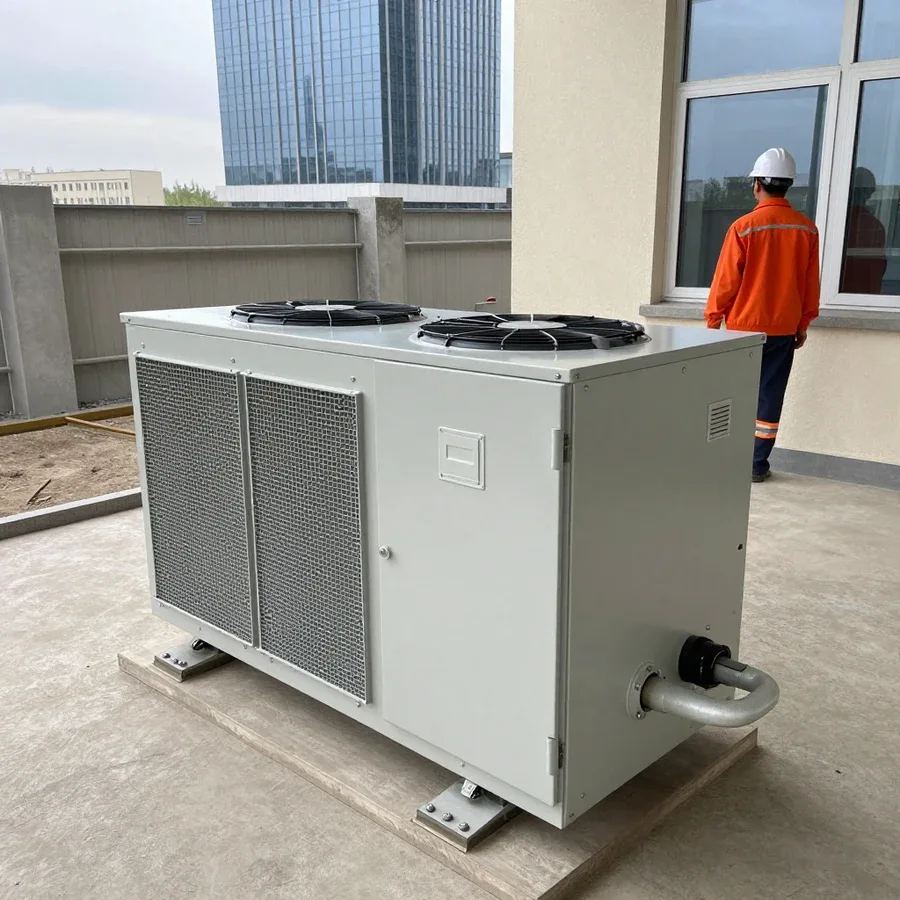
We work with industrial and commercial machines in shopping centers and offices, not just household cooling systems. These are monoblock and modular units with screw and scroll compressors, air- and water-cooled condensers, with capacities from tens to hundreds of kilowatts. In such facilities, the equipment is connected to central air conditioning, ventilation, and cooling supply, so diagnostics are carried out along the entire chain: the unit, pump group, fan coils, automation, and monitoring. We base our service for shopping centers and offices in Astana on minimizing downtime — we coordinate work with the building's schedule. In a large facility, equipment rarely operates alone — it's important to check it together with fan coils and pumps, otherwise a fixed fault will return through an adjacent component.
How free diagnostics works and where the cost comes from
Diagnostics is not a formality before restoration — it's the stage where the cause is determined. Here's what it includes, why it's free, and when the cost of work is quoted.
What free chiller diagnostics includes
Our diagnostics are free: the technician inspects the chiller, checks the components, and determines the cause of the breakdown before any work begins. The on-site specialist reaches the facility anywhere in the city within 60 minutes, inspects the unit, measures parameters in the circuit, checks the electrical part, the condition of the compressor and heat exchanger, and decodes error codes from the control panel. Based on the inspection, they state the cause and scope of work — the owner learns the cost after the check, not before. This approach benefits both sides: the owner gets an accurate diagnosis without paying for an 'inspection,' and we don't waste time working blindly or replace working parts. The technician records pressure measurements, inlet and outlet temperatures of the heat exchanger, and compressor current consumption — this data reveals the cause more accurately than a single symptom. You can pay via Kaspi QR, Kaspi Red (instalments), bank card, cash, or bank transfer for companies, and the 1-year warranty covers both labor and parts.
How to tell a compressor failure from a circuit problem
To tell a compressor failure from a refrigerant circuit problem, a technician checks pressure and refrigerant condition: if pressure is normal but there's no cooling, the compressor is the prime suspect. The technician measures suction and discharge values, inspects the lines for leaks, and assesses the condition of the compressor oil and heat exchanger. A drop in capacity with a working compressor usually points to a leak or a dirty heat exchanger, while noise and vibration at normal operating parameters indicate wear of the unit. A mistake in this direction is costly: replacing the compressor when there's just a leak means unnecessary work, so the diagnosis is confirmed by measurements, not by ear. The difference in symptoms is subtle: with a refrigerant leak, the unit typically runs longer and doesn't reach the target water temperature, while compressor wear brings a metallic sound and rising current draw. These scenarios must not be confused—they determine both the scope of work and which parts will be needed.
Which chiller components fail most often
| Component | Typical symptom | What the technician checks |
|---|
| Compressor | no cooling, noise, vibration | operation, wear, oil |
| Refrigerant circuit | capacity drop | pressure, leaks |
| Low-pressure switch | error, self-shutdown | circuit pressure |
| High-pressure switch | safety shutdown | excess pressure |
| Heat exchanger | poor water cooling | contamination, heat transfer |
| Control panel | error code | code interpretation, sensors |
| Fuses | chiller won't turn on | circuit integrity |
Warranty and responsibility for the repair
The warranty is what a chiller owner wants to understand before booking. Here's what it covers and why a direct contractor is responsible for the result.
What the 1-year warranty covers
We provide a 1-year warranty on both labor and parts—meaning responsibility covers not only the service itself but also the installed components. For the owner, this means that if a failure recurs, there's no need to figure out whose defect it is: we come and fix the problem as a warranty case. This applies to the compressor, the heat exchanger, and the automation replaced during service. A separate warranty on parts matters because some failures are caused by the parts themselves, not by the quality of work—the owner doesn't have to prove whose defect it is. In my view, this approach removes the customer's main fear: after paying, they're left alone with the equipment.
Why a direct contractor is responsible for the result
Tech Service is a direct contractor: our technician comes to the site, not an intermediary, so one company is responsible for diagnostics, work, and warranty. We don't pass the request to a subcontractor and don't act as a dispatcher between you and the technician. When working through an intermediary, responsibility is blurred between the dispatcher and the subcontractor, but with a direct contractor, a warranty claim is filed with the same service that performed the work. In practice, this saves time: you don't have to re-explain the breakdown history to a new person and wait for approval again. In the city, the technician arrives within 60 minutes, and the same specialist handles the site from the first visit to the warranty claim, so the whole picture stays with one person.
Technician experience and payment
Our technicians have 4 to 20 years of experience, and you can pay for the service in any convenient way — via Kaspi QR, Kaspi Red, bank card, cash, or bank transfer for companies. A technician's experience directly affects diagnostic accuracy: the more hands-on work with industrial cooling, the less often parts are replaced "on a guess" and the more precisely the real cause of failure is identified. The technician quotes the price after free diagnostics, once it's clear which component has failed and what to do about it. In our practice, we often arrive at sites with chillers where a third-party contractor has already "diagnosed" the problem — and in about half of those cases, the cause turns out to be in a different component. That's why we start with our own inspection rather than replacing what someone else named, and we back the result with our warranty.
Repair or maintenance — when you need which
Not every drop in performance means the unit needs repair — sometimes maintenance is enough. Here's how to tell the difference and when to think about regular care.
When maintenance is enough and repair isn't needed
If the equipment runs but performance gradually drops, the cause is often a dirty heat exchanger, and maintenance is enough — no need to replace components. We start with free diagnostics: we measure circuit pressure and water temperature at the inlet and outlet, and check the condition of the heat exchanger and filters. A heat exchanger clogged with scale or oil reduces heat transfer — the unit takes longer to reach operating mode and uses more energy, even though the compressor is fine. In chiller-fan coil systems, a dirty internal circuit is more common than compressor failure: water with impurities settles on the tubes, not in the unit itself. A technician arrives at your site within 60 minutes anywhere in the city and flushes the heat exchanger on site. A gradual drop in performance is a reason to check the whole system: sometimes a compressor "repair" turns out to be maintenance of the heat exchanger and circuit.
How often to service a chiller to avoid repairs
Regular maintenance reduces the risk of sudden failure: the sooner a drop in performance and dirty components are noticed, the less often it comes to repair. In practice, checks are tied to the season: before the heating season, the refrigerant circuit, heat exchanger, and electrical parts are inspected so the unit doesn't let you down in freezing weather. For a busy commercial site, it makes sense to add an interim inspection at the height of the cooling season, when the equipment runs without pauses. Frequency depends on water quality in the circuit, load, and site conditions — there's no single schedule for everyone. A seasonal check before winter covers the main risks: circuit leaks, worn seals, and a dirty heat exchanger. Preventive maintenance is cheaper than emergency repair not only in labor but also in downtime: a breakdown at the height of the season costs a site more than a scheduled check.
One-time service or regular maintenance
A one-time repair fixes a specific breakdown, while regular maintenance of chiller-fan coil systems helps prevent it — the choice depends on the unit's condition and the load on the site. If the unit has already run for several seasons without inspection, a one-time diagnostic will show what needs attention first: the circuit, heat exchanger, or electricals. At a commercial site with constant load — a shopping center, office, or production facility — clients more often choose a maintenance contract with us: scheduled checks follow a plan, and a technician arrives within 60 minutes when a fault is reported. Our 1-year warranty on labor and parts covers both one-time repairs and maintenance. For a busy commercial site, prevention pays off: it spots component wear before the equipment stops on a workday.
Chiller specifics in Astana's climate and how to choose a service
Astana's cold winters affect how a chiller operates, and your choice of service affects what downtime will cost. We cover both questions in this section.
What to check before winter
Before winter, a chiller needs a seasonal check: it's important to make sure the circuit, heat exchanger, and safety controls are ready for cold and temperature swings. A technician checks the refrigerant circuit for leaks, the condition of the heat exchanger, and whether the protection relay trips — these are the components that react first to frost and daily temperature changes. They also look at the piping and how the controls behave when the outdoor air is cold. Freeze protection settings get checked too: the sensor must read the water temperature in the circuit correctly, otherwise the controls will either fail to trigger protection in time or shut the system down for no reason. In winter, equipment runs in different conditions, so problems that go unnoticed in summer show up in the cold: a seasonal check catches them before an emergency shutdown. In my view, it's cheaper to go over the components once in the fall than to deal with the aftermath of a frozen circuit in the middle of the heating season.
How to choose a service and avoid overpaying a middleman
When choosing a service, it's worth asking whether the technician comes directly or through a middleman: with a direct contractor, diagnostics, work, and warranty are all in one pair of hands. In our practice, the first question to ask is simple — who exactly will come to the site and who is responsible for the result. A direct contractor does the free diagnostics themselves, quotes the price after the inspection themselves, and gives a 1-year warranty on labor and parts themselves. A middleman adds their markup to the work and blurs responsibility, so the question "who exactly will come" matters more than it seems at first glance. It's easy to check: if the person coming to the site is an employee of the same company that advises you on the phone, the chain is short and there's no one else to hold accountable.
How fast the technician arrives and how to book
A technician arrives on site within 60 minutes anywhere in the city, so a faulty chiller gets inspected shortly after you call. You can book by phone or leave a request on the website — the dispatcher asks for the site address, the chiller brand, and how the fault shows up, so the technician arrives prepared. Diagnostics are free: based on the results, you get a report and a quote, and you decide after the inspection. The sooner the technician sees the chiller, the lower the risk that a minor fault turns into a system shutdown — so arrival speed directly affects the outcome. For sites where the chiller keeps a process running, those 60 minutes are often the difference between scheduled maintenance and downtime.
Chiller repair and what to expect
Chiller repair comes down to three decisions: find the cause of the failure, choose the format of work, and assess the contractor's responsibility for the result. Below are the takeaways that help you make these decisions without extra costs.
- The symptom narrows the search: no cooling, failure to start, an error code, or self-shutdown point to a specific group of components, but only diagnostics confirm the exact cause.
- Work on site: most faults are fixed on site, and the unit is sent to the service center only when a component can't be restored in place.
- Diagnostics and cost: the check should be free, and the price is quoted after it, once the cause is known.
- Warranty and contractor: a warranty on labor and parts is a key selection criterion, along with whether the technician comes directly or through a middleman.
- Prevention: regular maintenance and a seasonal check before winter reduce the risk of an emergency shutdown.