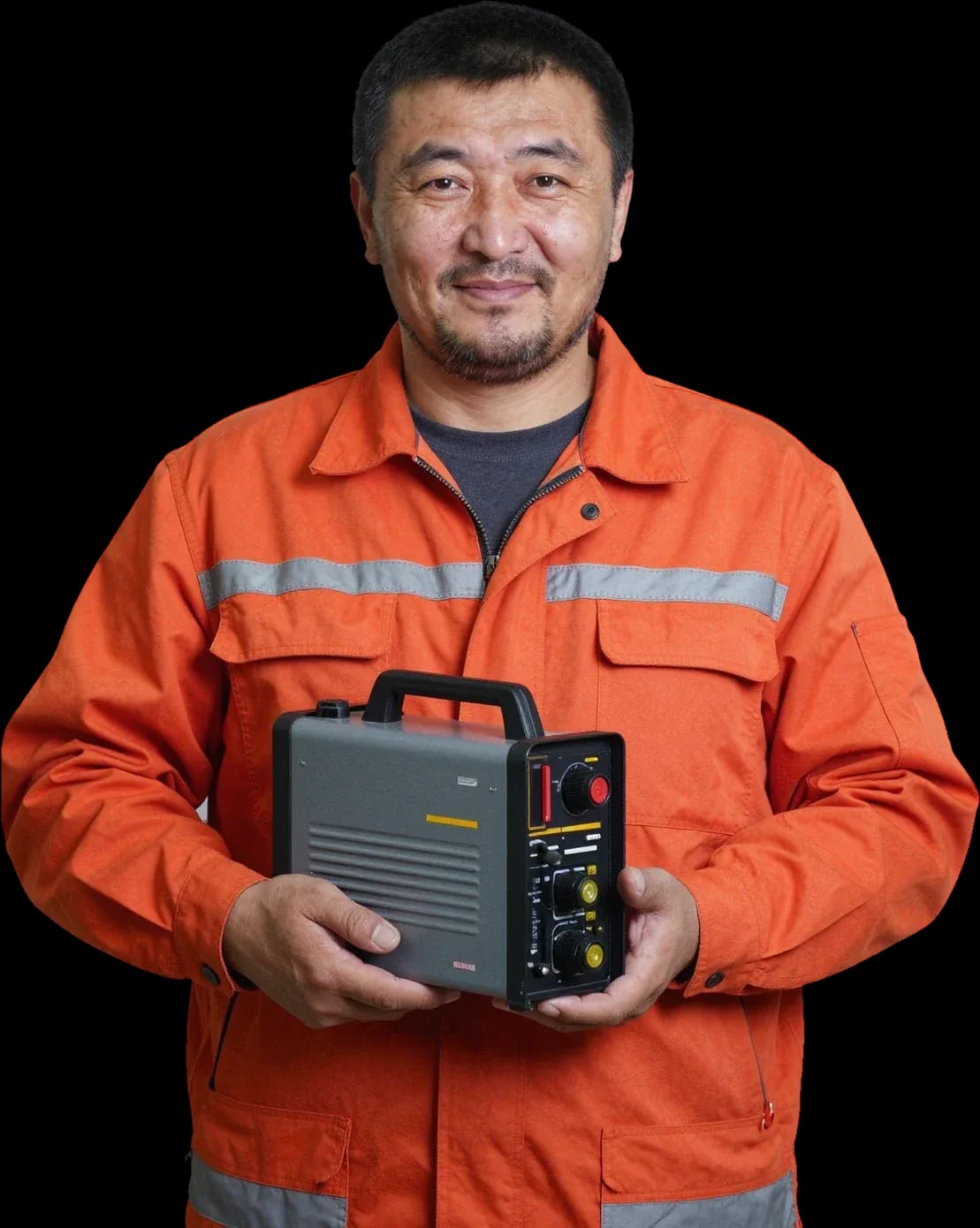
Tech Service repairs welding machines in Astana directly, without middlemen: our technician comes to your home within 60 minutes or takes the machine for repair at our service center. Diagnostics are free, we agree on the price after diagnostics, and we provide a 1-year warranty on labor and parts. Our technicians have 4 to 20 years of experience.
Why the machine stopped welding after repair and what it means
A symptom is not a verdict but a pointer to a specific component. It helps the technician narrow down the causes before the visit, so it's important to describe exactly how the machine behaves when turned on and under load.
The machine won't turn on or turns off immediately
If the machine won't turn on or trips the breaker at startup, the cause is usually in the power supply — cable, terminals, connectors, and input rectifier — rather than a burnt board. Inspect the power cable along its entire length for kinks and signs of melting, check that the input terminals are tight and the power plug is intact: a loose contact heats up and causes voltage drop under load. The input diode bridge breaks down due to phase imbalance or a sudden surge in the mains — then the breaker trips within a couple of seconds after turning on. A separate issue is the breaker in the panel itself: if it's old or incorrectly rated, it trips before the machine can reach its working current. Before calling a technician, check whether the breaker holds the load from another powerful appliance — this way you can separate a wiring problem from a machine fault.
Doesn't hold the arc, sputters and hums without welding
If the arc sputters or won't strike while the machine hums, it's a typical sign of problems in the inverter's power section: diode bridge, capacitors, and power modules that stop delivering stable voltage. The welding inverter converts AC mains to DC for the arc, and any failure along this path shows up as unstable arc burning. Dried-out capacitors in the power section lose capacitance and stop smoothing ripples — the arc starts to "tear" at medium currents. A broken diode bridge produces a characteristic hum without ignition, and a faulty power module causes jerks and pops instead of a smooth weld. Check the ground clamp and torch connector: poor contact mimics the same picture as an electronics failure. If the hum appeared suddenly after long operation at maximum power, overheating of power elements is more likely than mechanical cable damage.
Overheats and shuts down under load
Overheat shutdown is almost always related to cooling: a clogged fan, dried thermal paste, or a faulty temperature sensor makes the machine go into protection prematurely. Dust and metal shavings clog the cooling fan blades, speed drops, and the heatsink can no longer dissipate heat from the power modules. Thermal paste between the module and heatsink dries out over a few years and turns to crumbs — thermal contact is lost even though everything looks intact. A failed temperature sensor sends a false signal, and protection triggers on a working machine. Check that the ventilation grilles are not blocked and how strongly air blows out of the case under load. Don't ignore repeated shutdowns — operating in protection wears out power modules faster than overheating itself.
What we repair in inverters and semi-automatic machines during welding machine repair
We restore welding equipment in Astana at the component level — from the control board to the wire feed mechanism — rather than just "replacing the whole thing." Below is a breakdown of which components we check in inverters and semi-automatic machines.
Control board and power modules
We check the control board and power modules with IGBT transistors separately and decide what to repair and what to replace — often it's enough to restore one unit rather than resolder the entire power section. The inverter's electronic block handles pulse-width modulation: it sets the current and arc stability, so when the arc is "floating," the technician first looks at the traces, capacitors, and optocouplers. The power module is an assembly of IGBT transistors and diodes that switches current in hundreds of amps; if at least one switch breaks down, the machine hums or trips the breaker. Electronics are more often restored, while power assemblies are replaced when they break down — these are jobs of different complexity, and the technician determines the option during diagnostics. In my opinion, a restored block lasts no worse than a new one if the insulation is checked after the work.
Wire feed mechanism in a semi-automatic welder
If the semi-automatic welder doesn't feed wire, we service the feed mechanism — rollers, guide channel, and drive — and check whether the path is clogged or the rollers are slipping. In a welding semi-automatic, the consumable goes from the spool through the feed rollers into the guide channel and then to the torch and cable; a clog or a pinched liner slows it down even if the motor is working. We remove the path, blow it out, and inspect the rollers for groove wear: over time, the groove on a roller for the required diameter widens and stops pulling. Roller slipping is often confused with a broken feed motor, though the cause is a worn roller or incorrect pressure — adjusting the pressure is easier than replacing the drive. Replacing the roller for the correct diameter restores smooth feeding.
What machines and components we take on
| Machine type | What we check first | What we repair most often |
|---|
| Welding inverter | control board, power modules, diode bridge | power section, cooling |
| Semi-automatic welder | wire feed mechanism, torch, cable | wire feed, connectors |
| Professional machine for service stations and workshops | power modules, capacitors, fan | power section, cooling |
Repair at home or at the service center
Some breakdowns are fixed on site, while others require work at the service center — the difference is which component has failed and whether the machine's power section needs to be disassembled.
What we fix at the customer's home
At home, we handle what doesn't require deep disassembly of the power section: inspecting the cable, terminals, and connectors, checking the torch, servicing the wire feed mechanism, and diagnostics. The on-site technician first tests the power cord and checks the contact in the connector — oxidized terminals cause voltage drops that make the inverter go into protection. On a semi-automatic welder, we separately check the feed mechanism: worn rollers and a clogged feed channel cause jerky feeding and an unstable arc, even if the electronics are fine. We disassemble the torch, check the core, nozzle, and contact tip. If after the on-site inspection it's clear that board soldering or replacement of power modules is needed, the machine is taken to the service center — this way the work is done more carefully, without the risk of damaging traces while holding the board in the air.
When the machine is taken to the service center
A machine goes to the service center when power modules need replacement, work on the control board is required, or the power section needs to be tested under load — these are tasks that can't be done properly on-site. Soldering power switches and diagnosing the PWM controller require a stable workbench, lighting, and testing under current, not balancing on your knee. Cases with blown diode bridges and inverter transistors also go there: without a load test, you can't be sure the component will handle welding mode rather than failing on the third electrode. The on-site technician immediately says whether the work can be done on-site, so you don't pay for unnecessary transportation. In my opinion, it's more honest to say so right away than to stretch the visit for half a day for work that will still have to be finished at the workshop.
How soon the technician will arrive
A mobile technician arrives within 60 minutes anywhere in the city, so you can show the problem to a specialist on the day you call. Diagnostics are free: the technician inspects the unit and identifies the cause, then quotes the cost of work after the check. The service covers all districts — from the left bank to the outskirts — so you don't have to wait to deliver equipment to the workshop. To speed up the visit, describe the symptom in advance — won't turn on, hums without an arc, trips the breaker, shows an error code. Based on your description, the technician brings the right tools and parts for the likely cause and fixes more on site than a blind inspection would. A precise symptom also saves time on a second visit if the unit still has to be taken to the service center.
How a request works and what the warranty covers
A request goes step by step: you contact us, a technician visits or you drop off the unit at the service center, free diagnostics, cost approval, the work itself, and a warranty on the work and parts.
Free diagnostics and cost approval
Diagnostics are free, and the technician quotes the price based on the results — you agree on the scope before work starts and know what you're paying for. First, the specialist inspects the unit, checks the power supply, tests the power circuits, checks the diode bridge and examines the control board to separate a cheap fix from an expensive one. Welding machine repair in Astana starts with this check — without it, any sum would be a guess, and replacing components would turn into trial and error at your expense. Then you get a clear explanation: which component failed, what parts are needed, and how much the work will cost. If the inspection shows that repair isn't worthwhile, you'll know before disassembly, not after the work is done — and you won't pay for something that's easier to replace.
1-year warranty on labor and parts
We provide a 1-year warranty on labor and parts, so if the problem returns within that period, we deal with it again. The condition covers both at once, not just the technician's work: a replaced power module, control board, or wire feed mechanism also remains protected. For the owner, this means a repeat failure for the same reason doesn't become a new expense, and the discussion doesn't start with "whose fault is it." The warranty covers installed parts as well as the work itself — this matters when a power module or board is replaced. In our experience, repeat calls are more often related to components, so we include them in the warranty: the technician who installed the part is responsible for how it performs under load, just as for the quality of soldering.
Payment and technician experience
You can pay via Kaspi QR, Kaspi Red (instalments), bank card, cash, or bank transfer for companies, and our technicians have 4 to 20 years of experience — this allows them to pinpoint the cause rather than replace components at random. The range of experience within the team works in your favor: complex cases with inverter boards are handled by someone who has seen them dozens of times, while typical semi-automatic machine failures are fixed faster. An experienced technician can often determine the likely cause from the symptom before disassembly, which saves diagnostic time and reduces unnecessary replacements. You can pay in the way that suits you — cash, card, or transfer — and the technician quotes the price after free diagnostics, before work begins. This approach removes the risk of a dispute about the sum later: you pay exactly for the agreed scope, not for an extended search for the fault.
Failures after power surges and short circuits
Power surges and short circuits are a common cause of failure in the power section of an inverter, and the scope of work depends on what exactly was damaged.
What gets damaged during a power surge
When voltage spikes, the input rectifier, capacitors, and power modules are the first to fail — they absorb the surge and stop delivering stable voltage for the arc. The diode bridge breaks down, electrolytic capacitors swell and lose capacitance, and the switching module may fail partially or completely. After a surge, the machine often turns on and even hums but won't weld — an outwardly intact case doesn't mean the internals are undamaged. In our practice, such inverters are most often brought in after a thunderstorm or substation accidents when the mains voltage jumps above the operating range. It's best to check the machine right after a surge without waiting to turn it on again: reapplying power to a broken component finishes off the surviving parts and increases the scope of work.
Machine after a short circuit
After a short circuit, power modules and protection fuses are most often damaged, so diagnostics start with checking the integrity of the power circuit and protective elements. A short from the electrode to ground or moisture on the board causes a sharp current surge that burns traces and breaks switches. If the machine trips the breaker after a short, don't turn it on again — this can finish off the surviving components. The technician tests the circuit according to the schematic, finds the breakdown point, and assesses what needs replacement and what can be restored. Diagnostics are free throughout the city, so it makes sense to have it checked before any attempts at self-repair: that way you don't risk burning out still-working components. The technicians' experience ranges from 4 to 20 years, and by the nature of the damage they quickly determine where exactly the current surge passed.
How to tell a blown module from a fuse
A blown fuse usually looks like an open circuit and is replaced without consequences, while a broken power module requires replacement and checking the entire power section — you can't determine this visually without instruments. A fuse is a consumable protective element; it's the first to take the current surge and break the circuit, leaving other components intact. A broken module may look normal outwardly, but a multimeter will show a short between its terminals, and the diode bridge and capacitors will show deviations in capacitance and resistance. Replacing only the fuse when the module is broken doesn't solve the problem — the machine will trip protection again under load. That's why the technician checks the whole chain: a new fuse paired with a broken switch will blow again and take neighboring parts with it.
Repair or replace
The decision to repair or replace depends on which component failed, how heavily the equipment was used, and whether it's worth investing in an old model. Let's look at the criteria that become clear during diagnostics.
When repair is justified
Restoration is justified when a single component fails — the control board, cooling fan, or wire feed mechanism — while the power section and housing are otherwise intact. The control board handles the inverter's logic: it sets the PWM frequency, monitors current and protection, and replacing it restores normal behavior without touching the power circuit. The cooling fan is a consumable component: when dust clogs the blades, the heatsink overheats, thermal protection triggers, and the equipment shuts down under load. The wire feed mechanism in a semi-automatic welder wears out at the rollers and guide channel — it's a separate repairable unit not connected to the electronics. If the model is otherwise functional and matches your power needs, replacing one component gets it back to work without buying a new one.
When replacement is smarter
Replacement makes more sense when the entire power section is damaged at once — several power modules, the diode bridge, and the power-section capacitors — or when the equipment isn't built for your loads and constantly runs at its limit. The diode bridge and capacitors work together with the modules, and in a cascading breakdown almost the whole power chain changes, not just one component. A professional model with power headroom handles long welding sessions without overheating, while a household unit on the same task goes into thermal protection. Constant operation at the limit speeds up wear on power components, so sometimes it's better to choose a model with power headroom than to repair an old one. It's also worth weighing separately: if the unit has already been through one cascading repair, a second breakdown along the same chain will cost more than new equipment suited to your tasks.
How we help you decide
After free diagnostics, we explain exactly what has failed and what options you have — repair one unit or replace the equipment — and you decide without pressure. We're the direct contractor: our technician comes to your home, performs the diagnostics, and quotes the cost of work based on the inspection, with no middlemen in the chain. Our specialists have 4 to 20 years of experience, so from the nature of the fault they can tell a local breakdown from cascading damage to the power section even before disassembly. An honest assessment during diagnostics saves money: sometimes repair isn't worthwhile, and it's better to know that before the work, not after. We don't push replacement where repair is enough, and we say straight out when the investment won't pay off.
Welding machine repair and what to keep in mind
The signs collected in this article help you understand what's happening with the unit in advance and prepare for a conversation with the technician. Below is a short summary of the whole topic.
- A symptom isn't a verdict: from how the unit turns on, hums, or shuts down, the technician narrows down the causes even before disassembly.
- At home or in the shop: some faults are fixed on-site, while restoring the control board and power modules requires a workshop.
- Diagnostics and approval: a free check and discussing the work before it starts removes the risk of unexpected costs.
- Warranty matters more than speed: a year on labor and parts protects you from a repeat breakdown of the same unit.
- Repair or replace: the decision depends on how many units are affected and whether the equipment suits your loads.