 experience9 years
Ruslan Ts.
Washing machine and refrigerator repair technician

A technician arrives within 60 minutes anywhere in the city. Diagnostics are free.
Our own technicians4 to 20 years of experience




Repair prices
Below are frequent symptoms and likely causes. A symptom can have several causes, and the technician checks them one by one.
brushes, switch, cable
from2 000 ₸
striking mechanism, lubrication, piston
from6 500 ₸
worn cells, circuit board, charger
from2 000 ₸
brushes, commutator, overload
from2 000 ₸
bearing, gearbox, fan
from2 000 ₸
contamination, worn brushes, winding
from2 500 ₸
gearbox, shaft, coupling
from3 000 ₸
overload, bearing, gearbox
from2 000 ₸
1–3 daystime
from 4,000 ₸cost
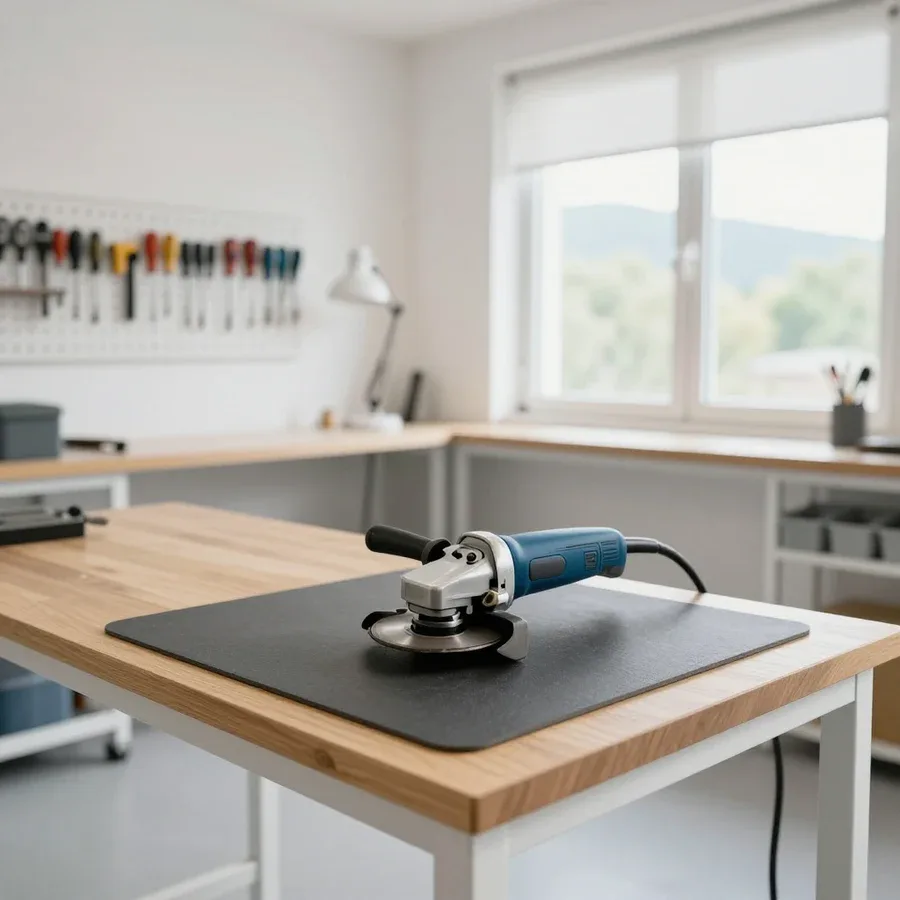 BeforeAfter

Five steps from request to checking the tool's operation.
Describe the symptom and tool model so the technician brings the right parts.
The technician arrives anywhere in the city and inspects the tool on site.
The technician checks the unit and identifies the cause of the breakdown.
You confirm the scope of work and parts replacement, then the technician starts.
You receive the tool and check the complete set together with the technician.
The home appliance repair department in Almaty has 8 technicians with 8 to 12 years of experience.
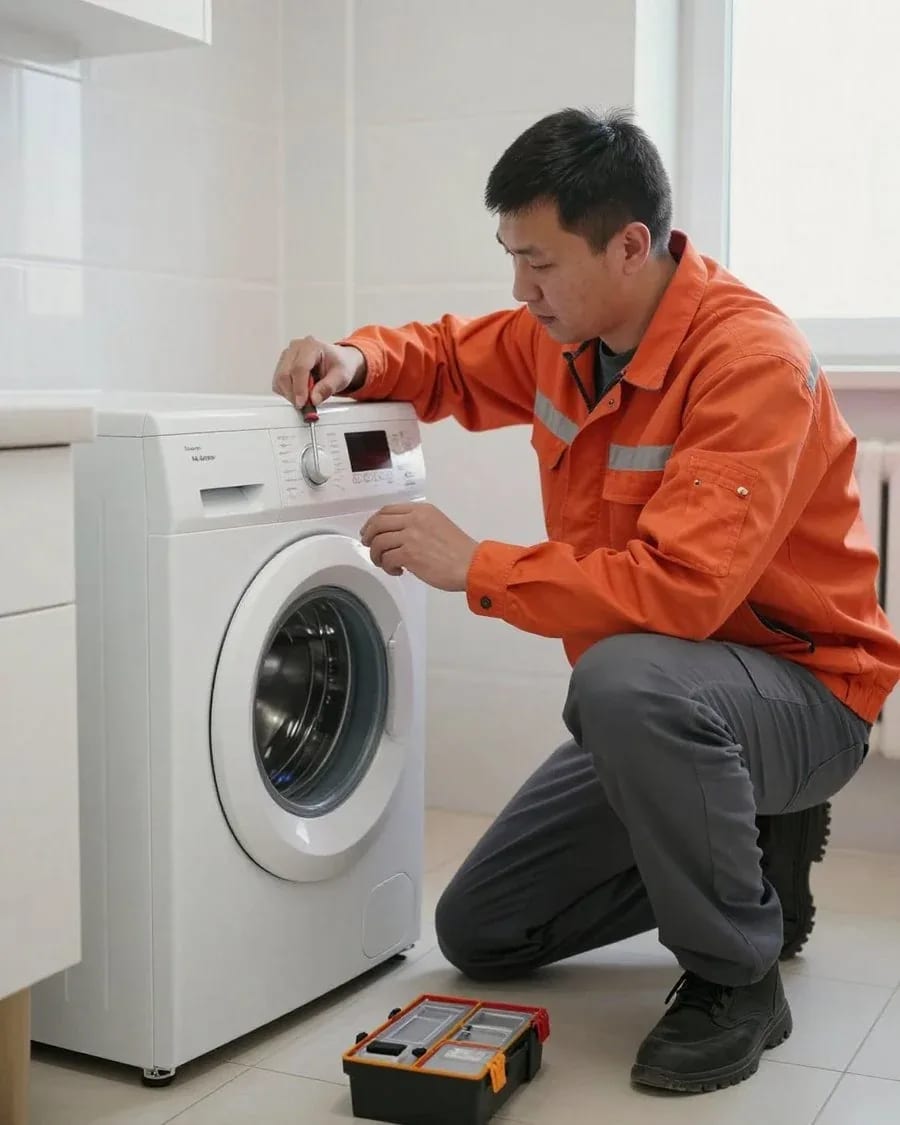
The department has 8 specializations — they are listed on the technicians' cards.
experience9 yearsWashing machine and refrigerator repair technician
 experience12 years
General household appliance repair technician
 experience10 years
Field technician for washing machine and refrigerator repair
 experience8 years
Expert washing machine repair technician
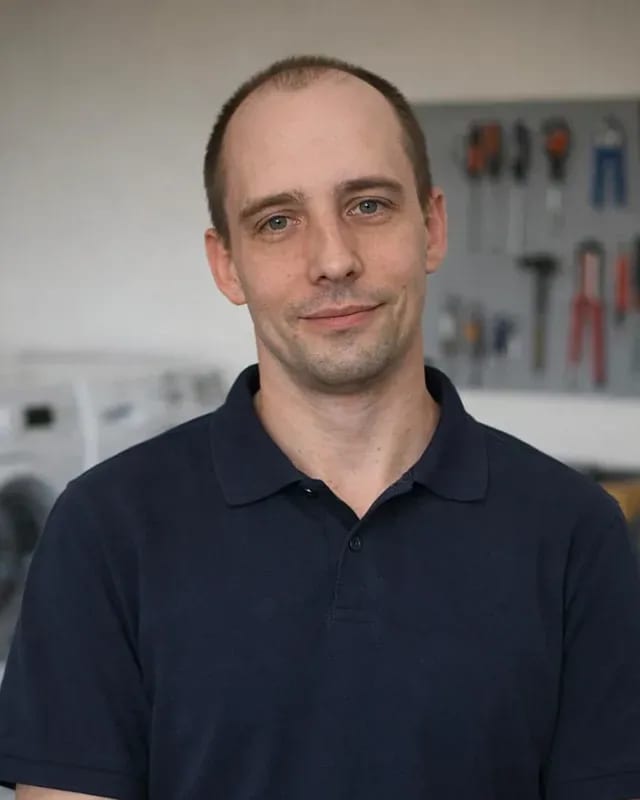 experience8 years
Field refrigerator repair technician
 experience8 years
Senior washing machine repair technician
 experience11 years
Dishwasher repair technician
 experience9 years
Washing machine repair technician
We reply during working hours
Leave a request for diagnostics — the technician will arrange a convenient visit time. You can pay via Kaspi QR, Kaspi Red, bank card, cash, or bank transfer for companies.

Warranty question? Call us
+7 (778) 046 88 53Tech Service repairs power tools in Almaty: a technician comes to your home within 60 minutes anywhere in the city or you can drop the tool off at the service center. Diagnostics are free, and there's a 1-year warranty on labor and parts. We're a direct provider with our own technicians who have 4 to 20 years of experience, not an aggregator.
The owner notices a symptom: the tool won't turn on, sparks, or overheats. Each of these signs points to a specific component, and we break down the three most common cases — from the contact group to the gearbox bearings.
Most often the culprit is the switch, power cable, or brush assembly, not the entire motor — we start diagnostics with these components. The start button carries the full inrush current, so the contact group burns out, and the cable frays at the entry point into the housing, where bending is most frequent. Brushes wear down to their minimum length and stop pressing against the commutator — the motor hums but doesn't reach full speed or starts intermittently. The electric motor fails less often: usually it's preceded by months of operation with worn brushes and overheating windings. During free diagnostics, the technician tests the circuit component by component and identifies the cause before disassembly. If the tool only comes to life when you jiggle the button or cable, it's almost certainly the contact group, and replacing the assembly is simpler than the symptom suggests.
Sparks and a burning smell almost always indicate worn brushes, a clogged cooling path, or motor overload. Carbon brushes wear down, pressure weakens, contact with the commutator becomes spotty — hence the shower of sparks and the characteristic smell. Dust from sawdust and concrete clogs the cooling channels and impeller, air can't pass through, and the winding overheats even under moderate load. The third scenario is running at maximum power: the motor doesn't have time to cool between passes, and thermal protection trips more and more often. Thermal paste between the motor and housing dries out over time, reducing heat dissipation. Light sparking under the brushes is normal, but if sparks fly in a circle and the commutator darkens, running it 'until it dies' wears down the commutator and turns a brush replacement into a motor replacement.
Vibration and knocking come from the bearings and gearbox, while a jammed drill bit or disc comes from the chuck and seating area. Bearings lose lubrication and start to hum at high speeds, then shaft play and knocking under load appear. In the gearbox, gear teeth wear down, especially if the tool has been overloaded or run without lubrication. A chuck with worn jaws doesn't hold the shank: the bit spins, the disc wobbles, and the tool jams in the material. The spindle seat deforms after drops, and then even a new chuck mounts with runout. If the tool was dropped in water and started working after drying, bearing corrosion will still show up as knocking within a few weeks — better to show it to a technician right away.
You can't carry a rotary hammer or angle grinder in your pocket, so the service format matters as much as the breakdown itself. We explain when a mobile technician comes to your home and when it's better to bring the tool to the workshop.
We arrive within 60 minutes anywhere in the city, and for most power tool breakdowns that's enough — the technician brings diagnostic and repair tools. The mobile format covers what can be checked and fixed on site: won't turn on, sparks, knocks, won't hold speed, cable break, worn brushes. Diagnostics are free, and the cause is often found right at the workbench or on the job site where the tool broke. This scenario is also convenient when you don't want to spend time traveling to the workshop and back. It almost always makes sense to start with a home visit — the technician will tell you on site whether the tool can be repaired at home or if the case isn't suitable for a mobile visit. Such power tool repair at home saves time and covers most typical faults.
For complex cases like gearbox disassembly, motor replacement, or electronics work, we handle the repair at our service center, where our technician receives the equipment. Such breakdowns require full disassembly and inspection of components, which can't be done on-site — without it, you can't replace parts blindly. In the workshop, they disassemble unit by unit, check the armature and stator, inspect the bearings and grease in the gearbox, and test the control board. Equipment is also brought here after a fall or moisture exposure, when it looks intact but works intermittently. Complex issues almost always come up during full disassembly. If in doubt, bring the tool to the service center right away: extra disassembly on-site won't add anything to the diagnosis. A 1-year warranty on labor and parts applies in both cases — the format doesn't change that.
| Format | When it fits | Who does the work | What happens to the tool |
|---|---|---|---|
| On-site | Won't turn on, sparks, knocks, brushes and cable replaced | On-site technician | Stays with the owner, repaired on the spot |
| In-shop | Gearbox disassembly, motor replacement, complex electronics | Service center technician | Accepted for repair, returned after work |
| Mixed | First inspection on-site, then pickup to the workshop | Both formats | Diagnosis on-site, work in the workshop |
After requesting service, the owner needs to know what happens next. We show the path from request to a ready tool and explain why the initial inspection costs the client nothing.
Our diagnostics are free: we check the power supply, brush assembly, motor, and gearbox to find the cause, not just confirm the symptom. First, we test the power cable and switch — a significant share of failures come from this pair when the tool is silent but the outlet works. Then we remove the brushes and assess their wear, inspect the motor commutator for burnt bars, and check the gearbox for play and grease condition. We also check the bearing seats separately: wear there causes vibration that owners often blame on the attachment. This inspection gives a full picture of the components' condition, not just the one that made noise or failed. Free diagnostics benefit both sides: it rules out cases where repair isn't worthwhile and doesn't turn into 'we took it apart and added up the bill'.
We go from symptom to component: if the tool won't turn on, we check the power circuit in order — cable, switch, brushes, motor. A break in the cord at the plug and a burnt contact in the switch produce the same external sign but are fixed differently, so each section is tested with a multimeter rather than replacing the first suspicious part. For overheating and a burning smell, we measure current draw and check the motor winding — an interturn short shows up exactly like that. Vibration and knocking lead to the gearbox and bearings: we check shaft play and gear wear. The same symptom in two identical rotary hammers can have different causes, so the specialist goes through the entire circuit and tells the owner the specific component, not a general phrase. The technician travels across the city within an hour — with measuring tools on hand to check the component on-site.
After diagnostics, we tell you the cost of the work and only proceed with the repair once you approve. You get a clear picture: which component failed, what we're doing with it, and which parts are being replaced. You can pay via Kaspi QR, Kaspi Red, bank card, cash, or bank transfer for companies. The technician gives you the price after free diagnostics, and if it doesn't work for you, you lose nothing—the initial inspection was already free. After that, the work is done on-site or at the service center—the format depends on the nature of the breakdown and the conditions at your location. There's a 1-year warranty on labor and on the parts we install, and technicians with 4 to 20 years of experience take on components that others prefer to replace entirely.
The main fear after a repair is that the tool will fail again in a week. Here's exactly what our warranty covers, what to do if it breaks again, and where to go if the tool is still under the manufacturer's warranty.
We provide a 1-year warranty on labor and on parts—the same term for replacing brushes and for restoring a gearbox. During this period, re-inspecting the component, replacing a part we supplied, and checking the tool are all covered under warranty. There's one condition: the failure is related to what we repaired, not to new damage—a drop, moisture ingress, or overload. The technician inspects the tool upon intake, so if you come back, it's clear what has changed. The parts commitment is just as important as the labor commitment: the same 1-year warranty applies to the parts we install. So when talking to any service center, ask about the term for labor and for parts separately—the latter is often shorter or missing entirely.
If the tool breaks again within the warranty period after our service, we handle it under warranty. The service technician re-inspects the tool, compares the nature of the fault with the previous visit, and determines whether it's a warranty case or a new cause. You just need to describe the conditions under which the failure occurred: load, mode, temperature, and the nature of the sound. A repeat breakdown doesn't always mean the same cause: the technician checks whether another worn component has failed that was still within normal range during the first visit—in that case, it's a new job, not poor service. Sometimes it happens: we replaced the brushes, and later a bearing failed that was at the limit of acceptable wear during the first check.
If the tool is under the manufacturer's warranty, it's worth contacting them first—it may be free for you. The factory warranty covers defects in the motor, electronics, and housing parts—provided the tool hasn't been opened or dropped. Wear on brushes, the power cord, and bearings is usually not included: these are consumable components, and work on them is still done at a service center. Before contacting them, check if you still have the receipt and whether the seals are intact: an opened housing often voids the factory warranty. If the failure is deemed not covered, service is paid—and here it's useful to ask in advance who provides a guarantee on the work itself and under what terms.
A screwdriver that won't charge is a separate story: the cause could be the battery, the charger, or the contacts, and that determines what needs to be repaired.
The "not charging" issue falls into three groups: the battery itself, the charger, and the contact plates on the tool. Inside the battery pack, the culprit is usually one of the cells or the protection board: it cuts off charging when parameters go out of tolerance, and the indicator simply doesn't light up. In the charger, the contacts and power cord are the most common problems, less often the electronics that stop recognizing the power source. The contact plates on the tool itself oxidize and burn from sparks when connected, causing charging to be intermittent or not work at all. Another common cause is deep discharge after long storage: the voltage drops below the threshold, and the smart charger refuses to start the cycle, considering the source faulty. The charging connector itself is also checked separately: a loose plug gives a false contact and a blinking indicator. Before taking the drill to the service center, check the charger on another battery of the same platform — this immediately shows whether the charger or the battery is to blame.
We look at the condition of the cells: if the problem is in the contacts or one cell, the pack can be restored, but if the whole battery has degraded, it's more cost-effective to replace it entirely. Restoration begins with measuring the capacity of each cell: a drop in one of them while the rest of the pack is still good is a typical case for partial intervention. Restoration makes sense when the other cells still hold capacity; otherwise, the new cell will quickly become unbalanced with the worn ones, and the tool will lose power again. With full degradation, we recommend a new battery — it's more predictable in operation and won't require reopening in a month. The restored pack undergoes testing so the technician can confirm even discharge across all cells. Cell replacement and restored batteries come with a 1-year warranty — the same term as for other work. The technician quotes the price after free diagnostics, once the scope of restoration is clear.
| Tool type | Power source | What we check when it breaks | What we replace most often |
|---|---|---|---|
| Cordless drill | Battery | Battery, charger, contacts | Battery or charger |
| Drill/driver | Battery | Brushes, switch, battery | Brush assembly, battery |
| Corded tool | Power cord | Power cord, switch, motor | Power cord, switch |
Besides repairs after a breakdown, there are two topics that often go unnoticed: servicing gas-powered tools and caring for equipment that still works.
We repair gas-powered tools — saws and trimmers — following the same scheme as for electric ones: technician visit to your home or drop-off at the service center, free diagnostics, 1-year warranty on labor and parts. Chainsaws and trimmers come in with a typical set of issues: won't start when hot, stalls under load, the saw "sneezes" when you press the throttle, the trimmer loses power in tall grass. Such equipment has its own risk points — the carburetor, fuel filter, and spark plug, plus a clogged air filter that makes the mixture too lean. Our technicians have 4 to 20 years of experience with this class of equipment, so they immediately check the condition of the carburetor diaphragms and ignition system. Gas-powered tools suffer more often from fuel mixture and spark plugs than from mechanical wear, so we start diagnostics with the fuel and ignition systems.
If you hear knocking in the gearbox, smell burning, or the tool stops holding speed, maintenance won't help—you need diagnostics. Knocking points to worn bearings or gears, a burning smell to an overheated winding or worn brushes, and loss of speed to electronics and power supply issues. Putting off a visit to the technician with these symptoms is risky: running it until it fails turns a brush replacement into a motor replacement, and preventive lubrication into a gearbox rebuild with new gears. During free diagnostics, the technician opens the unit and shows you exactly what's worn—that picture makes it clear whether the repair will be minor. Overheating signals cooling, brush, or load problems, and you shouldn't ignore it for more than a couple of days.
Here's the key things to keep in mind when your tool stops working: from diagnosing the problem to choosing how to fix it and prevent future issues.
Tech Service technicians repair other appliances too — with the same 1-year warranty on labour and parts.
 Refrigerator Repair in Almatyfrom 3 000 ₸
 Washing Machine Repair in Almatyfrom 3 000 ₸
 Dishwasher Repair in Almatyfrom 3 500 ₸
 Oven Repair in Almatyfrom 3 000 ₸
 Cooktop Repair in Almatyfrom 3 500 ₸
 Air Conditioner Repair in Almatyfrom 3 500 ₸
 Boiler and Water Heater Repair in Almatyfrom 2 500 ₸
 Freezer Repair in Almatyfrom 6 000 ₸
 Tumble Dryer Repair in Almatyfrom 5 000 ₸
 Coffee Machine Repair in Almatyfrom 2 500 ₸
 Robot Vacuum Cleaner Repair in Almatyfrom 3 500 ₸
 Vacuum Cleaner Repair in Almatyfrom 1 500 ₸
 Microwave Oven Repair in Almatyfrom 2 000 ₸
 Hair Dryer Repair in Almatyfrom 1 500 ₸
 Iron Repair in Almatyfrom 3 000 ₸
 Electric Kettle Repair in Almatyfrom 2 500 ₸
 Mixer Repair in Almatyfrom 2 500 ₸
 Multicooker Repair in Almatyfrom 500 ₸

If your dishwasher won't drain, the most common culprits are a clogged filter or drain hose; less often, it's the pump, impeller…
24 March 2026 · 12 minutes read
A washing machine can hum for many reasons, and the first thing to figure out is when the sound appears.
20 March 2026 · 12 minutes read
If your washing machine isn't filling with water, the most common culprits are a closed valve, a clogged inlet filter screen on the hose…
20 February 2026 · 13 minutes read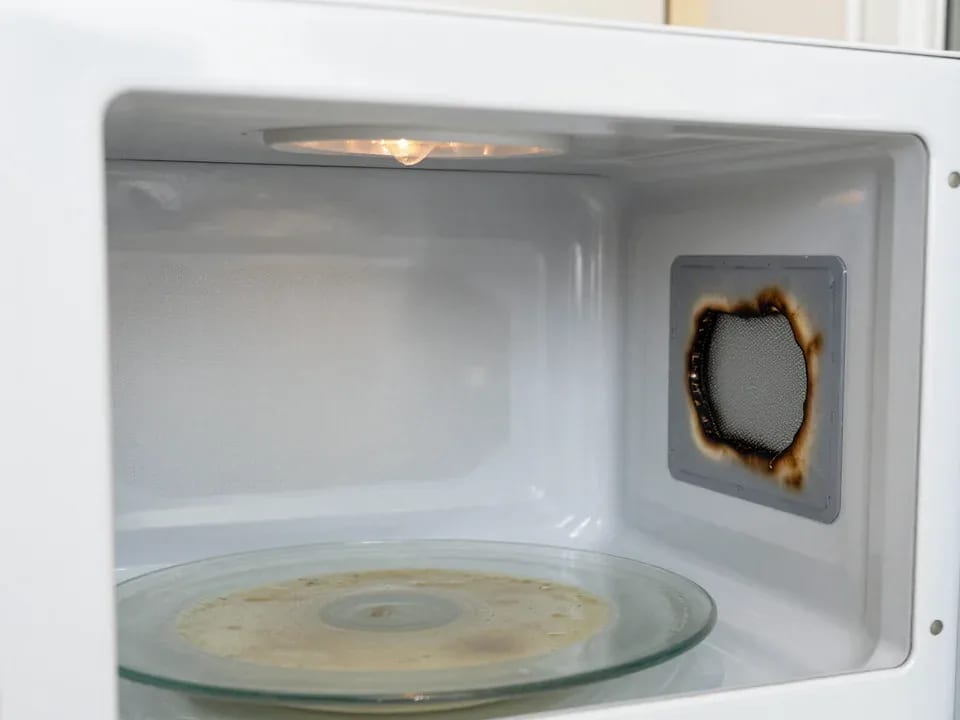
If your microwave isn't heating but the light and turntable still work, the problem is usually one of the high-voltage components — the magnetron, diode…
15 February 2026 · 12 minutes read
If your refrigerator stops working, first check the outlet, the power cord, and the thermostat setting, and after defrosting let it stand for a while.
4 February 2026 · 12 minutes read
Washing machine error codes are self-diagnostic codes that point to a specific component: drain, water fill, heating, motor, or door lock.
29 January 2026 · 13 minutes read