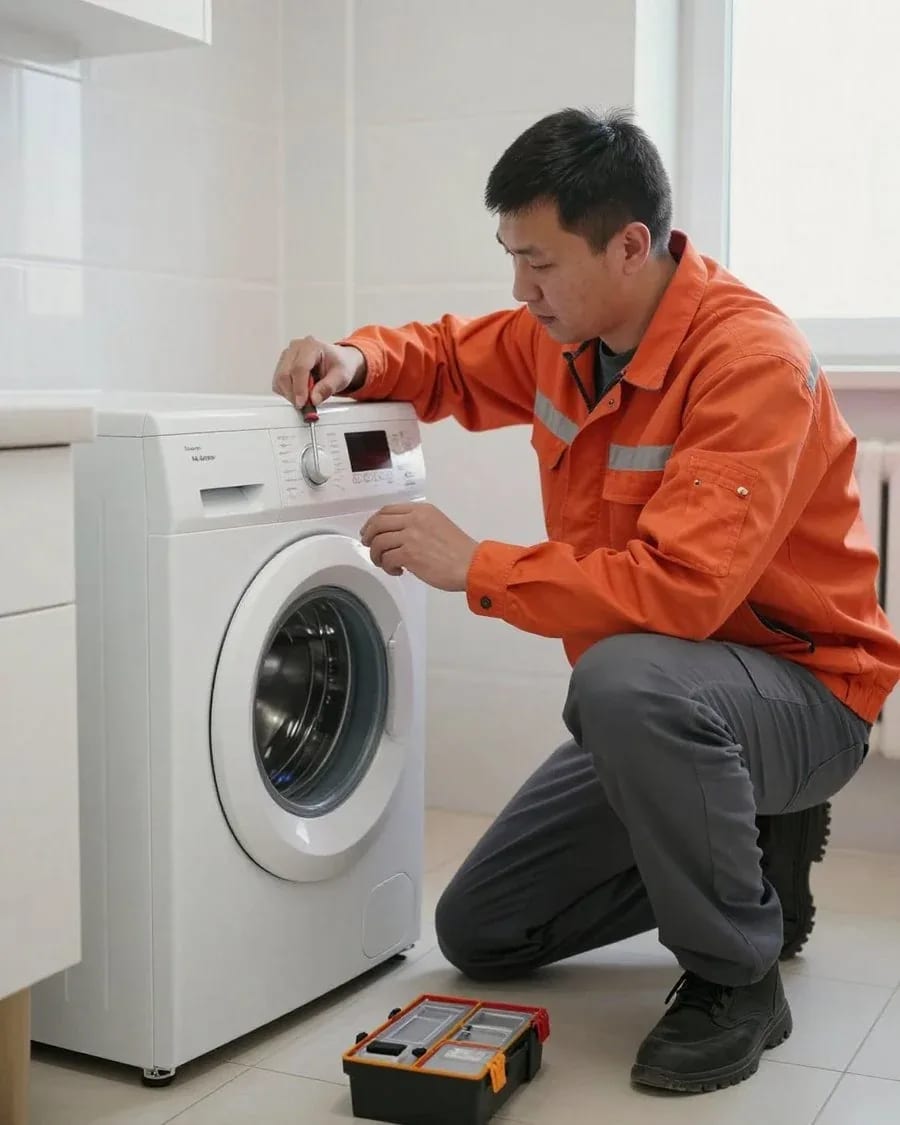
Tech Service provides heating system flushing in Almaty with a technician visiting your home within 60 minutes anywhere in the city. Before starting, we perform free diagnostics and choose the method that suits your system, and we provide a 1-year warranty on labor and parts. The technician gives you the price after diagnostics.
When It's Time to Flush Your Heating System
The system itself sends signals that it's time to step in. Here's how a technician tells a clog apart from an air lock or a boiler malfunction.
Signs That Your System Needs Flushing
- Uneven heating: the top of the radiator is hot but the bottom is cold — sludge has built up in the lower part of the unit.
- Differences between risers: one branch heats more than another, and radiators farthest from the source cool down first.
- Noise and humming: scale and corrosion products narrow the passage, causing turbulence and whistling in the flow.
- Slow warm-up: the room takes noticeably longer to reach operating temperature than with a clean system.
- Frequent burner cycling: a layer of deposits on the walls reduces heat transfer, so the boiler turns on more often.
- Rusty stains at connections: internal corrosion eats away at threads and seals, leaving marks.
How to Tell a Clog from an Air Lock and a Boiler Failure
During the free diagnostics, our technician bleeds air through the Mayevsky valves and checks the heating — if the radiator doesn't even out after that, the cause is a clog, not an air lock. An air lock produces the same symptom but is fixed in minutes without flushing, so we never start with the machine until we've ruled out air and boiler settings. Next, the specialist compares the pressure and temperature on the supply and return lines: a difference of a few degrees between branches points to a blocked section, while stable readings with a cold radiator indicate a closed valve or incorrect settings. Heating system flushing in Almaty is needed when air and boiler settings have been ruled out but the heating remains uneven. With 4 to 20 years of experience, our technicians can distinguish all three causes — air, clog, and malfunction — in a single visit and won't offer flushing where it's not needed. A visit anywhere in the city takes up to 60 minutes, and diagnostics are free.
Heating System Flushing Methods and How We Choose for Your System
The cleaning method is selected based on the pipe material, radiator type, and degree of contamination. Below is how the two main methods differ and when each is appropriate.
How Chemical Flushing Differs from Hydro-Pneumatic Impulse Flushing
| Method | What it removes | When we choose it |
|---|
| Hydro-pneumatic impulse | Loose sludge, suspended particles, air locks | Mixed systems, old radiators |
| Chemical | Scale, hardened corrosion products | Dense layer of deposits on metal |
| Combined | Sludge after reagent treatment | Neglected circuits with thick buildup |
Is Chemistry Harmful to the Boiler, Cast-Iron Radiators, and Polypropylene Pipes?
Chemical cleaning is safe for the system if the reagent is matched to the material: for cast-iron radiators and ferrous metal we use a mild formula, and for polypropylene we avoid aggressive concentrations. Cast iron is brittle and sensitive to sudden temperature changes, so we halve the concentration and limit the exposure time. Polypropylene pipes resist most formulas, but overdosing can damage seals on fittings and threaded connections. We clean the boiler heat exchanger in a separate circuit to avoid running reagent through narrow channels under excess pressure. After treatment, we always flush the system with clean water — residual formula in the heat exchanger accelerates corrosion and shortens the unit's service life. Underestimating this step leads to repeated clogs as early as the next season.
Flushing Without Removing Radiators or Underfloor Heating
We clean the system without removing radiators by connecting to the shut-off valves, and we treat underfloor heating circuits through the manifold. Connecting to the supply and return valves lets us flush each branch separately without touching the units themselves or disassembling the piping. We handle underfloor heating loops one by one: remove the caps from the flow meters, connect the machine to the manifold, and feed the solution into each line. This approach saves time and doesn't require draining the entire system. But if individual units are heavily clogged, the technician will honestly say during the free diagnostics if a local removal is needed to get results. In homes with a manifold on each floor, this option is most often suitable.
How heating system flushing works from diagnostics to inspection
The work proceeds step by step, and each stage matters for the result. We show what happens from the specialist's arrival to checking the heat distribution and why you can't start cleaning without the first step.
What the free diagnostics before flushing includes
- Checking heat distribution: the specialist feels the radiators and circuits, notes cold sections and risers — this shows where sediment has built up.
- Eliminating air locks: we bleed air through the Mayevsky valves and check whether that's the cause of uneven heating.
- Inspecting the boiler: we compare pressure, pump operation, and supply temperature — a boiler fault produces the same symptoms as clogging.
- Assessing contamination: we look at the color of the coolant sample and the thickness of deposits on the walls to choose the cleaning method for your system.
- Deciding whether work is needed: this is where it becomes clear whether the procedure is necessary at all or if adjusting the boiler and bleeding air will solve the problem — diagnostics are free.
Flushing stages and how long it takes
The specialist drains the coolant, connects the equipment, flushes the circuits using the chosen method, refills the coolant, and checks the heat distribution. First, a cleaning solution is run through the system — with the chemical method it dissolves scale and sludge, while with hydro-pneumatic impulse the water-air flow knocks deposits off the walls. Then the circuits are rinsed with clean water until it runs clear, until the return water has no suspended particles. The equipment is connected to the system without fully removing the radiators. After refilling the coolant, we start the boiler, bleed any remaining air, and measure the temperature at the inlet and outlet of each radiator. The exact time depends on the number of radiators and the degree of contamination, so it's given after diagnostics, not over the phone — that makes the estimate more honest.
Apartment or private house
Heating system flushing works for both apartments and cottages, but the circuits are designed differently. We explain the difference and when maintenance is worse than replacing the units.
How maintenance differs in an apartment and a private house
In an apartment, we more often flush radiators and risers through the shut-off valves, while in a cottage there are also underfloor heating circuits, the boiler heat exchanger, and extensive piping. In a multi-story building, access to the system is limited by the common riser: we treat each unit separately by connecting to the valves on the supply lines. In a country home, the circuit is connected to the boiler, and the technician flushes the heat exchanger, manifold, and underfloor heating loops through the manifold without opening the screed. Piping in a cottage can have 10–15 radiators and several branches, so work is done in stages, circuit by circuit. In a private house, prevention is more important: the longer the circuit and the harder the water, the faster scale builds up, so after maintenance the technician will suggest an interval for your system.
When cleaning won't help and it's better to replace radiators
If a radiator has rusted through, lost its seal, or its walls have thinned from corrosion, treatment will only give a temporary effect and won't restore heat output. Over time, pinholes and sludge form inside a cast-iron or steel battery, clogging the lower collectors: cleaning removes some deposits, but the metal no longer holds pressure, and the unit leaks at the threads or sections. Aluminum radiators suffer from corrosion when exposed to air and water with high pH — the walls thin out, and after treatment the leak returns within a season. In such cases, replacing the unit costs less than repeated flushings, and during diagnostics the technician will show where servicing still makes sense and where it no longer does — sometimes it's enough to replace one section rather than the whole block.
Warranty, technician visit, and direct service
When the work is done by a direct provider with their own technicians, not an intermediary, it's easier to get a warranty and a predictable result. Here's what that means in practice.
What warranty covers labor and parts
We provide a 1-year warranty on labor and parts, and technicians with 4 to 20 years of experience perform the procedure using a method matched to your system. Behind every visit is our technician, who is personally responsible for the result. The 1-year warranty covers labor and parts — if after servicing a component doesn't behave as it should, we handle it, not a third party. This is often the deciding factor: equipment owners want to know who to turn to if something goes wrong. A warranty only makes sense with a direct provider: Tech Service is not an aggregator or intermediary, so responsibility for the result lies with us, not an outside contractor.
How fast the technician arrives and how to pay
The technician arrives at your home within 60 minutes anywhere in the city, and quotes the price after a free diagnostic when they see the scope of work. The diagnostic is free and done on-site: the specialist inspects the system, checks the components, and only then suggests a method and gives you the price. This order is convenient because the price is based on the actual inspection, not a guess over the phone. In Almaty, arrival is within an hour regardless of the district, so you don't have to wait half a day. We accept Kaspi QR, Kaspi Red, card, cash or bank transfer for companies, so you can choose the most convenient one on-site — this doesn't affect the arrival time or the warranty. If you have questions about how components work after the visit, the technician stays in touch and will advise you on what to do next.
Heating system flushing benefits
Flushing restores the heating system's design heat output, but it doesn't help in every case. Below are brief takeaways to keep in mind before making a decision.
- Uneven heating: this is the main sign of a blockage, but first rule out an air lock and a boiler malfunction — otherwise the procedure won't help.
- Choosing a method: the method is selected based on the material of pipes and radiators, not on the principle of 'the stronger, the better'.
- Chemicals in moderation: the reagent is applied precisely where needed and must be flushed with clean water until neutral.
- Private house: long circuits and a larger volume of coolant make preventive maintenance more important than in an apartment with compact piping.
- Radiator wear: with severe corrosion and thinned walls, cleaning is inferior to replacing the units — otherwise the leak will return after the first heating season.