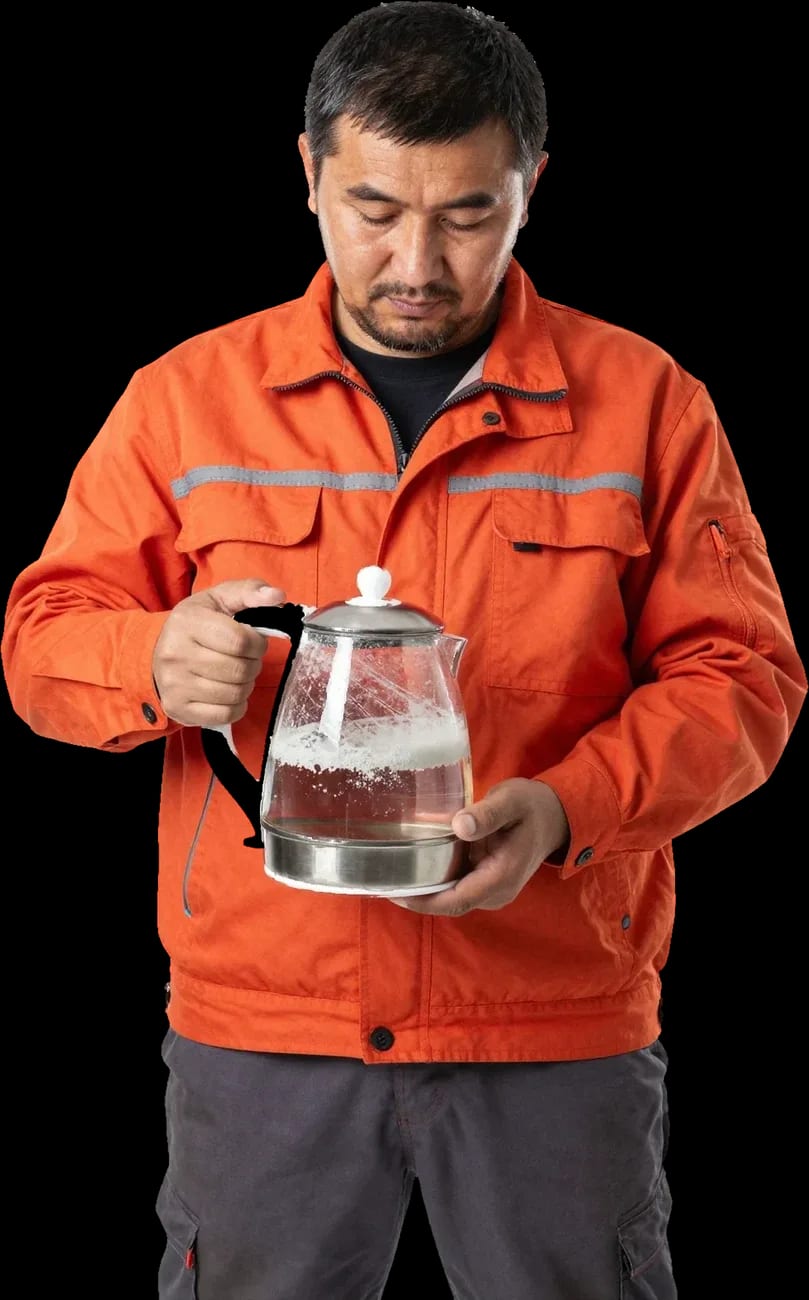

Why scale appears even with filtered water
The easiest way to remove scale from a kettle is with citric acid: 1–2 tablespoons per liter of water, boil for 5–10 minutes, then drain and rinse. If after cleaning the kettle takes longer to boil, doesn't switch off, or doesn't heat, the scale has already damaged the heating element. Tech Service in Almaty offers free diagnostics, a technician arrives within 60 minutes, and you get a 1-year warranty on labor and parts.
Scale isn't dirt or a sign of carelessness—it's a deposit of salts that are always dissolved in water. Let's look at where it comes from, why a filter doesn't give full protection, and how this layer affects your kettle.
Where the deposit on walls and heating element comes from
Scale forms when calcium and magnesium salts precipitate from water during boiling and settle on the heating element and walls. In water, these salts are dissolved as calcium and magnesium bicarbonates, but when heated above 60–70 degrees, they break down into insoluble carbonate and carbon dioxide. The harder the water, the more salts per liter and the faster the layer grows: calcium carbonate crystallizes on the hot surface of the heating element as a thin crust, while loose flakes settle on the bottom and walls. Tap water in Almaty comes mainly from underground sources and surface intakes with high mineralization, so scale appears just a few weeks after buying a kettle. Even a household filter only traps part of the hardness salts: a pitcher softener reduces their concentration but doesn't remove them completely, while reverse osmosis without a mineralizer produces almost distilled water—scale doesn't grow on it, but the taste of the drink changes.
How scale interferes with the kettle's operation
A layer of scale on the heating element acts as a thermal insulator, so the kettle takes longer to boil and the heating element overheats. The thermal conductivity of the carbonate crust is tens of times lower than that of the coil metal: heat doesn't go into the water but accumulates in the heater itself, and its temperature rises above the design value. For a motorized kettle, this means the thermal sensor triggers later, water boils longer, and energy consumption increases. On models with an exposed coil, the crust peels off in pieces and clogs the filter mesh at the spout. On a disc heater covered by a plate, the scale holds tighter and is harder to remove. The thicker the layer, the higher the energy consumption and the faster the heating element wears out, so neglected scale is a common reason for replacing the heating element, not just an aesthetic problem.
Is scale harmful to health
Scale itself consists of harmless calcium and magnesium salts, but it traps impurities and chlorine, and pieces of the deposit get into your drink. Calcium carbonate is not toxic and doesn't accumulate in the body, so accidentally swallowing it is not dangerous. The problem is in the structure: the loose porous layer works like a sorbent and retains iron and manganese compounds and organic matter from the water, and during boiling, reaction products with chlorine settle in it. This causes the cloudy sediment in your cup and the characteristic aftertaste. The danger is not the chemical composition of the scale but the fact that contaminants from the water get trapped in the porous layer, so sediment in your cup is a reason not to drink such water and to check the condition of your kettle.
What to use to clean the kettle from scale and in what proportions
We look at three home remedies that actually work: citric acid, baking soda, and vinegar. We give exact proportions and soaking times so cleaning removes the scale without damaging the appliance.
Citric acid — proportions and time
Use 1–2 tablespoons of citric acid per liter of water, bring to a boil and let it sit for 5–10 minutes, then pour out the solution and rinse the kettle twice with clean water. The acid reacts with the carbonate scale on the heating element and walls, softening it so deposits flake off. Dissolve the powder in cold water completely—grains left at the bottom can leave local spots on the metal when heated. Don't boil for more than ten minutes: the solution has done its job, and extra heating dries out the seals around the lid. If the layer is thick, repeat the procedure but don't increase the acid dose—a concentrated solution will eat through seals and plastic parts faster than it helps. After pouring out, check the bottom against the light: dark spots under the scale are already corrosion, and cleaning will only expose them. If you're not sure how to remove scale from a kettle with citric acid, follow these proportions and don't exceed the soaking time.
Baking soda and soda water for a thin layer
Baking soda is used for a thin light film: 1–2 tablespoons per liter of water, boil for five minutes and leave until cool; soda water is used as a mild remedy for fresh deposits. Baking soda creates an alkaline environment that softens the loose carbonate layer but doesn't dissolve it completely—after the procedure, wipe the walls with a soft sponge to remove the swollen mass. Pour soda water without heating and leave for 30–40 minutes: the bubbles and phosphoric acid loosen fresh deposits, but this method is weak against a hard crust. Baking soda softens but doesn't dissolve old scale, so for a thick layer switch to acid rather than increasing the amount—excess alkali leaves white streaks on metal and plastic. For maintenance, one treatment a month is enough, not weekly boiling with soda.
Vinegar and its limitations
Vinegar handles scale but is more aggressive than citric acid: dilute it with water 1 to 2, boil briefly and ventilate the room thoroughly because of the sharp smell. Use 9% table vinegar to fill a third of the kettle and top up with water—this mixture dissolves the carbonate layer in 5–7 minutes of boiling, but the fumes irritate mucous membranes, so keep a window open and leave the lid ajar after pouring out. Vinegar is acceptable for metal and glass bodies, but riskier for plastic parts and seals—with frequent use they lose elasticity faster, and the lid starts leaking steam. If choosing between citric acid and vinegar for regular care, the acid is gentler on the appliance materials, though it costs more and dissolves slower. Keep vinegar as a last resort when nothing else is on hand.
How to clean a kettle depending on the body material
The same remedy behaves differently with glass, stainless steel, ceramics and plastic. So the body material matters more than the thickness of the scale—we sum up the remedies and limitations in a clear table.
Table of remedies by body type
| Body material | Suitable agent | Limitation |
|---|---|---|
| Glass | Citric acid | No sudden temperature changes |
| Stainless steel | Citric acid, baking soda | Don't scrub with a metal brush |
| Ceramics and enamel | Baking soda, weak acid | No abrasives |
| Plastic and seals | Minimal concentration | Vinegar is not recommended |
Glass electric kettle
A glass kettle is best cleaned with a weak citric acid solution, because glass can handle acid but is sensitive to sudden temperature changes. Just fill the heat-resistant glass body with warm solution for 20–30 minutes: the limescale on the walls softens and wipes off with a soft sponge without scrubbing. Pour out hot water from such a kettle gradually and never put an empty body under cold running water — internal stress in the glass builds up unnoticed. I recommend rinsing the body with water at the same temperature as the cleaning solution, and letting the kettle cool in the air. Don't pour cold water into a just-boiled kettle — cracks come not from scale but from thermal shock during rinsing. Thin glass handles temperature contrast worse than thick glass, so for cheaper models use a weaker acid solution and leave it for less time.
Metal, ceramic, and plastic parts
Stainless steel and ceramic are cleaned with baking soda or a weak acid, while plastic parts and seals should be treated with minimal concentration and for a short time. Inside a metal body, scale sticks harder than on glass, so the solution for stainless steel can be a bit stronger, but don't scrub the walls with a metal brush — it leaves micro-scratches and scale will build up faster. Treat ceramic and enamel with baking soda: abrasive powder and the rough side of a sponge remove the glaze, and the surface then darkens. Plastic and rubber seals age from frequent contact with acid, so for them it's better to under-soak than over-soak. It's easier to remove the detachable plastic ring and rinse it separately than to soak it with the body. Vinegar for metal and plastic requires care: it's stronger than citric acid and has a sharper smell.
What to do if the kettle works incorrectly after cleaning
Sometimes the appliance behaves strangely: it smells, won't turn on, or heats differently. Here are three common scenarios and what to do about them.
The kettle smells of acid
Get rid of the acid smell by boiling clean water two or three times, and there's no need to add acid the last time — just pour it out and let the appliance air out with the lid open. Citric acid dissolves limescale, but some of the solution remains in the pores of the plastic, on the lid seal, and in the spout, so the first portions of water smell from there. Fill to the maximum mark, bring to a boil, and pour out completely — this rinses the solution from hard-to-reach places faster than simple rinsing. It helps to boil water with a couple of tablespoons of baking soda: it neutralizes acid residues in the pores. If the smell persists after three rinses, the issue isn't the cleaning agent but the seal that absorbed the solution — it should be inspected and replaced.
The kettle won't turn on
If the appliance won't turn on after cleaning, most likely moisture got into the contact group or base, and it needs diagnostics, not another cleaning. The contact group is located in the base of the body and connects to the heating element through spring contacts: water that gets in during rinsing short-circuits the circuit or causes oxidation, and the indicator simply doesn't light up. We don't recommend drying the device with a hairdryer or disassembling the base yourself — it's easy to damage the spring contacts on the contact group, and then the repair will cost more. At Tech Service, diagnostics are free, a technician comes to your home within 60 minutes anywhere in the city and checks the power circuit without disassembling the body on site. We provide a 1-year warranty on labor and parts.
Takes longer to boil or won't switch off
If the appliance still takes longer to boil or won't switch off after cleaning, the problem is no longer scale but the heating element or the auto-shutoff mechanism, and a technician needs to fix it. We remove thick scale from the coil, but if the heating element has deformed from overheating, heating remains slow regardless of how clean the surface is. The auto-shutoff mechanism is connected to the lid and steam sensor: if the steam channel is clogged or the bimetallic plate is worn, the appliance doesn't trigger and keeps boiling the water. We check both components at once, because a failed auto-shutoff is more dangerous than slow heating — the appliance can boil until all the water evaporates. A technician visit takes 60 minutes around the city, and we accept payment in any convenient way.
When scale buildup means it's time to call a technician
Cleaning removes the film, but it doesn't always get the kettle working again. Here are the signs that it's time to call a technician, and how the visit works.
Signs that cleaning won't help anymore
- Doesn't heat water: the kettle turns on and the indicator lights up, but the water stays cold — the heating element is already damaged.
- Doesn't switch off: the water boils until it evaporates because the auto-shutoff mechanism doesn't trigger and the protection doesn't break the circuit.
- Takes longer to boil: after removing the scale, the speed hasn't returned to normal, meaning the scale layer has already damaged the heating element.
- Clicks and crackles: strange noises during operation indicate overheating contacts or a damaged base.
- Signs of overheating: darkening, bulging, or cracks on the body and base mean the metal is already deformed.
- Leaks at the seam: moisture on the stand appears because the joint has separated, and cleaning won't fix that.
How the technician visit works
We come to your home or accept the kettle at the service center, start with free diagnostics, and quote the price only after we've found the cause. A technician arrives within 60 minutes in the city, so the fault is inspected the same day you call. Diagnostics show exactly what has failed: a burnt-out heating element, a burnt contact group, or a stuck auto-shutoff mechanism. Then the technician gives you the price and agrees on the scope of work — no surprises at the end. We are the direct contractor: our own technician comes, not a middleman with someone else's crew, so the same service is responsible for both the work and the parts. You can pay via Kaspi QR, Kaspi Red, bank card, cash, or bank transfer for companies. In our experience, a kettle with thick scale is more often brought in with overheating damage than with scale alone.
What the technician checks and what the warranty covers
The technician checks the heating element, contact group, base, and auto-shutoff mechanism, and we provide a 1-year warranty on labor and parts. First, they test the heating element for continuity and check for a short to the body, then inspect the contacts for burning and verify that the circuit opens when the water boils. The base and seams are tested for tightness, because a microcrack only shows up under load. Our technicians have 4 to 20 years of experience, so they can tell by sound and heating behavior whether it's element wear or a thermostat failure. The warranty covers parts too, so if the problem recurs you won't have to pay separately for the part — that's what sets repair apart from a one-time cleaning. Before handing over the kettle, ask whether the warranty includes replacement of the heating element, not just the labor.
How often to clean and how to prevent scale in hard water
Cleaning frequency depends on water hardness, and simple prevention significantly slows scale buildup on the heating element and walls. Below are guidelines for Almaty water and habits that extend the life of your appliance.
How often to clean the kettle
With hard water, clean the kettle every 2–4 weeks; with soft water, every 1–2 months, guided by visible scale and boiling speed. Tap water in Almaty is high in calcium and magnesium salts, so a thin gray layer settles on the heating element within a month. As soon as the same volume takes noticeably longer to boil and white streaks appear on the bottom, it's time to clean before a thick crust forms. In winter and spring, when more groundwater enters the supply, scale builds up faster than in other seasons. Regular light cleaning with a weak solution is safer for the appliance than rare but concentrated cleaning — it prevents the scale from growing to a layer that only aggressive agents can dissolve.
Prevention in hard water conditions
- Water filter: traps some of the hardness minerals and noticeably slows the buildup on the heating element.
- Boil only what you need: don't fill the whole kettle for one cup, and don't leave water sitting in it for long.
- Rinse after each use: wash away the sediment from the bottom before it hardens into a thin layer on the walls.
- Don't boil twice: reboiling concentrates the minerals left in the water after the first cycle.
- Pour out the leftovers: standing water speeds up scale formation, especially if the kettle sits with water in it for days.
- Replace the cartridge on time: a spent filter stops trapping minerals and lets them through into the kettle.
Why coffee machine cleaners aren't suitable for a kettle
Coffee machine cleaners are designed for its materials and circuit, and when they come into contact with a kettle they're too aggressive and can damage the plastic and seals. In a coffee machine, the solutions run through tubes and stay there only briefly, while in a kettle the cleaner contacts the exposed heating element and lid gaskets for longer. Scale in both appliances is calcium and magnesium salts from hard water, but the materials of the body and parts differ. The coffee machine and the kettle share only the nature of scale, not the materials, so there's no universal formula that's safe for both. For a kettle, choose solutions labeled as safe for contact with food-grade plastic.
When descaling a kettle makes sense
Here's the key takeaway after caring for your appliance: where scale comes from, which product works, and when home methods no longer solve the problem.
- Scale is minerals from water: they settle in a crust on the heating element and walls, which slows heating and increases energy use.
- Citric acid is the basic option: 1–2 tablespoons per liter of water, boil for 5–10 minutes, then rinse and boil with clean water.
- The body material matters: glass, metal, ceramic, and plastic parts each need a different approach, and aggressive formulas can damage certain surfaces.
- Watch how it behaves afterward: if the appliance doesn't heat, clicks, or won't switch off, home methods won't help anymore — you need a technician.
- Prevention reduces how often you need to descale: a filter and regular rinsing slow buildup, but they don't replace routine cleaning entirely.