Tech Service repairs Ardo washing machines in Astana with its own technicians: 60-minute arrival anywhere in the city, free diagnostics, and a 1-year warranty on labor and parts. The technician matches the error code against the table for your model, selects the part by number, and checks the machine for leaks after reassembly.
Ardo Washing Machine Repair in Astana and What Makes This Brand Different
Ardo has a recognizable design, and owners need to understand whether a narrow specialist is required or a general technician can handle it. Let's break down what exactly determines the servicing of such a machine.
Who Services Ardo in Astana and Why It's Not a Narrow Specialization
We service Ardo washing machines both at home and in our workshop, and a separate narrow specialization by brand isn't necessary: a technician arrives within 60 minutes anywhere in the city and works with Ardo just like with other brands. We repair Ardo washing machines in Astana both on-site and in our service center, so narrow brand specialization isn't required. We are a direct provider, not an intermediary, so our own employee visits your request, not a third-party contractor. Diagnostics are free, and based on the results, the technician quotes the cost of work. Our technicians have between 4 and 20 years of experience; over this time, they've handled various Ardo series, including models with electronic and mechanical controls. What matters isn't brand specialization but knowledge of the specific component's design: where the pump is located, whether the tank is split or sealed, whether the motor is brushed or inverter—this determines which operations can be done on-site and which require removing the tank.
How Ardo's Design Determines Servicing
Servicing Ardo differs not because of proprietary parts but due to design variations within the brand itself: some models have a split tank, others don't, and the motor can be brushed or inverter. A split tank allows removing the drum and replacing the bearing, whereas with a sealed tank, the bearing isn't replaced separately—the assembly is replaced as a unit. A brushed motor eventually requires checking the brushes for wear, while an inverter motor has no brushes, so the cause of stoppage is sought in the board, sensors, or winding. Spin speeds for most models are typically 800–1600 rpm depending on the model, and this affects the load on the bearing. The practical consequence: first, determine the tank and motor type from the rating plate and visual inspection, and only then choose the method of work—some operations are done on-site, others require removing the tank.
Where Are the Components Most Often Checked on Ardo Located
- Drain filter: at the bottom front, behind the service flap, accessible without disassembling the body.
- Emergency drain hose: also behind the service flap, used to drain water before servicing.
- Drain pump: at the bottom, check if the impeller rotates freely.
- Heating element and temperature sensor: in the tank, on most brands replaced without removing the tank.
- Door seal: at the front by the door, its wear causes leaks specifically at the front.
Ardo Error Codes and What They Mean for Ardo Washing Machine Repair
A code on the display is not a verdict but a hint where to look. Let's break down the meaning of common Ardo designations and why it depends on the model.
What Do Ardo Codes E18 and E17 Mean
For Ardo, the designation E18 or F18 (on some models d02) indicates a drainage problem, while E17 or F17 means that water isn't filling within the allotted time. The letter E or F hides the same thing: in some generations, the manufacturer marks faults with a number prefixed by E, in others with F, and these series must not be confused. The designation E18 or F18 most often leads to the drain filter at the bottom front behind the service flap, to the corrugated hose, or to the pump itself, while E17 or F17 leads to a clogged mesh in the inlet hose, a closed tap, or the inlet valve. The meaning depends on the model, so the technician checks it against the table for your machine rather than relying on memory: the same combination in different generations can lead to different components.
How to Read the Code If Your Ardo Has No Display
On models without a display, error codes are shown by indicators: a combination of flashing lights corresponds to the same code as the digits on the screen. You count not a single light but the whole flashing pattern — which indicators are on at the same time, which flash in turn, and at what interval. The rhythm and set of lights differ across Ardo generations, so without a table for a specific series, decoding becomes guesswork. Practical tip: before the technician arrives, take a photo of the indicator combination or note at which stage of the program it appeared — this narrows down the units to check even before diagnostics. A signal during the fill stage and a signal during the spin stage point to different components, even if the lights look similar, and the exact program stage helps rule out unnecessary versions.
Drain codes from other brands for comparison
- Samsung: code 5E (SE, E2) — water drain failure.
- Electrolux: E20 — water drain failure.
- Indesit and Hotpoint: F05 — water drain failure.
- Bosch and Siemens, older series: F18 — water drain failure.
- General rule: the meaning is the same, but tables differ by brand, so there is no universal “drain code” — the technician checks the specific manufacturer’s table.
Typical Ardo failures: from symptom to cause
An Ardo owner usually describes a symptom rather than a component: “won’t drain,” “won’t spin,” “leaking.” We show how a symptom turns into a list of causes — from the most common and simple to the complex.
Ardo won’t drain water — what to check in order
If your Ardo won’t drain water, we go from simple to complex: filter, drain hose, then pump — and only after that check the wiring and control board. The filter is at the bottom front, behind the service flap, and it’s the first to catch coins, lint, and small items from pockets. Next, the technician removes the drain hose and checks it for clogs and kinks, then inspects the pump: whether the impeller turns freely. A multimeter won’t show a jammed pump — the technician checks if the wheel turns by hand, and a common cause of pump failures is debris (coins, lint, small items) and a clogged filter. Before calling a technician, unplug the machine and drain the water through the emergency hose behind the service flap at the bottom front, placing a towel underneath — the water may be hot.
Ardo won’t fill with water, won’t spin, or won’t heat
If your Ardo won’t fill with water, the causes go from the tap and inlet filter screen to the inlet valve; if it won’t spin — from load imbalance and draining to the belt and motor; if it won’t heat — from the heating element to the temperature sensor. A clogged inlet filter screen and a partially closed tap produce the same symptoms as a failed valve, so we start there. During the spin cycle, the technician first redistributes the laundry and checks draining, then inspects the drive belt and motor. Heating is checked via the heating element and temperature sensor, not by immediately replacing the unit. The “simple cause first” order saves time and parts: imbalance and a clogged screen are fixed without replacing components, and the motor and heating element are only checked after simple versions have been ruled out. Models with an inverter drive have no brushes, so “brush wear” is only checked on brushed motors.
Ardo leaks from the bottom or stops mid-cycle
- Leak from the bottom: hoses, pump, connections — check the fittings and pump housing.
- Leak at the front near the door: worn door seal, not lower components.
- Stops mid-cycle: most often draining, imbalance, or the motor.
- Control board: one possible cause of stopping, but not the main one — checked after simple versions.
Repair or replace the board, bearing, and motor
Not every component is replaced entirely: the board can sometimes be restored, the bearing depends on the tank, and not all motors have brushes. We explain the technician’s decision logic.
The Ardo control board can be restored, not just replaced
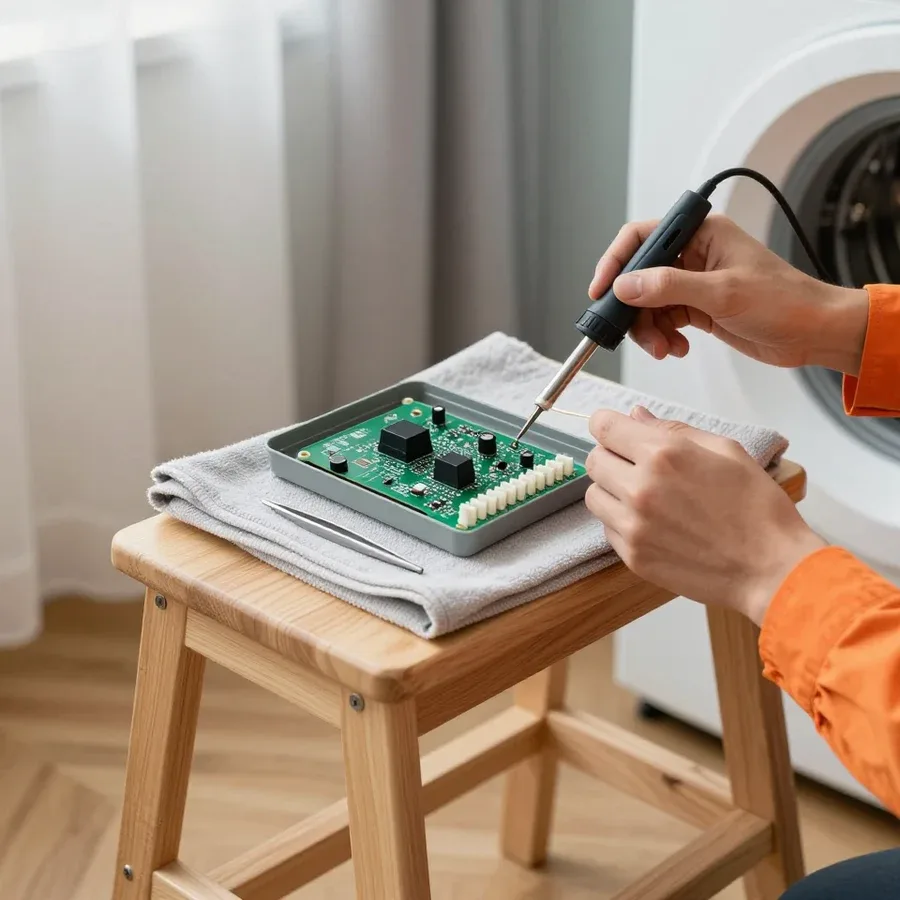
Ardo control boards can often be restored rather than just replaced: we first check the module and assess whether restoring the unit or replacing it is more cost-effective. Our diagnostics are free, so the conclusion about the board is based on the test results, not on a single symptom. The board controls water intake, draining, spinning, and indication, so "stopped mid-cycle" could equally point to a module fault, a clogged filter, or an unbalanced load. The technician tests the traces, checks connector contacts and moisture protection, rules out external causes — the level sensor, pump, wiring — and only then decides the fate of the module. The decision depends on the nature of the module fault, not on the "age" of the machine: sometimes replacing the board is the only reasonable path, but that conclusion is made after diagnostics, not based on the symptom "stopped."
Drum bearing and tank disassembly in Ardo
The drum bearing in an Ardo is replaced separately only if the tank is disassemblable; with a sealed tank, the bearing is not replaced separately. A sign of wear is a humming noise during spinning that increases with speed; typically this is 800–1600 rpm depending on the model. On a disassemblable tank, the technician unscrews the housing, removes the old bearing and seal, installs a new one, and reassembles the unit. With a sealed tank, the housing is welded shut, so the bearing is not available as a separate part — they assess the feasibility of working on the entire unit. Bearing replacement is the longest job because it requires removing the tank and drum, so the technician explains the scope of work in advance rather than leaving it to "as we disassemble." The seal is replaced together with the bearing: a worn seal will let water reach the bearing race again.
Brushes, motor, and heating element — what gets replaced and what gets checked
| Component | What is done | What it depends on |
|---|
| Motor brushes | replaced when worn | only on commutator motors |
| Inverter motor | sensors and board are checked | no brushes |
| Heating element | replaced or checked | on most brands without removing the tank |
| Temperature sensor | checked when "not heating" | second cause after the heating element |
| Drive belt | checked when "not spinning" | after imbalance and draining |
How we repair Ardo washing machines
Work begins not with disassembly but with diagnostics and agreeing on the scope of work. First, the technician finds out how the machine behaves, then inspects the components, and only after that provides a list of work. We show the specialist's steps and current terms.
From request to diagnostics — how to call a technician
You submit a request, and our specialist arrives at your home within 60 minutes anywhere in the city; diagnostics are free, and the cost is quoted after they are completed. We service Ardo washing machines in Astana either at your home or at our service center — depending on what is more convenient for the owner and how large the scope of work is. We repair Ardo washing machines in Astana after agreeing on the scope: first, the engineer listens to how the appliance behaves: at what stage of the cycle it stops, whether there is water in the tank, whether a signal is lit on the display. Then they inspect the components, compare the readings with the table for your machine, and provide a list of work. Diagnostics before work, not after, is protection against surprises: you agree to a specific scope rather than learning the outcome when the appliance is already disassembled. This order saves both time and nerves for both parties.
What the technician checks and how they select a part
The technician matches the fault signal against the table for the specific Ardo model, checks components in order, and selects the part by its number or model code. The inspection goes from simple to complex: first the drain filter at the bottom front behind the service flap and the hose, then the pump, inlet valve, and heating element. On versions without a display, the combination is shown by indicators—the engineer decodes them using the same table. He finds the part number or series designation on the nameplate; on some versions it is located in the hatch. Selecting by part number or model code, rather than by eye, matters: components that look identical across different Ardo generations are not interchangeable. A mistake here costs more than carefully checking the number before ordering the part.
Warranty and repair terms
- Warranty: 1-year warranty on labor and parts—we stand behind both the installation and the part itself.
- Payment: we accept Kaspi QR, Kaspi Red, card, cash or bank transfer convenient for the equipment owner.
- Repair format: at home or at the service center, depending on the breakdown and convenience.
- Technicians: 4 to 20 years of experience, working without intermediaries.
- Repair format: at home or at the service center, depending on the breakdown and convenience.
How to approach Ardo washing machine repair
Diagnosing Ardo breakdowns comes down to a few key points—they determine how accurately the technician will identify the right component and how long the work will take.
- Error code: the meaning depends on the model; it is checked against the table for the specific machine, not guessed.
- Symptom and cause: "not draining" leads from the filter and hose to the pump, not straight to the control board.
- Design: the bearing is replaced separately only on a split tub; brushes—only on a commutator motor.
- Work order: first free diagnostics, then agreement on the scope and restoration.
- Scope agreement: the technician lists the work before starting repairs so the owner understands exactly what will be done.