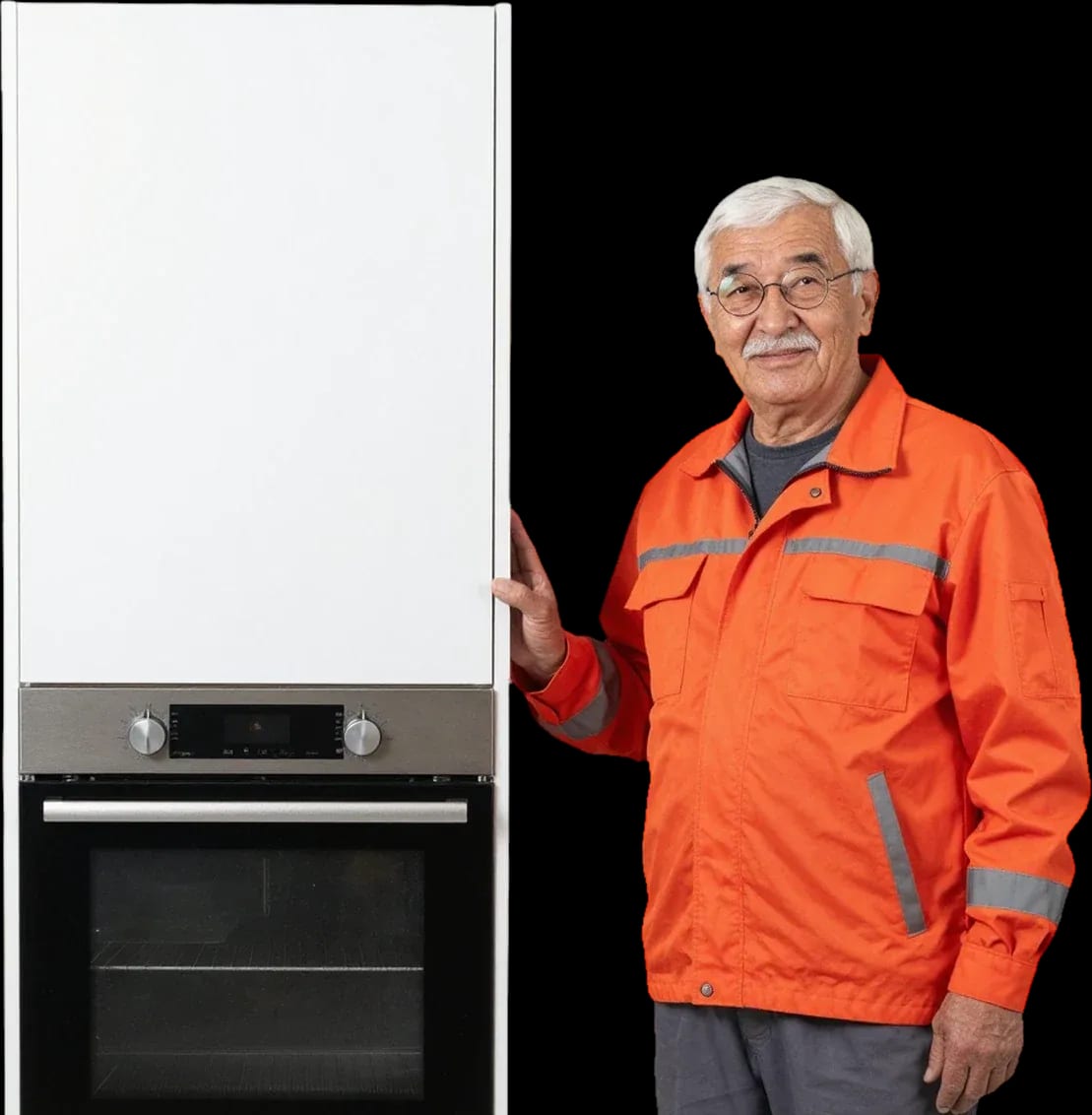
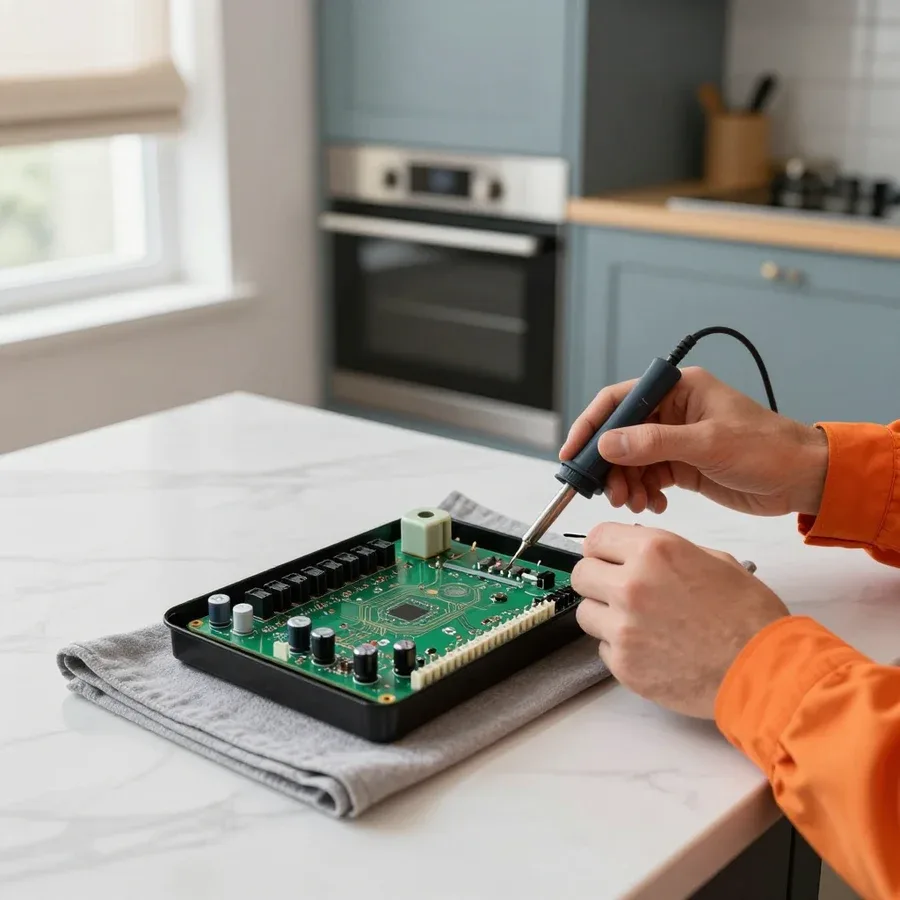
Tech Service repairs Ariston ovens in Astana: our technician arrives at your home within 60 minutes or takes the appliance to our service center. Diagnostics are free, with a 1-year warranty on labor and parts, and technicians have 4 to 20 years of experience. We quote the price after diagnostics and you can pay via Kaspi QR, Kaspi Red, bank card, cash, or bank transfer for companies.
Why Your Ariston Oven Won't Heat, Won't Turn On, and What the Display Shows
An oven can fail in three different ways: no heat, no power-on, or an error on the display. Let's break down how the symptom narrows down to a specific component before the technician even arrives.
Oven Not Heating or Heating Weakly — How to Tell the Heating Element from the Thermostat
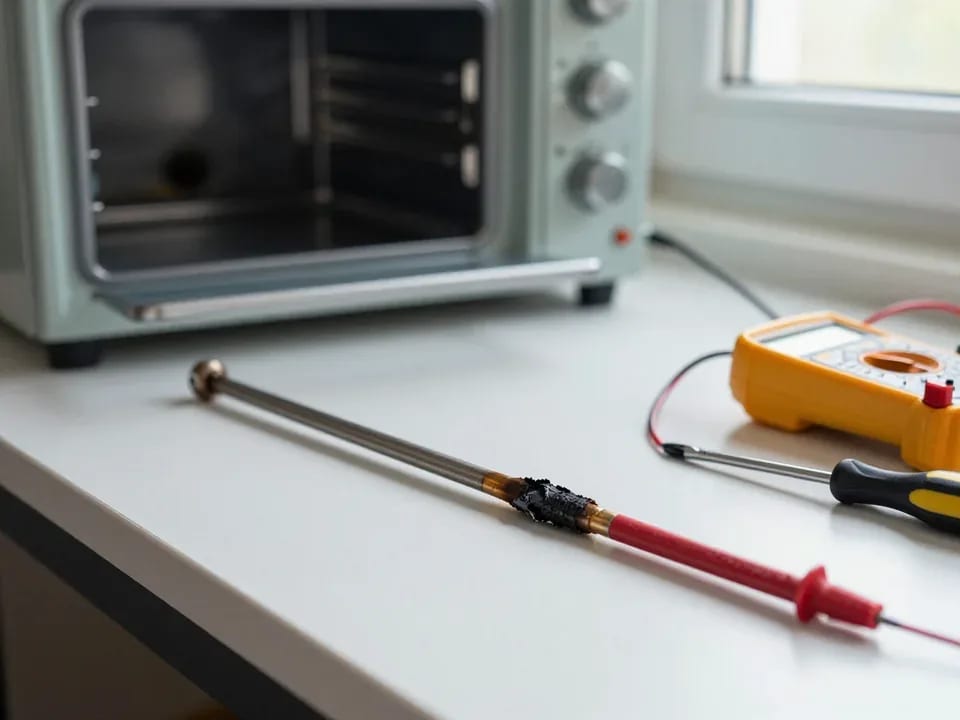
If the cavity doesn't heat at all, the heating element is usually to blame; if it heats but doesn't hold temperature, it's the thermostat or temperature sensor — our technician checks both on site. The heating element is responsible for warming the oven cavity, and its coil eventually burns out or loses contact in the terminal block. The thermostat and temperature sensor control the heat: the former opens the circuit when the set temperature is reached, the latter sends readings to the control module. With weak heating, the cavity takes a long time to reach temperature, and baked goods come out pale on top and undercooked inside — a sign of a tired thermostat, not the coil. In such cases, work begins by testing both circuits with a multimeter. Ariston oven repair in Astana often starts with exactly this kind of testing when the symptom doesn't yet point to a specific component. A quick home test: turn on the heat and see if the element glows evenly along its entire length — a dark spot on the coil almost always means local overheating and an imminent break.
Ariston Display Error Code and Which Component It Points To
| What the display shows | Likely component | What the technician checks |
|---|
| Temperature sensor error | temperature sensor, thermocouple | circuit integrity, resistance readings |
| Failure after a power surge | control module | board, traces, terminal connections |
| No response when selecting a mode | mode selector, timer | contacts, selector functionality |
| Heating doesn't start | heating element, thermal relay | coil, thermal protection circuit |
| Indicator on, no heating | heating circuit, terminal block | contact, wiring |
Oven Won't Turn On After a Power Surge
After a power surge, an Ariston oven most often fails to start due to a burnt-out control module or triggered thermal protection, and our technician begins diagnostics with the board and power circuit. A surge can damage board traces, burn terminal connections, and cause thermal protection to open the circuit, preventing the appliance from starting. The indicator may still light up while heating doesn't start — the symptom resembles a failed mode selector, so the board isn't condemned without testing the circuit. Tech Service technicians in Astana start by checking the power supply and fuses on the module. Before bringing the appliance in, check if child lock is activated — it mimics a complete failure to turn on and can be disabled in seconds.
What Breaks in Ariston Ovens and How the Technician Finds the Faulty Component
An Ariston oven has a limited set of components, and each fails in its own way. Below is a map of 'symptom → component → technician's action' so you know what to expect during the visit.
Convection Not Working in Ariston Oven
- Fan not spinning: our technician removes the back panel and checks whether the impeller turns freely — carbon buildup and grease often make it stick.
- Humming or grinding: the noise points to worn motor bearings, and the winding is tested for continuity.
- Wiring and power: we check the motor power circuit and terminals — oxidized contacts cause the same symptoms as a burned-out winding.
- Heating element and heat: we make sure the coil around the fan is intact and the impeller doesn't touch it.
- Replacement instead of repair: if the winding is good, we install only a new motor or impeller without touching the rest of the wiring.
Ariston oven door won't close
The door doesn't stay shut because of worn hinges, a stretched seal, or a bent mechanism, and our technician adjusts the hinges and replaces the seal, restoring the chamber's tightness. In such cases, Ariston oven repair starts with checking the seal pressure around the entire perimeter. Over time, hinges sag under the weight of the glass, and the rubber loses its elasticity from the heat and stops pressing the door along the contour. We check the locking mechanism and handle separately: a bent mount prevents the door from sitting straight even after adjustment. A loose door is a hidden cause of the complaint "the oven bakes poorly": heat escapes, the appliance works harder, and the heating element and thermostat wear out faster. After replacing the seal, check the pressure around the entire perimeter — a gap in one corner cancels out the chamber's tightness, and heating becomes uneven again.
Which Ariston oven components fail most often
| Component | Symptom | Technician action |
|---|
| Heating element | doesn't heat, heats weakly | tests the coil, installs a new element |
| Thermostat | doesn't hold temperature | checks the sensor, adjusts or replaces |
| Control module | errors, won't turn on | diagnoses the board, repairs or replaces |
| Convection fan | not spinning, humming | checks the motor and impeller |
| Door seal | loses heat | installs a new seal, adjusts hinges |
How repair differs for Ariston ovens of different series and types
Ariston ovens differ in controls and features, and this directly affects what breaks and how the repair goes. Let's break it down by type.
Electronic vs. mechanical controls — where failures are more common
- Electronic module: in models with a display, the control board itself often fails — traces, relays, and indicator elements suffer.
- Mode switch: in mechanical versions, the contacts of the rotary switch wear out, and the mode stops turning on or the wrong one turns on.
- Thermostat: a mechanical thermostat loses calibration over time, and the oven heats weaker or stronger than set.
- Display: on electronic models, display segments go dark or it shows an error even when the heaters are fine.
- Terminal connections: oxidized or loose terminals are equally dangerous for both types of controls.
- Technician's approach: when working on the board, we additionally check the terminals — a bad contact will knock out the module again.
How a gas Ariston oven differs from an electric one
In an Ariston gas oven, the gas part is added to the electrical part — the thermocouple, igniter, and flame control system — so diagnostics cover both circuits at once. The technician checks the ignition circuit, gas supply, and flame sensor operation rather than limiting themselves to a single component. An electric oven is simpler in design: it has no gas fittings, so troubleshooting comes down to the heating elements, thermostat, module, and wiring. If the flame goes out, the cause is often not the gas supply but a cooled thermocouple that stops holding the valve — this is checked first, before disassembling the gas fittings. Our technicians service Ariston gas ovens with this dual-circuit logic in mind, so they bring tools for both the electrical and gas parts on a visit.
Ariston series and their typical weak points
| Series | Design feature | What the technician checks |
|---|
| Classix | mechanical controls | switches, thermostat |
| Multiflow | convection and fan | fan, wiring |
| Digital | electronic module | board, display, sensors |
| With grill | separate heating circuit | grill heating element, power circuit |
Why Ariston ovens break down specifically in Astana
Appliances in the capital have their own risk factors: power grid fluctuations, dry air, dense construction. Let's look at which of these affect Ariston ovens and how to extend their service life.
Voltage surges and oven electronics
- Control module: voltage surges in Astana's grid are a common cause of board failure, and the technician checks it first.
- Heating element: a sudden surge burns out the heating coil more often than a gradual load change.
- Terminal connections: overheating causes contacts to oxidize and burn, making heating unstable.
- Voltage relay: protects the line from sharp spikes and reduces the risk to the control module after another surge.
- Diagnostics: at the first signs of heating issues, the technician tests the power circuit and assesses the condition of the contacts.
How to extend the life of your Ariston oven
- Seal: check that it hasn't hardened or come away from the door, otherwise heat escapes from the cavity.
- Carbon buildup: clean the cavity and heating element to keep heating even.
- Voltage: install a relay or stabilizer if the grid has frequent fluctuations.
- Door: don't slam the door to avoid bending the hinges and stretching the seal.
- Diagnostics: at the first oddities in heating, don't delay checking the components.
Technician visits by district of the capital
Technician visits by district of the capital Our technician travels throughout the city — to Esil, Almaty, Baikonur, and Saryarka — within 60 minutes to diagnose your Ariston oven right at home. We inspect a built-in oven in its niche on site: some components are checked through front access without removing the appliance. This approach saves time and reduces the risk of damaging furniture and fasteners during removal. Diagnostics are free, and based on the results the technician quotes the cost of work and explains exactly what has failed. For residents of new residential complexes with unstable power lines, this is especially convenient: no need to haul a heavy oven across the city. If the oven has already malfunctioned after a surge, the specialist first assesses the board and heating element rather than replacing parts at random. Tip: before the technician arrives, note down how the fault manifests — this will speed up finding the cause.
How repair works at home or in the service center
Most Ariston oven breakdowns are fixed at home, but there are cases when it's better to take the appliance to the service center. We explain where the line is between a home visit and bench work.
What the technician does at your home
- Diagnostics: we check the heating, thermostat, and power circuits right in your kitchen before taking the case apart.
- Heating element replacement: we replace the heating element on site if the fasteners and terminals are accessible without removing the appliance from its niche.
- Thermostat and sensors: we compare temperature readings and replace the unit without taking the oven away.
- Convection fan: if there's a humming noise or uneven heating, we remove the fan blade and replace it at your home.
- Door seal: we replace a worn seal in one visit to restore the oven's airtightness.
- Post-reassembly check: we turn on the heating, monitor it reaching the set mode, and explain what to do if the issue comes back.
When the oven still has to go to the service center
An Ariston oven is taken to the service center when work on the control module or complex disassembly is needed that can't be done safely at home. The electronic board fails after power surges, and diagnosing it requires testing under load, not just checking contacts for continuity. There are no conditions in a kitchen to test the board under load, so the module is tested at the service center, and then the appliance is returned with a test run. Complex disassembly is also needed when the door mechanism jams: hinges and springs are only removed at the service center. In our experience, a home visit resolves most requests, and taking the oven away is needed much less often. The board requires testing under load, so the module is tested at the service center and the appliance is returned with a test run.
Diagnostics are free, and if the problem isn't confirmed
Our diagnostics are free, and if a technician comes out but the problem isn't confirmed, we don't charge for the check. They will still inspect the appliance and explain what's happening with the heating so you don't need another visit for the same reason. Often the "problem" turns out to be an activated lock mode or a changed program: the technician unlocks it, restores the settings, and shows you how to prevent it from happening again. It makes sense to have the check done at the first signs — free diagnostics don't depend on whether the defect is confirmed or not. Payment for the board or replacement of a unit starts only after we agree with you, and the 1-year warranty covers both labor and parts. If you have any questions about how the oven works after the visit, the technician will explain what to look out for the next time you turn it on.
Warranty, diagnostics, and choosing a technician for Ariston
When choosing a service provider, the warranty, transparent diagnostics, and how well the specialist knows Ariston ovens specifically are important. Here's what to look for so you don't end up with the same problem a month later.
What warranty covers Ariston oven repair
We provide a 1-year warranty on labor and parts, so if a unit fails again due to our work, the technician will return and fix the problem. One year covers both the work and the installed part — it's a single period, not different terms for different units. Most hidden defects show up within this time: an incorrectly selected heating element, a defective thermostat, or a faulty control module make themselves known in the first months of use. Moreover, separate warranty coverage for the part and its installation addresses two different risks: a manufacturing defect in the part and an installation error. Warranty on parts separate from labor is important because some failures are related to the part itself, not the installation — so you're protected in both cases.
How to tell if a technician really knows Ariston ovens
A specialist who focuses on Ariston will immediately name the typical components and error codes for this brand rather than asking general questions — our technicians have 4 to 20 years of experience. The person sent to your home clarifies the series and control type before the visit and, on site, checks the heating element, thermostat, and control module for the specific model. A generalist usually starts with vague phrases about electronics failure and suggests replacing everything, while a specialist narrows it down to one unit. Moreover, a single error code can show whether the person has read the service documentation for this particular line. Ask how the technician will test the control module and what will confirm the diagnosis — specifics about components distinguish a specialist from a generalist.
Repair cost and payment procedure
- Cost after diagnostics: the technician gives you the price once the faulty part and scope of work are clear — no numbers before that.
- Free diagnostics: we don't charge for the inspection and fault-finding, so you can find out what's wrong at no risk.
- Payment methods: we accept cash, bank transfer, and cards — whichever is easiest for you.
- Compare with a new appliance: knowing the scope of work, you can weigh it against buying a new oven and decide with confidence.
- Transparent diagnostics before work: it shows you what you're paying for and keeps you from agreeing to work blindly.
Key points on Ariston oven repair
Ariston oven faults usually come down to a few recurring scenarios — no heating, an error on the display, door problems, and convection issues. Below is a quick summary to check before calling a technician.
- The symptom points to the part: no heating, an error code on the display, and failure to turn on point to different components — the heating element, the sensor, or the control board.
- Error codes need checking: one signal can mean either a broken sensor or an electronics fault, so the code is confirmed with a multimeter test.
- Home or service center: most faults are fixed on site, while the control module is handled in the workshop with a load test.
- Local factor: voltage spikes in the city grid speed up electronics wear, and line protection noticeably extends the appliance's service life.
- Warranty and diagnostics: free diagnostics and a 1-year warranty on labor and parts protect you from repeat failures and extra costs.