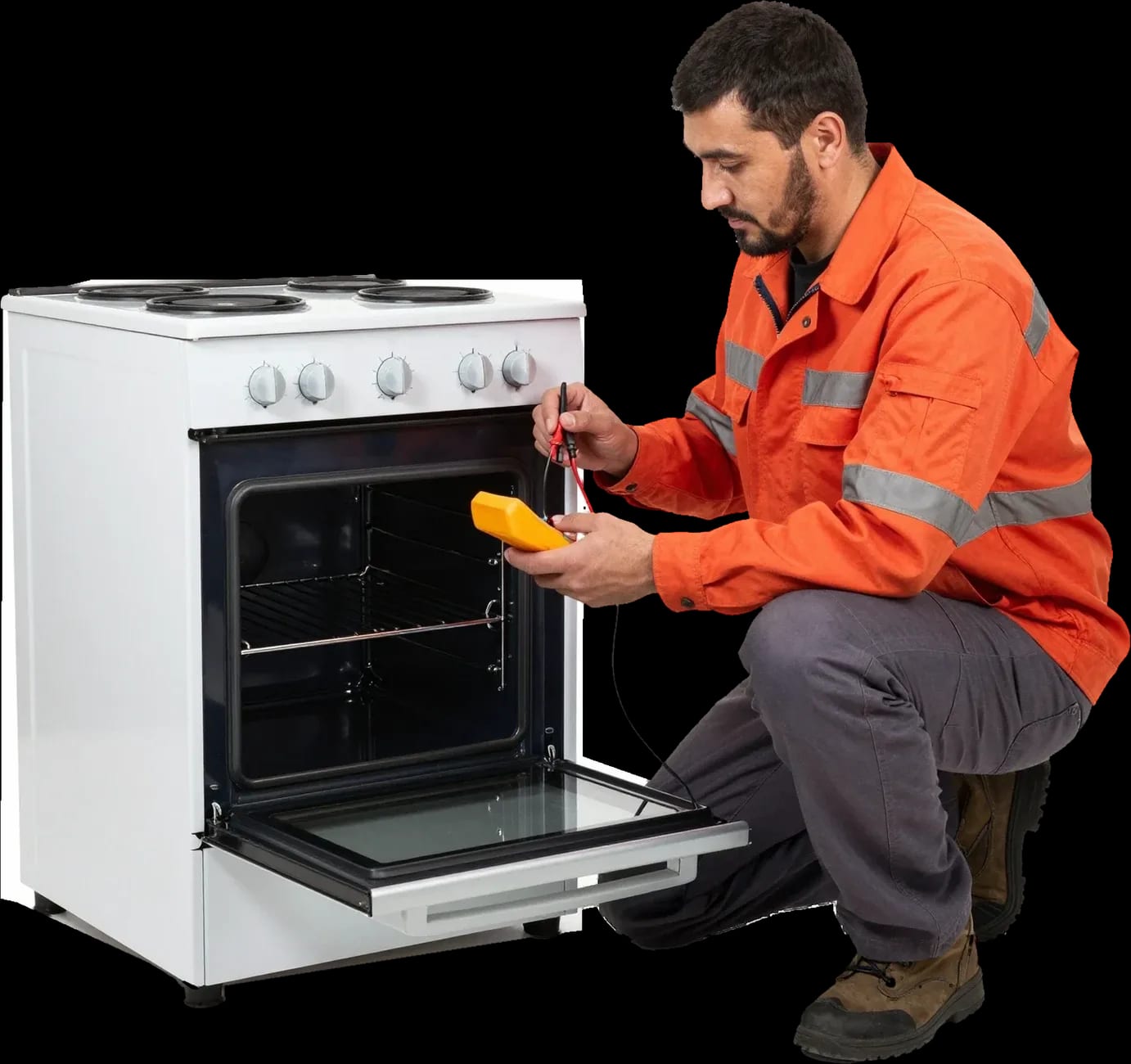

What to Check First If Your Oven Won't Turn On
If your oven isn't working, first check the outlet, the circuit breaker in the panel, and the selected mode, then assess the symptom: not heating, tripping breakers, shutting off, or showing an error code. Tech Service repairs ovens at your home and in our service center, diagnostics are free, a technician arrives within 60 minutes anywhere in the city, and we provide a 1-year warranty on labor and parts.
Before calling a service center, go through this quick checklist. It takes a couple of minutes and in some cases immediately shows that the problem isn't with the oven itself but with the power supply or settings.
Step-by-Step Checklist for a Non-Working Oven
- Outlet and plug: unplug and plug it back in until it clicks, and check if the outlet works with another appliance.
- Circuit breaker in the panel: find the breaker that the oven is connected to and make sure it's not tripped and hasn't tripped after a load.
- Power cord: inspect the cable along its entire length — melted areas, kinks, and traces of soot indicate a break or overheating.
- Mode selector: turn the knob all the way to the heating position and make sure it doesn't slip or stay between modes.
- Timer and delay: cancel any set start delay — if the timer is active, the oven won't start heating until it finishes.
- Control module: if the oven is dead after a power surge but other appliances work, the protection in the unit itself has likely tripped — this is a job for a technician, not the user.
Why the Oven Won't Turn On but the Light Inside Works
If the light works but there's no heat, power is reaching the oven — so the problem is in the heating circuit: heating element, thermostat, relay, control module. The light and the heating circuit are powered by different lines, so "the light is on" doesn't rule out checking the heating elements. If the coil is broken, the heating element stays cold even though the indicator and fan may work. A thermostat stuck in the open position gives the same picture — the oven hums but doesn't heat. Burnt relay contacts on the board interrupt the heating command. You can check the circuit with a multimeter: test the heating element for resistance and inspect the relay contacts for carbon buildup. Start with the heating element — it fails more often than other parts of the heating circuit, and replacing it is simpler than repairing the board. It also happens that the oven doesn't heat even though the light and fan are working — then the cause is almost always one of the elements in this circuit.
What to Do If the Oven Stopped Turning On After a Power Surge
After a power surge, the control module and fuse are most often damaged — we handle such cases with free diagnostics so we don't replace parts at random. A surge in the grid blows the protective fuse on the board, and the module stops sending heating commands even though the mechanical switches remain intact. Don't turn the oven back on "just to try": if the protection has tripped, reapplying power can finish off the electronics that could still have been restored. A Tech Service technician arrives at your home anywhere in the city within 60 minutes, checks the board and fuse, and quotes the cost of work after free diagnostics. We provide a 1-year warranty on restored electronics and replaced parts. Before the specialist arrives, turn off the oven's circuit breaker in the panel — this way you prevent power from being reapplied to the damaged module.
Why the Oven Doesn't Heat and Won't Hold Temperature
"Not heating" isn't a single fault but a whole group of symptoms. Let's look at how the appliance behaves with different malfunctions and how to narrow down the suspects.
Oven Doesn't Heat Even Though the Fan Works
If the fan is spinning but there's no heat, the heating circuit is to blame: most often it's a burnt-out heating element or a failed heating relay. The convection fan ensures even heating by circulating air throughout the cavity, but it doesn't generate heat itself — it only distributes what the coil produces. When the heating element's wire is broken, the fan keeps running, the motor hums, but the temperature stays at room level. A similar picture occurs with a stuck or broken relay: the contacts don't close, and current doesn't reach the element. The working fan spins normally, and outwardly the appliance looks functional. Fan noise without heat is a good diagnostic sign: it rules out power supply issues and points to the heating circuit. Start by inspecting the coil for breaks — there should be no visible cracks or damage.
Oven heats only from the top or unevenly
Heating only from the top or one side usually means one of the elements has failed — top, bottom, grill — or the temperature sensor is malfunctioning. Each circuit is powered separately, so if one coil breaks, the other keeps working: the pie burns on top and stays raw on the bottom. The temperature sensor sends readings to the control module, and if the values are off, the electronics either overheat the cavity or don't provide enough heat. It's also worth ruling out a mechanical cause — a deformed rack or cookware blocking airflow. Check unevenness together with the convection mode: if the difference persists with the fan on, it's a part issue, not a setting. Move the baking sheet to another level and turn on the fan — this will quickly tell you whether the element or the dish placement is at fault.
How a heating element failure differs from a thermostat failure
| Symptom | Likely part | What to check |
|---|---|---|
| No heat at all, fan hums | Heating element | Coil and contact integrity |
| Heats but overheats or underheats | Thermostat | Activation at the set level |
| Temperature fluctuates for no reason | Temperature sensor | Readings on the control module |
| Heating only on one side | Top or bottom heating element | Individual element circuit |
| Heats intermittently, clicks | Heating relay | Contact closing and opening |
Electrical and safety when the oven breaks down
Some symptoms are electrical, and care is important here. Let's go over what each sign means and when it's better not to turn the appliance on until a technician arrives.
Oven trips the breaker when turned on
If turning on the oven trips the circuit breaker in the panel, the cause is most often a faulty heating element, relay, or wiring — and this is a signal not to use the appliance until diagnosed. The relay and fuse protect the circuit from overload: when the heating element's insulation is broken or a contact is burnt, the leakage current exceeds the threshold, and the breaker trips before the damage turns into a fire. The same effect can be caused by old wiring not rated for the appliance's power, or moisture getting on the terminals after washing. The heating element is checked with a multimeter for resistance and for a short to the body — these are two different faults with different repairs. Turning it on again "to check" after the breaker trips increases the risk of damaging the wiring and electronics, so it's better to just note one fact: which mode was turned on and after how many seconds it tripped.
Oven turns off by itself after a few minutes of operation
Shutting off on its own after 10–15 minutes is usually caused by overheating, a faulty thermostat, or a protection trip — diagnostics will pinpoint the exact cause. The thermostat regulates temperature: when its contact burns or the sensor gives false readings, the control module receives incorrect data and either cuts the heat or powers down the whole appliance. The temperature sensor inside the cavity drifts over time, and the overheat protection trips if the cooling fan for the housing isn't spinning or the vents are clogged. Another possibility is a voltage drop in the mains: when powerful appliances run at the same time, the electronics go into protection mode. If the shutdown repeats on the same mode and after roughly the same time, it narrows things down to a specific circuit rather than the whole appliance.
Can I use the oven if it sparks?
Don't use a sparking appliance: it's a sign of a problem with the wiring, contacts, or heating element, and you shouldn't turn it back on until the cause is fixed. A spark at the terminal block means poor contact and overheating, a spark inside the cavity means the heating element has broken down, and flashing on the housing indicates there's no grounding in the outlet. Our technician arrives within 60 minutes anywhere in the city and determines on the spot whether the spark is related to the power supply or an internal circuit — that decides where the repair happens: at your home or at the service center. Diagnostics are free, and there's a 1-year warranty on labor and parts: if the cause was the outlet, the technician will tell you straight instead of replacing a working component.
Error codes and electronic oven controls
Ovens with electronic controls don't just "fail to heat" — they show a fault code on the display. Here's what to do about it and why decoding it matters before the repair.
What an error code on the oven display means
A message on the display is the control module signaling a specific fault: a temperature sensor, heating, communication between units, or overheat protection. The board reads the temperature sensor signals, compares them with the set mode, and when they don't match, it logs the fault and blocks startup. Letter and number combinations vary by manufacturer: for some, E01 means an open temperature sensor; for others, it's a communication failure between the board and the panel, and F-series codes are often tied to overheat protection. Sometimes when the sensor is open, the board shows several symbols in a row — and these aren't separate breakdowns but a single cause. The same combination can mean completely different things across brands, so decode it by model, not by a generic list from the internet.
How to decode the code and what to do next
- Write down the combination: copy the symbols from the display in full, with letters and numbers, without rounding or shortening.
- Note the conditions: record when the fault appeared — during startup, while heating up, or mid-cooking.
- Check the manual: find the decoding in your model's instructions; a generic list from the internet often doesn't match.
- Don't keep resetting: repeated restarts with an unresolved cause put stress on the control module and temperature sensor.
- Check the power: if the fault appeared after a power surge, note it — the technician will factor that in during diagnostics.
- Call a technician: with the code and the conditions, a specialist can find the faulty component faster.
Why oven electronics are sensitive to voltage surges
The control module is the most surge-sensitive part of the appliance: it's the first to react to an unstable mains supply and can fail before the heating elements do. The board runs on low-voltage circuits, and a mains surge passes through the power supply and fuse, damaging traces and microchips. Externally, the fault looks like a blank display, chaotic symbols, or spontaneous shutdown during heating. Heating elements are more resistant to surges — they're designed for high current, while electronics aren't, so the heating element usually stays intact when the board has already stopped responding. If your home has frequent voltage fluctuations, it's worth checking the wiring and protection — that reduces the risk of repeat electronics issues.
Oven door, seal, and hinges
Not all breakdowns are electrical. The door, seal, and hinges affect how well the appliance retains heat, and some of these issues are visible without disassembly.
Why the oven door doesn't close tightly
A loose door is most often caused by a worn seal or misaligned hinges, which makes the chamber lose heat and heat unevenly. The rubber gasket hardens, cracks, and stops fitting snugly against the body over time, while the metal hinges sag under the weight of the glass and constant opening. As a result, heat escapes through the gap, top dishes burn, and bottom ones stay raw, and the owner blames the heating element. The misalignment worsens gradually: first the door just needed a bit more force, then it stopped closing evenly, and eventually a visible gap appeared along the edge. It's also worth checking the strike plate: the latch tongue wears down, and even an intact seal stops holding the door pressed shut. You can check the seal without tools: if a noticeable gap remains after closing or the door springs back, the seal is likely the cause.
Seal or hinges and what you can do yourself
- The seal is easier to replace: the gasket comes off without disassembling the body, and a new one is chosen by appliance model.
- Hinges require care: they are replaced in pairs and selected strictly for the specific model, otherwise the door will sit crooked.
- DIY seal replacement is doable: just remove the old gasket and fit the new one around the perimeter.
- A sagging door can't be fixed without experience: correcting misalignment after a makeshift hinge replacement is harder than fixing the original issue.
- Anyone can check the gap: a sheet of paper clamped around the perimeter will show where the seal is broken.
- Hinge adjustment starts with the fasteners: loose screws are tightened one by one, checking the door alignment after each step.
Oven door glass damage
Damaged door glass is not just about looks: a crack reduces insulation and creates a risk, so the part is replaced entirely, not repaired. The inner panel made of heat-resistant glass undergoes constant temperature changes, and even a small crack eventually spreads, and shards can fall onto the baking sheet. Replacing the panel yourself is risky: the fasteners hold several layers at once, and careless disassembly can easily damage the adjacent glass. Our technicians select glass for your model and install it at your home or in the service center. The warranty on labor and parts is 1 year, and diagnostics are free: a specialist arrives within 60 minutes anywhere in the city and determines on the spot whether replacing one part is enough. You can pay via Kaspi QR, Kaspi Red, bank card, cash, or bank transfer for companies.
DIY or a technician and how to call a specialist in Almaty
When a self-check doesn't help, it's time to understand where the line is between 'I can handle it' and 'I need a specialist,' and how to choose a contractor in the city.
What you can check yourself and what requires a technician
| What to check | You can do it yourself | A specialist is needed |
|---|---|---|
| Outlet and circuit breaker | Yes, visually and with a tester | No |
| Mode and timer | Yes, according to the manual | No |
| Seal and hinges | Yes, inspection and cleaning | For hinge replacement |
| Heating element | No | Yes, replacement |
| Thermostat | No | Yes, replacement |
| Control module | No | Yes, diagnostics and repair |
| Gas part | No | Yes, checking connections for leaks |
When oven repair is not worthwhile
Repair often stops making sense when the same circuit fails repeatedly, the housing is seriously damaged, or parts for the model are no longer available. If the control module has failed twice in a row, a third replacement brings back the same fault—the cause lies in the wiring or voltage spikes, not in the board itself. A damaged housing with cracks in load-bearing elements is not restored for safety reasons. Outdated models from discontinued series are left unrepaired when a heater or thermostat for them cannot be found. The decision should be made after diagnostics, not based on the age of the appliance: sometimes one replacement gets the unit back in service for a long time, and sometimes the problem returns. In my opinion, a repeat visit for the same breakdown within the warranty period is a signal to look deeper for the cause rather than replacing the part in a loop.
How to call a technician in Almaty and what to expect from the visit
- Direct contractor: Tech Service sends its own specialist to your home or picks up the appliance for service, with no middlemen or aggregators.
- Free diagnostics: the cause of the breakdown is identified before work begins, and you don't pay for the check itself.
- Arrival within 60 minutes: anywhere in the city, the technician arrives within an hour after the request is confirmed.
- 1-year warranty: the work performed and the parts installed are covered by a one-year warranty.
- Payment: we accept Kaspi QR, Kaspi Red, card, cash or bank transfer, and the price is quoted after free diagnostics—you pay for a confirmed cause, not for a guess over the phone.
What to remember about oven breakdowns
We've gathered the key things to keep in mind when your appliance stops heating: the order of checks, the logic of symptoms, and the line between a self-inspection and calling a specialist.
- Start with the power: check the breaker in the panel, the outlet, and the selected mode—this rules out some false breakdowns before disassembly.
- The symptom matters more than the part: "not heating," "tripping the breakers," and "turning off after a few minutes" lead to different causes and different diagnostics.
- Electrical and gas work is for a technician: disassembling live components or gas lines on your own is life-threatening.
- Note the error code in advance: photograph the display message before repair—decoding it speeds up finding the fault.
- The repair decision is made after diagnostics: the age of the appliance alone is no reason to give up on restoring it.