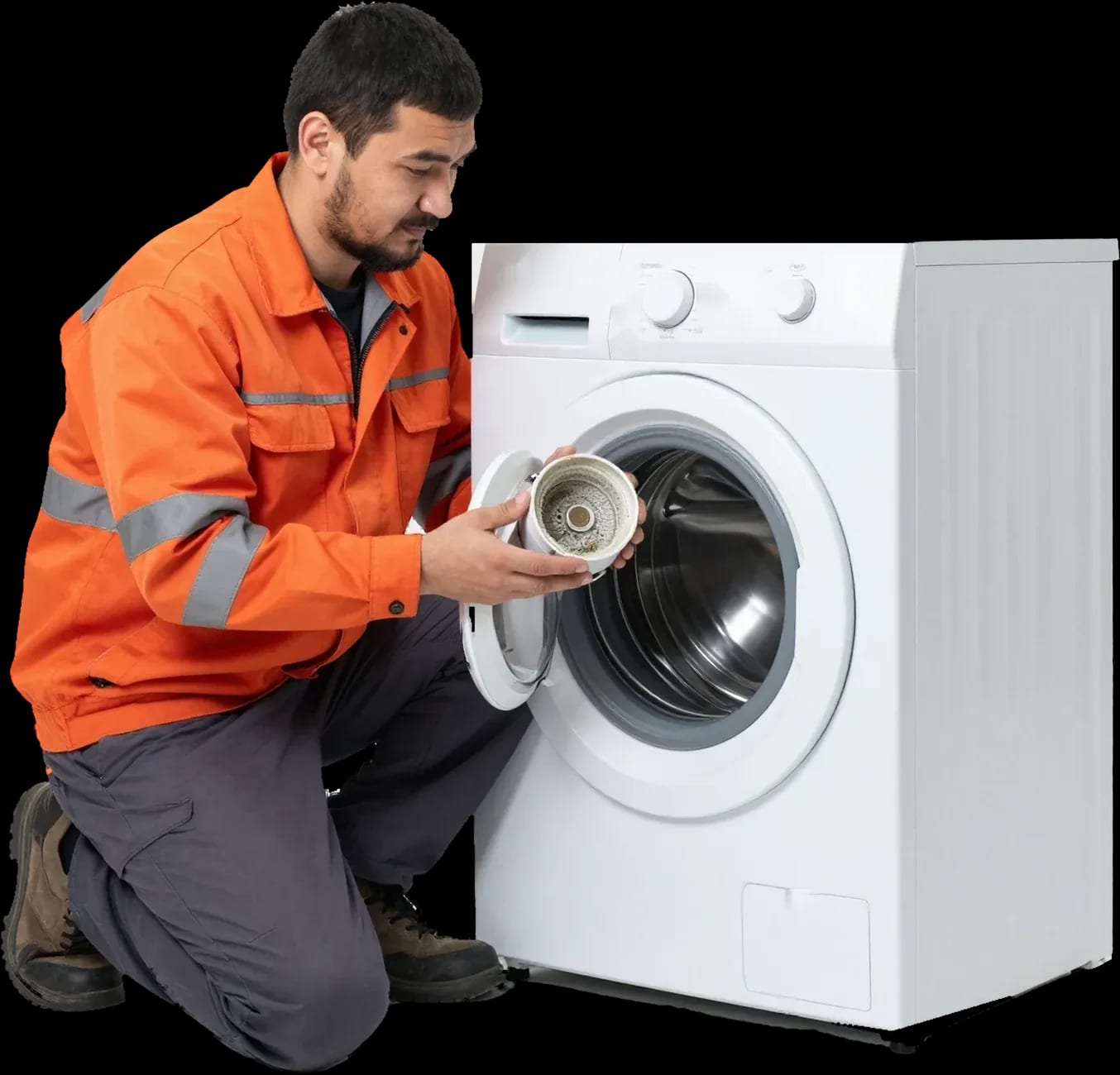

How to tell your washing machine isn't draining
If your washing machine won't drain, start with a safe step: unplug it and drain the water through the emergency hose behind the service flap at the bottom front, with a towel underneath. Then check the filter, hose, and pump impeller. At Tech Service, diagnostics are free, a technician arrives within 60 minutes, and there's a 1-year warranty on labor and parts.
You can spot a drainage problem by water left in the drum and wet laundry after the spin cycle. It's important to distinguish a malfunction from a cycle without a spin and not to restart the wash.
Signs that water isn't draining
Your washing machine isn't draining if liquid remains in the drum after the cycle and the laundry comes out wet instead of spun — this is the main sign of a drainage failure. The drain pump isn't pumping out the contents, and water stays above the fabrics even after the end-of-cycle signal. The second symptom is the machine freezing mid-cycle during rinse or spin with a full drum. The third is a puddle on the floor under the door, even though the cycle hasn't finished. The fourth is clothes feeling damp if left inside for a few hours. The fifth is the machine humming on the next start but water not draining: this is how a clogged filter or a jammed pump impeller behaves. If you restart the wash "just in case," water may overflow through the door, so drain it first and then figure out the cause.
Why a drainage problem is risky if left as is
Stagnant water puts pressure on the drainage components and speeds up pump wear, while repeated starts without draining add load to the pump. The drain filter clogs faster, the impeller gets covered with lint and detergent residue, and the machine runs under strain. Debris (coins, lint, small items) is the main cause of pump failures, so preventive filter cleaning extends its life. Stagnant moisture also causes odors and stains on fabrics, and with long standing — a film on the drum walls. A separate risk is leakage: an overfilled tub presses on seals and hoses, and water seeks a way out under the machine. After a few days of standing, mold appears on the door seal in addition to the musty smell, and its traces are then hard to remove even with a conditioner wash. Drain the contents as soon as you notice the problem and don't leave wet laundry inside overnight.
When water in the drum isn't a malfunction
- Delicate cycle: the program for delicate fabrics often runs without a final spin, and water remains intentionally.
- Wool program: wool washing excludes intensive spinning, so residual water after the cycle is normal for this mode.
- Manual spin setting: if the speed is set to zero, the machine will finish the program with water inside and won't signal a fault.
- Pause and delayed start: when stopped mid-cycle, moisture remains until resumed; this isn't a drainage failure.
- Check the manual: before looking for a fault, check the selected program and the code on the display against your model's guide.
What to check yourself before calling a technician
Check in order from simple to complex: drain filter, hose, pump impeller, control board. At each step there's a threshold beyond which you shouldn't go further and need a technician.
The drain filter at the bottom front and how to check it
The drain filter is located at the bottom front, behind the service flap, and a clog is the most common and simple cause of poor drainage. First, unplug the machine and drain the liquid through the emergency hose behind the same flap at the bottom front, with a towel underneath: it may be hot. Then remove the flap, unscrew the part counterclockwise, and inspect the housing. Remove coins, lint, bra wires, and small items — debris is what most often stops drainage. Rinse the housing with warm water and check that the impeller behind the filter turns freely. Only unscrew the element after the liquid is drained, otherwise it will spill on the floor, and on some models — right onto the electronic module.
How to tell a clogged hose from a pump failure
If the filter is clean but the water won't drain, check the drain hose for kinks and clogs, and only then suspect the pump. Remove the hose from the siphon or pull it out of the drain outlet and look for a plug of lint and soap scum inside, and straighten the corrugated hose if it's pinched by a cabinet leg or the back wall. Check the internal hoses for kinks and cracks—they can let water leak into the base pan instead of draining. The drain pump doesn't run during fill, so humming during drain points to the pump, not the fill cycle. If the machine hums during drain but water won't go out, the hose is almost certainly clear—the problem is in the pump or its impeller.
How to check the pump impeller without taking the machine apart
Check that the pump impeller spins freely—a multimeter won't show a jammed pump. Reach the impeller through the filter opening with a finger or a thin screwdriver: it should turn with light resistance and without catching, and remove any foreign object—thread, paper clip, bone—with tweezers. If the impeller is stuck solid or turns in jerks, the pump needs replacing, and that's a job for a technician. Don't unscrew the filter while there's water in the drum, and don't take the pump apart yourself: the pump housing is held by screws from below, and careless reassembly can cause a leak under the machine. A multimeter is useless here—it checks the winding, not mechanical jamming—so it's used only during disassembly.
When self-checks end and you need a technician
Our self-checks end with the filter, hose, and impeller—beyond that, the control board may be the cause, and a technician checks it. The electronic control module sends the drain command, and if the signal doesn't get through, the pump is fine but silent: we diagnose such cases during free diagnostics, and a technician can be at your door in Almaty within 60 minutes. The control board is one possible cause of no drain, but not the main one, so it's checked after the drain components, not instead of them. We give a 1-year warranty on labor and parts, and accept payment via Kaspi QR, Kaspi Red, card, cash, or bank transfer for companies. If water still stands after cleaning the filter and checking the hose, don't unscrew the filter again or take the pump apart—you need a meter and to open the housing.
How to safely drain water from the drum
Drain the water from the tank before any checks, and do it through the emergency hose, not the filter. The water inside may be hot, so prepare a towel and a container in advance.
Emergency drain hose behind the service flap
- Unplug the machine: pull the plug from the socket before opening the service flap at the bottom front—it's safer when working with water and electricity.
- Put down a towel: place a cloth under the flap and set a basin or bucket nearby, because residual water will still drip onto the floor.
- Take out the hose: behind the service flap at the bottom front, find the thin emergency drain with a cap and remove the cap over the prepared container.
- Drain in portions: direct the hose into the basin and hold it by hand until the water stops flowing, then put the cap back.
- Check the temperature: the water in the tank may be hot after a high-temperature wash, so protect your hands and the floor, and place the container in advance.
Why you shouldn't unscrew the filter with a full drum
You shouldn't unscrew the filter with a full drum because water will pour onto the floor, not into the prepared container. The drain unit is at the bottom front behind the service flap, and when the plug is open, the tank empties by gravity—the water volume in the machine can reach several dozen liters, and a towel won't hold that much. If you open the plug right after a high-temperature wash, the stream will hit down and sideways, and the water will be hot—it's easier than you think to scald your hand or flood the neighbors below. The emergency drain is made for this: it gives a thin stream into a basin, not a flood on the floor. First drain the water through the emergency hose, and only then open the filter for cleaning. In my opinion, this is the only order in which a self-check doesn't end with calling a technician for another reason—a flooded floor.
Where to put the drained water and what to do next
Drained water is collected in a basin or bucket and poured down the drain, and the machine is left unplugged until it is checked. If the tub is large, the container fills up several times — carry the water out in portions so you don't have to lug a heavy basin through the apartment. Cloudiness and lint at the bottom of the basin are not a breakdown in themselves: it's what accumulated in the tub and didn't go down the drain. After draining, you can safely check the filter and hose without risking flooding the floor: open the cap, remove the debris, and rinse the mesh under running water. The drain hose connection is also inspected — a kink or clog is immediately visible. If after draining and cleaning the machine still doesn't pump water, you need a technician: the cause is now in the pump or the wiring, and you shouldn't take the pump apart yourself.
What the error code on the display means
The combination on the screen narrows down the causes, but its meaning depends on the model and generation of the machine, so the technician always checks the code against the table for your series.
E18 or F18 and why the code depends on the model
E18 or F18 (d02 on some models) means a draining problem, but the meaning depends on the model. On modern Bosch and Siemens machines these are E-codes, while on older generations the same signal is shown as F18 — the difference is in the firmware and how it's displayed, not in the fault itself. The d02 combination points to a specific series, and the interpretation is selected based on that. This signal usually indicates one of three things: a clogged drain filter at the bottom front behind the service flap, a kinked or clogged drain hose, or a jammed pump impeller. On models without a display, the problem is shown by indicators — they blink in a certain sequence, and that sequence is checked against the table for the specific machine. Before doing anything, unplug the appliance from the power outlet: only then can you open the service flap and check the filter.
Drain codes for Samsung, Electrolux, Indesit, and Hotpoint
| Brand | Drain code | What it means |
|---|---|---|
| Samsung | 5E (SE, E2) | Water does not drain from the tub |
| Electrolux | E20 | Drain malfunction |
| Indesit | F05 | Drain problem |
| Hotpoint | F05 | Drain problem |
F-codes on older Bosch and Siemens series
On older Bosch and Siemens series (Maxx, Classixx, Logixx, Avantixx), F18 means a draining problem, and on models without a display it is shown by indicators. In the same lineup, F16 signals that the door is not closed, F17 — water is not filling within the allotted time, F19 — heating fault, F21 — motor, F23 — water in the sump and Aquastop has tripped. Don't confuse generations: on current Serie 2, 4, 6, and 8 models, the same draining problem appears as E18, not F18. A single combination doesn't identify the component — it can equally mean debris in the filter, pump wear, or a clogged hose. F-codes from older series are not mixed with E-codes from current models because they are different generations with different diagnostic logic. Write down the signal in full, with the letter and numbers — it will help the technician quickly understand which series they are dealing with and use the right table.
Humming, not draining completely, not spinning
The same draining failure manifests differently, and the manifestation determines which component is checked first: sometimes the machine hums and stands with water, sometimes it reaches the spin cycle and aborts the program.
The machine hums but water does not drain
If the machine hums but the water won't drain, the pump impeller is usually jammed or the drain filter is clogged. The drain pump hums because the motor is trying to turn the impeller, but it's stuck: a small object got into the housing—a coin, a bra wire, a dense clump of lint. Less often, the sound comes from the pump itself, which has worn out, and then the humming is heard in short bursts, while the water in the tub stays at the same level. The drain filter is at the bottom front, behind the service flap, and should be checked first: most of the debris collects there, and it's usually what's holding the water. The cause of pump failures is the same debris and a neglected filter, not scale. A multimeter won't show a jammed pump, so check whether the impeller turns freely: if it doesn't turn by hand, the assembly is removed and disassembled.
Doesn't drain completely and won't spin
If the water doesn't drain completely and the spin cycle won't start, it's usually one drain assembly, not two separate faults. The drain pump pumps water out of the tub during draining, and until the level drops to the working mark, the program won't move to spin—the machine just sits with water left in it. The second most common cause is a partial clog: the filter lets water through, but slowly, and the pump doesn't have time to empty the tub within the allotted time. Less often, the pump itself is to blame, with a worn impeller, or the level sensor sending a wrong signal. Spin won't start while there's water in the tub, so fix the drain first, then check the spin—otherwise it's easy to mistake a working spin assembly for a broken one.
Doesn't drain or spin, but the drum turns
- Load imbalance: one large item has bunched up, and the machine won't reach high spin speeds—usually 800–1600 rpm depending on the model.
- Drive belt: on belt-driven machines, it has stretched or slipped off, the drum turns sluggishly, and the spin doesn't pick up speed.
- Brushed motor: on these motors, the brushes wear out over time, and the speed drops specifically during spin.
- Drain as a related cause: water in the tub blocks the spin, so check the drain before the belt and motor.
- Inverter motor: Bosch EcoSilence Drive and LG Direct Drive motors have no brushes, so "brush wear" doesn't apply to them—check the drive and electronics instead.
When you definitely need a technician and how Tech Service works
You need a technician when self-checks haven't solved the problem or the cause is in components that can't be checked without disassembly. Let's look at where that line is and how our service works.
The point when you call a technician
Our customers call a specialist if the filter, hose, and impeller have been checked but the water still stands, or if the cause is in the board and pump. The drain pump, electronic control module, and a clogged drain filter produce a similar symptom—water in the drum—but they're checked differently: the impeller is visible after removing the filter, while the technician confirms the pump's condition and the board's signals on site. Moreover, a multimeter won't show a jammed pump—you need to check whether the impeller turns freely. The drain pump doesn't work during water intake, so humming at the start of the cycle points not to it but to the valve or tap. Another cause of pump failures is debris: coins, lint, small objects that got past the filter. The sooner you call a technician after self-checking, the lower the risk that repeated starts will finish off the pump: each new cycle runs the pump shaft dry and under the load of leftover water.
What the technician checks and why diagnostics are free
Diagnostics are free, and the technician checks the drain components, matches the error code against the table for your model, and selects the part by part number or model code. The drain hose, filter, hoses, and pump are inspected one by one — from simple to complex — and the code value is checked against the table for your specific machine, because the same number means different things across series. On Bosch and Siemens, the heating element is at the front and the pump at the bottom, so accessing the drain assembly doesn't require removing the tub. On Bosch, the E-Nr is on the rating plate inside the door, so the part is matched precisely to the model, with no guesswork based on appearance. Free diagnostics remove the main risk — paying for an inspection if the fault turns out to be minor — and the technician quotes the cost of work only after the check.
60-minute arrival, warranty, and payment
| Term | What we offer |
|---|---|
| Technician arrival | within 60 minutes anywhere in the city |
| Diagnostics | free |
| Warranty | 1 year on labor and parts |
| Payment | Kaspi QR, Kaspi Red, card, cash or bank transfer |
| Who comes | our own technician, not a middleman |
What to remember about washing machine drainage
Failure to drain almost always starts with simple components. Here's the sequence that resolves most everyday cases and helps you understand when it's time to call a professional.
- First, drain the water: unplug the machine, lay down a towel, and let the water out through the emergency hose behind the service flap at the bottom front — the water may be hot.
- Then the filter: unscrew the drain filter and remove coins, lint, and small debris — a clogged assembly is a common cause of pump failure.
- Next, the hose and pump: check the drain hose for kinks and make sure the pump impeller spins freely; a multimeter won't show a jammed assembly.
- The error code only narrows it down: E18 or F18 point to drainage, but the value is checked against the table for your specific model, not read as a ready diagnosis.
- Then you need a technician: if the impeller is stuck and there are no clogs, the cause is in the pump, wiring, or control board — that's a job for a specialist with disassembly.