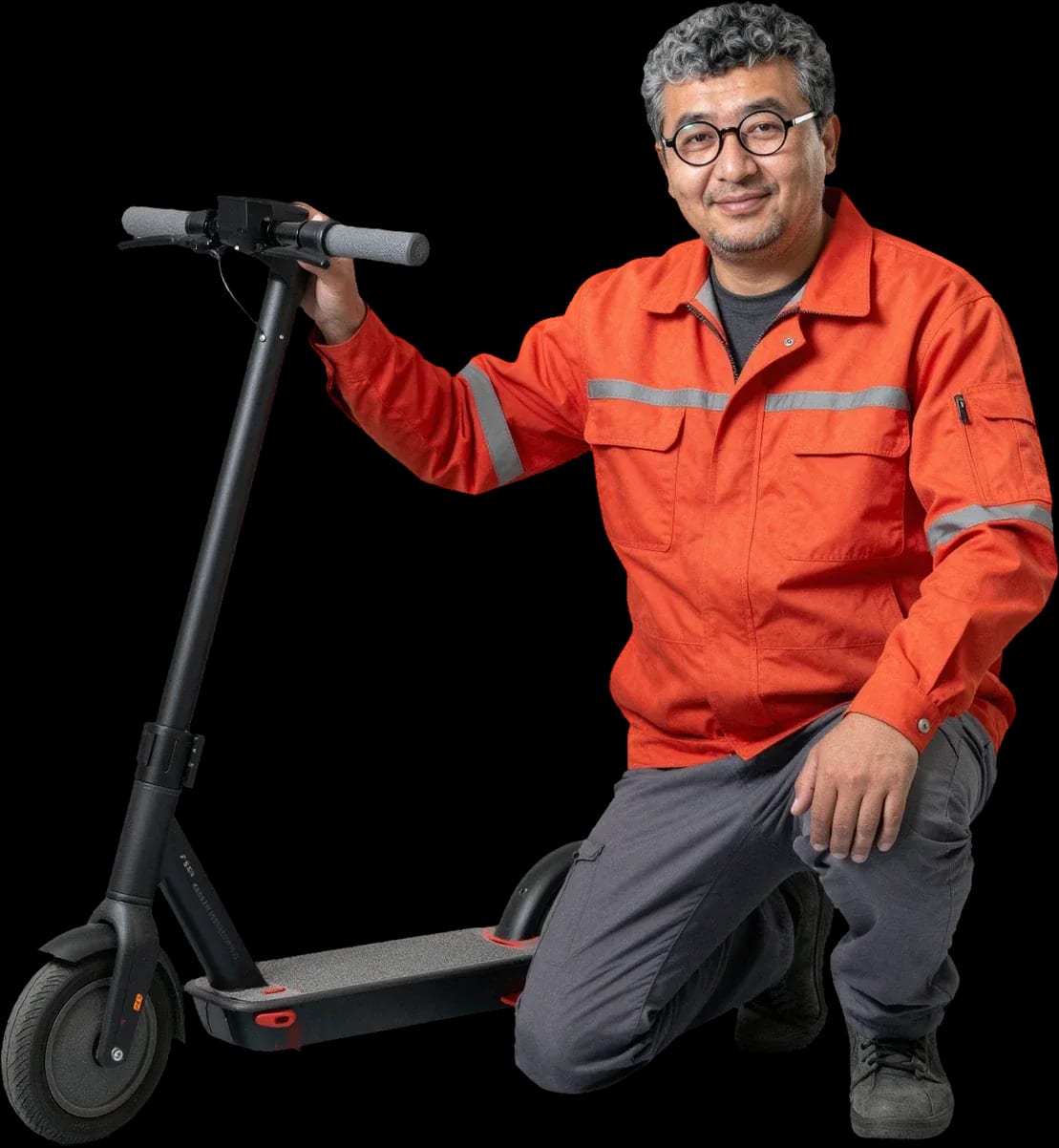
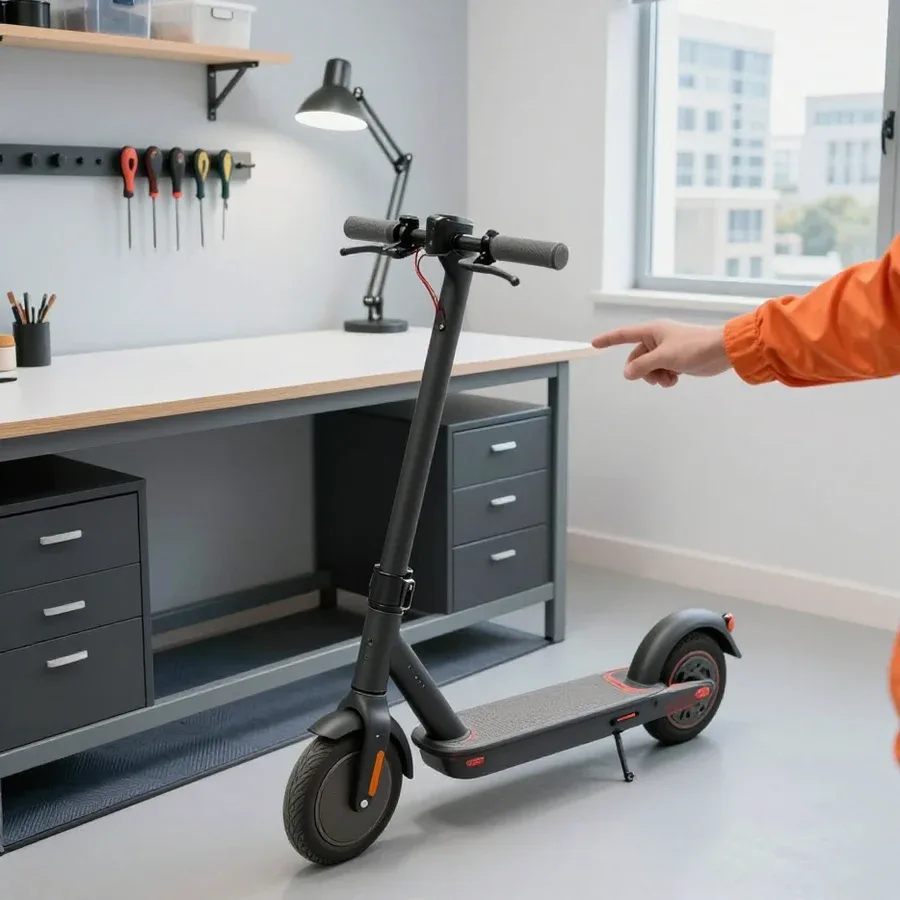
Tech Service repairs Xiaomi electric scooters in Astana: our technician comes to your home within 60 minutes or you can drop off the scooter at our service center. Diagnostics are free, the technician gives you the price after diagnostics, and you get a 1-year warranty on labor and parts. Our technicians have 4 to 20 years of experience.
What breaks on Xiaomi electric scooters and why
Xiaomi electric scooters fail predictably — specific components give out. Let's go over common breakdowns and their causes so you understand which fault is developing and when it's time to see a technician.
Why a Xiaomi scooter won't turn on
Most often, the scooter won't turn on because of a discharged battery or a loose contact in the power circuit, and less often because of a faulty controller or BMS. Electrical connections between the battery and the board disrupt power delivery: oxidized terminals, a frayed wire, a connector loosened by vibration on rough roads. The controller distributes current and responds to the throttle, while the BMS monitors the battery cells and shuts it down if something is off. If the control board doesn't receive correct data from the BMS, startup is blocked even with a charged battery. Diagnostics start with measuring voltage at the connectors and checking circuit integrity — that rules out half the possibilities. If the indicator doesn't respond even at full charge, don't take the battery compartment apart yourself: sealing and connector order matter more than speed.
Battery, controller, and hub motor — the three components that wear out first
- Battery: loses capacity from cell wear and deep discharge, so range drops and charging becomes erratic.
- Controller: fails from overheating, voltage spikes, and moisture, showing up as throttle failure or spontaneous shutdowns.
- Hub motor: suffers from overloads and water ingress, causing bearing play, humming, and jerking during acceleration.
- BMS: shuts off the battery when cells are unbalanced, and the scooter dies for no apparent reason.
- Connectors and wiring: oxidize and fray, disrupting contact between components.
Brakes, tires, and the aftermath of falls or water
Mechanical issues — brakes, tires, frame geometry — appear from wear, falls, and riding on wet surfaces. The braking system on Xiaomi scooters consists of a disc mechanism and electronic braking: pads wear out, the cable stretches, the disc warps from impact. Tires and wheels get punctures, and inner tubes get cuts from glass and curbs; bearing play worsens on tiles and dirt. Frame geometry gets knocked out of alignment by falls — the steering column shifts, and a clunk appears in the folding joint. Moisture is the worst enemy of electronics: water in the deck and hub motor causes contact corrosion and short circuits. If the scooter has been in water, don't turn it on until it dries: trying to start it with a wet board increases the damage.
Error codes and how diagnostics work
An error code on the display is a hint, not a verdict. Let's go over what common codes mean, how free diagnostics work, and what to prepare before contacting us.
What error codes on a Xiaomi electric scooter mean
| Code | What it indicates | What we check |
|---|
| E2 | Fault in the power circuit or controller communication | Connectors, cable, BMS contacts |
| E3 | Communication failure with the controller | Ribbon cable, board, firmware |
| E4 | Problem in the power section | Hub motor, phase wires |
| E5 | Battery voltage deviation | Cells, balancer, BMS |
How free diagnostics work
We provide free diagnostics: we check the power circuit, controller, BMS, and battery condition, then give you the repair cost. The technician tests the connectors and cable, reads cell voltage data, and evaluates the firmware and BMS balancing. This approach shows exactly where contact or signal is lost, not just which component triggered the error code. This matters because an error on the screen often points to a symptom, while the cause may be an oxidized connector, a frayed wire, or unbalanced cells. We don't replace a part until its fault is confirmed. Diagnostics before repair saves money: sometimes it's cheaper to fix the cause in the wiring than to replace the whole unit. A practical tip: keep a history of errors and the conditions when they appear—this speeds up troubleshooting and helps the technician check the power circuit and signal lines more accurately.
How to prepare your scooter for repair
- Charge the scooter: with a partial charge, it's easier for the technician to check the power circuit and see at what stage the error code triggers.
- Recall the conditions of the breakdown: after rain, a fall, or hard braking—this detail narrows down the suspect components.
- Record the code: take a photo of the message on the display if it disappears after a restart.
- Don't disassemble components yourself: an opened panel or battery complicates finding the cause and may add new faults.
- Describe the symptoms: unusual noise, jerking, a button not responding—all this speeds up locating the source of the issue.
Xiaomi models and their typical weak points
The brand's lineup includes several versions, each with its own weak components. Let's look at which components most often need repair on popular models and which parts owners should check in advance.
Mi Electric Scooter 3 and Pro 2 — what most often needs repair
Mi Electric Scooter 3 owners most often report power-on issues, while Pro 2 owners report error E2 and power circuit problems. On the 3, failure to start is often linked to the controller and the charging connector, which suffers from moisture and dust after rainy days. On the Pro 2, code E2 indicates a communication failure between the control board and the hub motor, so the harness, contacts, and the drive unit itself are checked. Xiaomi electric scooter repair in Astana most often starts with these two versions. These versions are almost indistinguishable externally, but their wiring and internal components differ—it's important for the technician to know the exact model before the visit. In my opinion, owners should copy the name from the sticker on the deck: it's used to select compatible parts and avoid wasting time on clarifications on site.
Mi Electric Scooter 4 and Essential — what owners should watch for
On Mi Electric Scooter 4 and Essential, tire and brake wear and gradual battery capacity loss are more common. On the 4, tires wear faster when riding on uneven asphalt, and the brake cable needs tightening after a couple hundred kilometers. On the Essential, the budget battery loses charge after seasonal use, especially if the scooter winters in an unheated room. Regularly checking tire pressure and brake condition extends component life more than rare maintenance after a breakdown. Inflate the tires every couple of weeks and inspect the brake pads—this way brake wear is more even, and the battery suffers less from increased load on inclines and hard starts. These simple procedures take little time but help you notice uneven tread wear and a loose cable in time, and avoid overloading the battery, which with proper care retains capacity longer and doesn't require premature replacement.
Summary of models and components
| Model | Common issues | What we check |
|---|
| Mi Electric Scooter 3 | Won't turn on | Controller, charging port |
| Mi Electric Scooter Pro 2 | Error E2 | Wiring harness, contacts, hub motor |
| Mi Electric Scooter 4 | Tire wear, brakes | Tires, brake cable |
| Mi Electric Scooter Essential | Battery capacity loss | Battery, charging unit |
How repairs work at Tech Service
The process follows a clear order — from request to pickup. Here's how it works and what the owner can expect at each step.
Technician visit within 60 minutes
We arrive within 60 minutes anywhere in the city if the owner prefers on-site service. The technician brings tools for typical work with the battery, controller, and hub motor, so some issues can be fixed right at your place. On-site diagnostics are free: the specialist checks the battery under load, tests the controller, and inspects the connectors. This format helps when the scooter won't fold, won't hold a charge, or the wheel is locked and it's inconvenient to bring it to the service center. On site, the technician first runs diagnostics and only then quotes the price — so the owner decides whether to proceed. In my opinion, this is fairer: you see the cause of the failure and then discuss the scope.
Service center and price approval
If it's more convenient to bring the scooter to the service center, we accept the equipment and after free diagnostics quote the price for the work. Intake takes little time: the specialist records the model, condition, and the owner's complaint, then disassembles the unit and finds the source of the failure. Some work with the BMS, firmware, and board soldering is better done on site, where the right tools and lighting are at hand. We accept Kaspi QR, Kaspi Red, card, cash or transfer, whatever suits the client. The price depends on the unit and scope of work, so the technician gives it after diagnostics, not over the phone. This avoids surprises: you approve the final cost knowing exactly what needs to be replaced on the scooter and why it can't be avoided.
What we do
- Battery: check cells and BMS, restore balance, replace failed elements and power connectors.
- Controller: diagnose the board, re-solder traces, install new power switches and connectors, check communication with the motor.
- Hub motor: eliminate bearing play, renew windings and Hall sensors, check housing tightness.
- Brake system: adjust and replace pads, discs, and cables, bleed hydraulics on models with it.
- Tires and tubes: install new rubber and tubes, fix punctures, check wheel alignment after an impact.
- Firmware: reflash the controller and update software if the failure is related to the software part and replacing a part doesn't help.
Warranty and who to trust with repairs
When choosing a service center, the owner needs to understand who will work on the equipment and what happens if the problem comes back. Let's cover the warranty, how we work, and the experience of our specialists.
1-year warranty on labor and parts
We provide a 1-year warranty on labor and parts so the owner can be confident in the result. The term is the same for any unit — whether it's the hub motor, controller, or tire replacement: if after the work the unit doesn't behave as it should, we inspect the equipment again within this year. The warranty also covers installed parts — this matters when a unit is replaced entirely, because the owner gets protection not only for the quality of soldering or assembly but also for the component itself. The combination of labor and parts covers the main fear after a repair — that in a month you'll have to find someone else and pay again. The specialist explains the warranty terms before work begins so there are no misunderstandings.
Direct contractor, not an aggregator
Tech Service is a direct service provider: our own technician comes to your home or accepts the device at the service center — we don't pass your request to a middleman. That means the same team that ran the diagnostics and approved the work is responsible for the result, with no chain of “dispatcher → contractor → another contractor.” When you go through an aggregator, you never know in advance who will work on your device or how: the job might go to someone with no experience on that specific brand, and there's no one to hold accountable. With a direct provider, responsibility for the result rests with one party, and the warranty is issued by the same organization that performed the work. You discuss the problem directly with the person who actually had the scooter in their hands — no middlemen. So when choosing a contractor, it's worth asking right away who will come to your address — a staff technician or an outside contractor assigned to the request.
Technician experience and service terms
- 4 to 20 years of experience: our technicians work with the electronics and mechanics of scooters of varying complexity, so diagnostics rely on accumulated observations of specific components.
- Free diagnostics: inspection and troubleshooting cost nothing, and the price for the work is quoted only after the check.
- On-site visit within 60 minutes: the technician comes to your home anywhere in the city — convenient when the scooter won't start and can't make it to the service center on its own.
- Payment methods: you can pay in whatever way is convenient for you; details are confirmed on site.
- 1-year warranty: covers the work performed and the parts installed; repeat visits for the same component are handled under this warranty.
Making the most of Xiaomi electric scooter repair
Here are the key points a Xiaomi scooter owner should keep in mind before contacting a technician — from common breakdowns to how the repair process works.
- Predictable breakdowns: Xiaomi scooters most often wear out the battery, controller, hub motor, brakes, and tires — these components are checked first.
- An error code is not a diagnosis: it points to a component, but the exact cause is revealed by disassembly and measurements, not by the combination on the display.
- Model matters: the Mi Electric Scooter 3, Pro 2, 4, and Essential each have their own weak spots, so the technician needs the exact version of your device.
- Diagnostics first: work begins with an inspection, after which you get a price — without it, it's too early to decide on repairs.
- Warranty and a direct provider: a one-year warranty on labor and parts plus a technician with no middlemen reduces the risk of a repeat visit for the same issue.