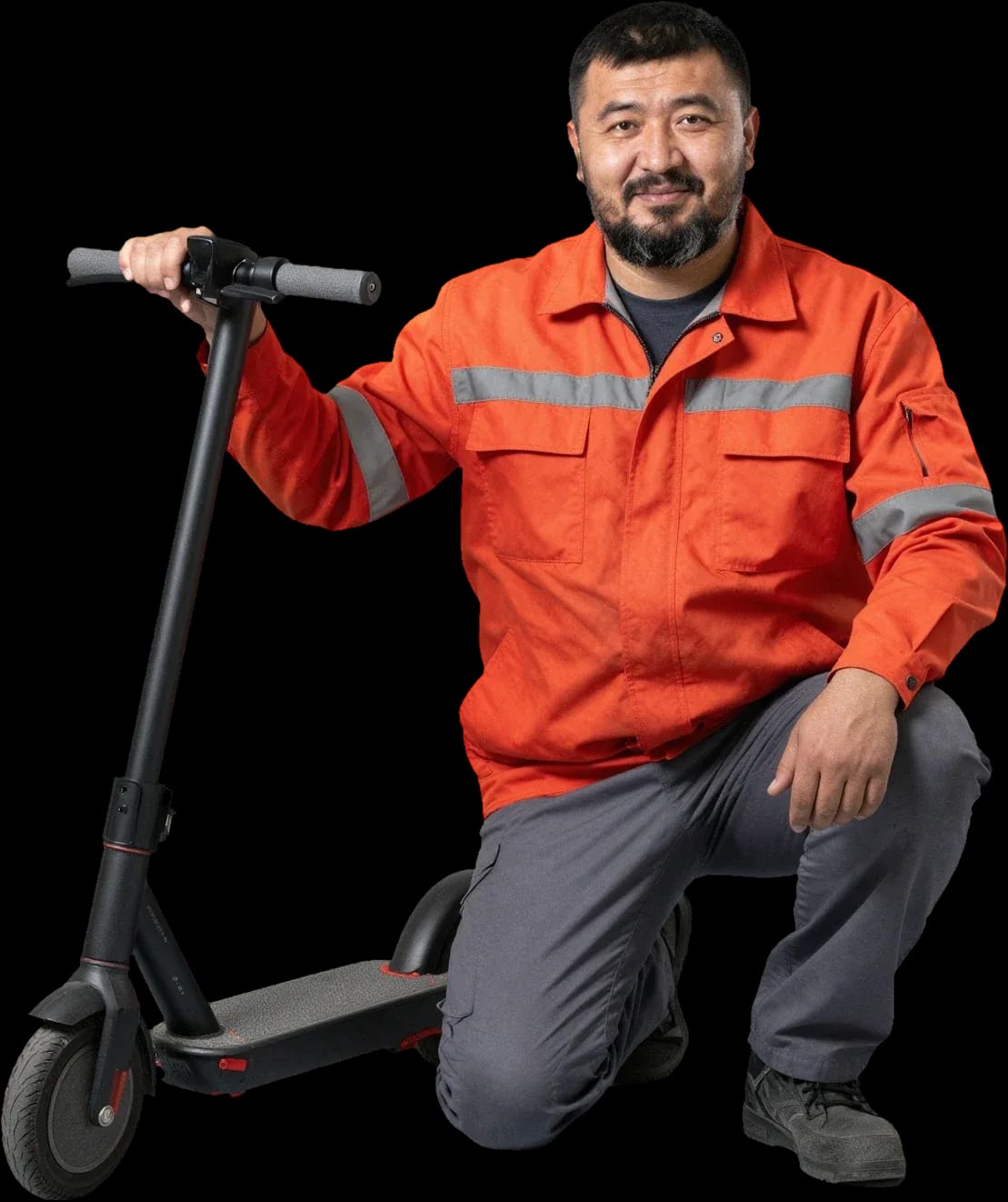
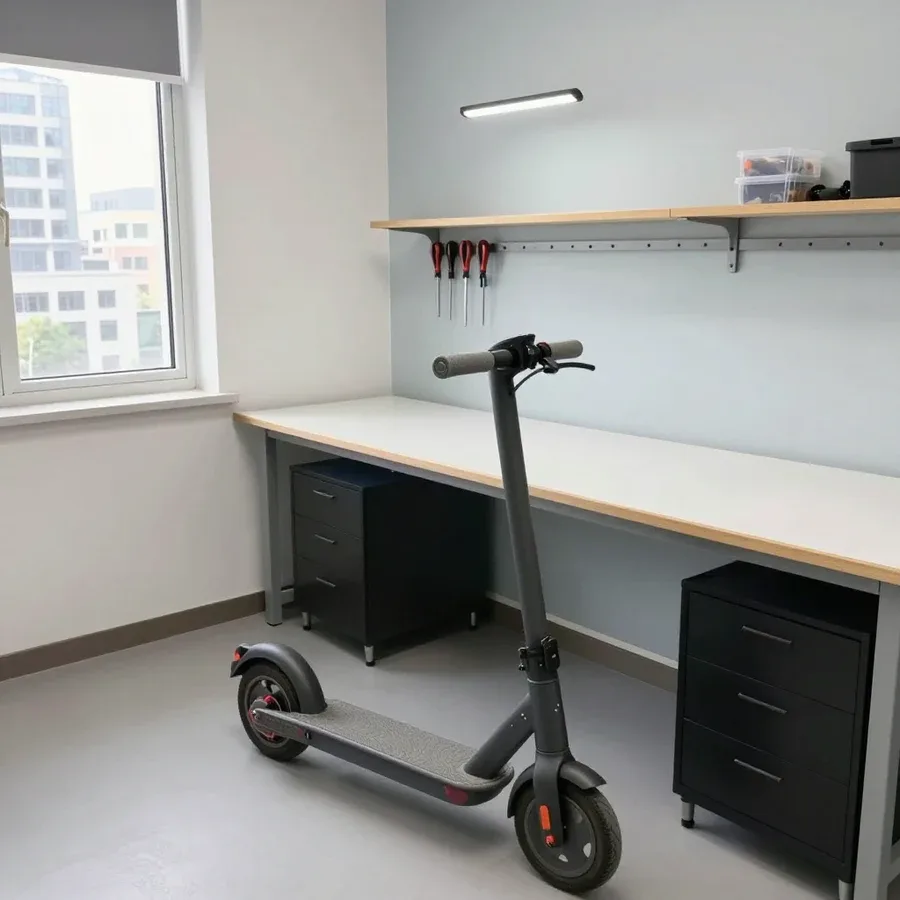
Tech Service repairs Ninebot electric scooters in Astana: a technician comes to your home within 60 minutes or you can drop the scooter off at the service center. Diagnostics are free, we agree on the price after diagnostics, and you get a 1-year warranty on labor and parts. Technicians with 4 to 20 years of experience fix Max, F-series, and E-series models.
Why a Ninebot won't turn on or charge
The scooter doesn't respond to the power button or loses charge before your eyes — that's a symptom, not a diagnosis. Let's break down how to use the scooter's behavior to identify the faulty component before the technician arrives.
What to check if the scooter won't turn on
If a Ninebot doesn't respond to the power button, first check the battery charge, the fuse integrity, and the charging port contact — usually one of these three is to blame. On the Max G30, open the compartment and inspect the connector for oxidation and looseness: after winter riding on road salt, the contacts turn green and power simply doesn't reach the controller. Check the fuse with a multimeter for continuity, not by eye — a blown filament inside the glass housing isn't always visible. Check the electrical connections between the battery and the board one by one: a loose connector gives the same symptom as a dead battery. A battery drained to zero on some models won't "wake up" from a normal charge, so before concluding the controller is faulty, let the scooter stay on the charger longer than usual. If your own checks don't solve it, it's best to leave Ninebot electric scooter repair in Astana to a technician with on-site diagnostics.
Why the scooter won't charge and drains quickly
Fast discharge and refusal to charge usually point to worn battery cells, less often to a faulty charging port or control board. When the scooter travels half its usual distance and the indicator drops in jumps, it's a sign that some cells have lost capacity — they drag the whole pack down. Check the charging port separately: a loose port with a bent pin prevents current from flowing evenly, and charging stops early. The control board is less often to blame in this chain — its failure usually shows different symptoms that the technician notes during diagnostics. If the scooter holds charge noticeably worse than before but still rides, it's a reason to check the battery before it fails completely — at an early stage some cells can still be restored rather than replacing the whole pack.
How to tell a battery fault from a motor fault
We distinguish these faults by behavior under load: if the scooter stalls and jerks during acceleration, the battery is more often to blame; if the wheel hums or doesn't spin at all, it's the hub motor. On a climb, voltage sag hits all consumers at once, so the scooter loses traction in bursts even though it runs smoothly on flat ground. Humming, grinding, or wheel play when you spin it by hand point to the motor's mechanical side, not the power supply. The controller is the third suspect in this pair: its failure mimics both symptoms, and you can only separate them by measurement. Jerking on a climb while riding smoothly on flat ground is a typical sign of voltage sag under load, not a mechanical failure; during diagnostics this is checked under load, not just at idle.
Ninebot error codes and what they mean
The Ninebot display shows a code instead of staying silent — that's a hint about which component to start with. Let's go over common combinations and what they mean in practice.
Common Ninebot error codes and their causes
| Code on display | What it indicates | What we check |
|---|
| Power fault | voltage sag or power interruption | battery, fuse, wiring |
| No motor communication | hub motor not responding | hub motor connector and cable |
| Brake electronics fault | faulty brake sensor | brake system and sensor |
| Controller fault | control board not working correctly | controller and its connections |
What to do if a code appears on the road
If a warning comes on while you're riding, it's safer to stop, turn the scooter off and back on — a one-off glitch often clears with a restart, but if it keeps coming back, it needs diagnostics. Next, assess how the scooter behaves: does the motor pull, do the brakes work, does the display flash in sync with acceleration. A combination of brake electronics or power issues is a reason not to continue the ride: some faults disable the limiters, and at speed the scooter reacts differently than usual. If the warning doesn't return after a restart, you can ride home at a calm pace, without sudden acceleration. A repeated signal on the screen is a reason not to delay inspection: the sooner a technician checks the indicated unit, the fewer parts get involved in the breakdown. On the road, note the conditions when the warning appears — on a bump, under load, or at idle: this detail narrows down the search during diagnostics.
How we decode the code during diagnostics
For us, decoding the warning is just the beginning: the technician cross-checks it with the model, inspects the indicated unit and confirms the cause with measurements, not just a single number on the screen. The same code on different Ninebot models can point to different units, so we always tie the interpretation to the specific model, not just the number. A power fault, for example, can come from the battery, a loose contact, or a fuse — without checking the unit, replacing parts at random only makes the repair more expensive. Diagnostics are free: a technician arrives within 60 minutes in the city, opens the unit, tests the circuit and shows exactly what failed. We provide a 1-year warranty on labor and parts. We accept payment via Kaspi QR, Kaspi Red (instalments), bank card, cash, or bank transfer for companies, and the technician gives you the price after diagnostics.
What breaks most often on Ninebot Max and F-series
Max and F-series put different loads on their components, so they break differently. Here's what owners of each line should watch for.
How Max and F-series failures differ
| Line | What gets more load | What the owner should watch for |
|---|
| Ninebot Max | hub motor, brakes | wheel hum, braking efficiency |
| Ninebot F-series | power system, controller | fast discharge, codes on the display |
| Ninebot E-series | wiring, connections | contact loss, failure to turn on |
Battery repair or pack replacement
We first check the battery cell by cell: if only part of it is worn, the pack can be restored, but if degradation is across the whole assembly, it's more honest to replace it entirely. During free diagnostics, the technician opens the case, measures the voltage of each cell group and compares the capacity spread between them. An even drop across all cells indicates natural wear of the assembly, while a dip in one or two groups points to a local defect that can be fixed precisely. Owners in Astana often start Ninebot electric scooter repairs with a complaint about fast discharge — and in half of such cases, the culprit is not the pack itself but an oxidized connector or a loose contact on the terminals. Restoring some cells makes sense when the rest still hold capacity; otherwise the scooter will be back in service within a month, and repeat maintenance will cost more than a one-time replacement.
When the controller and control board are replaced
The controller is replaced when the control board doesn't supply power to the motor or throws repeated errors after checking the wiring and connectors. On the bench, the technician tests the cables from the throttle to the hub motor, checks the integrity of the traces and signs of overheating on the power switches. Often it looks like an electronics failure: the scooter jerks, stalls under load, shows a code. In our practice, a noticeable share of such cases end not with a board replacement but with restoring connections — oxidation on connectors and worn insulation cause the same symptoms. Before replacing the board, we rule out a break in the wiring and a loose contact — outwardly it looks like a controller failure, but it's fixed by restoring connections, not by replacing the part.
How on-site repair with a warranty works
Our Ninebot electric scooter service in Astana follows a clear process — from request and visit to warranty. We break down each step so you know exactly what's happening with your scooter.
Technician visit within 60 minutes and free diagnostics
The technician arrives at your home within 60 minutes anywhere in the city, and diagnostics are free — you only pay for labor and parts once you decide to go ahead with the repair. The visit covers both the Ninebot Max and the F-series: on site we check the battery, controller, wiring, and mechanics, not just the part you mentioned on the phone. Some work we handle right at your place; the rest goes to the shop when a component needs to be taken apart. Ninebot electric scooter repair in Astana includes a technician visit, so on-site diagnostics make sense: the technician sees the scooter in the same condition you ride it in — wiring and contact issues show up when everything is assembled, not on a workbench. Plus you see exactly where the technician opens the case and which connectors they check.
How we agree on the work and the price
The technician gives you the price after free diagnostics and before any work starts — you know in advance which parts are being replaced and why, and you decide without surprises at the end. First we find the root cause, then we show you which parts need attention and explain what happens if you put it off. You can pay via Kaspi QR, Kaspi Red, bank card, cash, or bank transfer for companies. If a second issue turns up during the job, we agree on the extra scope separately instead of quietly adding it to the bill — so you stay in control of what you're paying for at every stage. That's why declining some operations is perfectly fine, not something we push back on. We confirm the scope and the list of items before work begins, so the final result matches your expectations. In our experience, agreeing on the scope takes longer than the actual part replacement, but it means no questions about the bill when you pick up the scooter.
1-year warranty on labor and parts
We provide a 1-year warranty on labor and parts — it covers battery replacement, controller repair, and mechanical work alike. Our technicians have 4 to 20 years of experience and have handled these cases many times, so they pinpoint the failed component right away instead of replacing everything in sight. Having parts and labor under one warranty matters because if a part fails, you don't have to prove whose fault it is: both the service and the installed part are covered for the same period. Before you hand over your scooter, ask exactly which items are covered — that prevents half the disputes if the problem comes back. The term is the same for the battery, control board, and mechanical parts — no need for separate conditions per component.
How to choose a technician who really knows Ninebot
Fixing "anything and everything" and knowing a specific brand are two different things. Here are the criteria that show a specialist has actually worked with Ninebot and understands how these scooters work.
Signs that a technician knows Ninebot
- Knows the models: can tell the Ninebot Max, F-series, and E-series apart and knows their weak points, instead of talking generically about "a scooter."
- Reads error codes: decodes the code on the display for the specific model instead of guessing from the symptom.
- Talks about components: discusses the battery, controller, motor, and brakes separately, not with a single "we'll have to take a look."
- Gives a warranty: states the term for labor and parts before work starts, not after.
- Works directly: comes himself instead of passing your request to third parties you know nothing about.
- Answers questions about the breakdown: ask about a common failure on a specific model — a specialist will give you a straight answer, while a generalist will start with vague words about diagnostics.
Direct contractor or middleman
We're the direct service provider: our technicians have 4 to 20 years of experience, and the same person who diagnoses your scooter also repairs it—not a third-party crew working from a forwarded request. At Tech Service, the same team that takes your request is the one responsible for the result, so the 1-year warranty on labor and parts is backed by a specific technician, not by messages between a dispatcher and a subcontractor. The technician comes to your home or you bring the device to us—your choice. In my view, the main difference shows up when there's a dispute: with a middleman, you have no direct contact with the technician, so you have to file a claim with the aggregator, who then deals with the contractor. With a direct provider, the same service that did the work handles your claim—and that saves time when a part needs to be redone under warranty.
What to clarify before the technician arrives
Before the visit, it's worth mentioning the Ninebot model, the symptom, and when it appeared—this helps the technician bring the right tools and get straight to work. For Ninebot Max, F-series, and E-series, the typical set of components differs, so the same complaint "won't move" leads to different checks depending on the model: on one, they check the controller first; on another, the battery and charging port. If there was an error code on the display, say it exactly or show a photo of the screen—the code tells the technician which circuit to look at before they even arrive. Our diagnostics are free, and the technician quotes the cost of work after diagnostics, once the cause is clear. The more precisely you describe the symptom, the less time it takes to find the cause on site: "won't turn on after rain" and "won't turn on after winter" point to different components, and that affects the set of tools the technician brings.
How Ninebot electric scooter repair helps
Here's what a Ninebot owner should keep in mind before contacting a service center: what to start with when looking for the cause and what criteria to use when evaluating a technician.
- A symptom is not a diagnosis: failure to turn on or fast discharge points to a group of components, not a specific part.
- The code on the display helps: it narrows the search, but the interpretation is checked against the model and confirmed by testing the component.
- The model matters: Max and F-series have different weak points, and this affects the order in which components are checked.
- Process matters: free diagnostics, approval of work, and a warranty on labor and parts make service predictable.
- Choosing a technician: brand-specific expertise and a direct provider are more reliable than a generic "we fix everything".